The Echoes of Mathias Goeritz offered a very complete retrospective view of the varied, and difficult to classify, work of this multi-faceted artist. The exhibition began with a series of portraits which included photographs, caricatures, and works reflecting Goeritz’s charismatic personality.
Born in Danzig in 1915, Goeritz was to travel far and wide before he accepted an invitation from Ignacio Diaz Morales to teach classes in the visual arts and art history at the Faculty of Architecture at the University of Guadalajara. Goeritz arrived in Mexico with a doctorate in the philosophy and history of art. He had also had long contacts with the Bauhaus and the School of Paris and had spent periods in Morocco and Santander—where he would later found the School of Altamira as a result of the impression of expressiveness and spontaneity made on him by the rupestrian paintings. It was on the basis of these experiences that this exhibition was organized, and though the show was divided into eight thematic modules, in all his work there prevailed a ludic and emotional aspect which Goeritz proposed as one of the bases of true art, what he called Great Art.
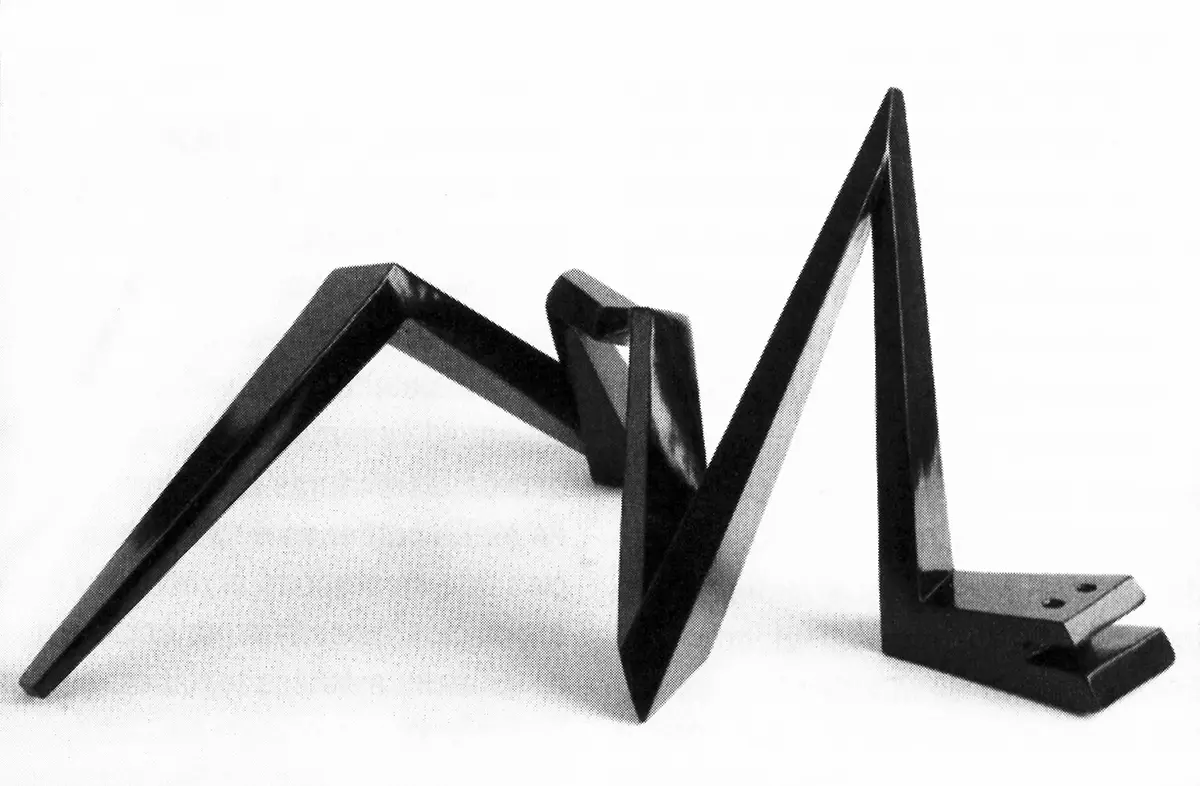
The first two sections, “Mathias before Mathias” and “The School of Altamira,” included early works in which the museographical discourse explored a certain influence by German expressionism, Arab motifs in the work done after his trip to Morocco, and finally the rupestrian images, which determined the direction of all his subsequent painting. The confrontation of these elements with the functionalism which had governed his artistic education resulted in a vision of art that, although based on abstraction, would never neglect the original expressive and emotional aspects of the creative act. This was made clear in the section dealing with his sculpture, where his work with materials appears as a manual/emotive experiment, including in some cases the participation of the spectator. An example can be seen in the series of sculptures based on fragments of various forms and sizes which can be reorganized ad infinitum like children's building blocks, resulting in sculptures of variable forms and dimensions.
There then followed a room devoted to the maquette, photographs, and plans of the experimental museum, The Echo, which was a milestone in the transgression of plastic language in Mexico. An analysis of this work reveals the emotive, ludic, and experimental vision of Goeritz’s project which unfortunately was not fully understood at the time. This resulted in the principles of the "emotional architecture" which was to form the basis of the rest of his construction work (both sculptural and architectural; here we come up against the problem of classifying his work within the categories of traditional art which seem to be conditioning factors in the full legitimation of artists as unclassifiable as Goeritz himself). This architectural project was represented in the exhibition by Goeritz’s participation in such collective urban sculpture projects as La Ruta de la Amistad (1968) and El espacio escultorico (1978), both in Mexico City, although there were other works done in Israel.
The section on “religious art” also highlighted this aspect of his work, particularly that concerning interventions in various restorations of colonial churches or collaboration with architects in the design and decoration of churches of various denominations. A less explored aspect of his work concerns his role in transgressing the limits separating the different arts, and above all, the arts and life, in an attitude that came very close to that of the avant-garde of the 1950s and 1960s. His participation in promoting the exhibition entitled Los Hartos (Antonio Souza Gallery, 1961) and his incursions into the practice of concrete poetry are less well-known aspects of his work but maintain a close relationship with the rest of the objects, drawings, and projects included in this exhibition.
The show as a whole managed to convey an idea of the complexity of Goeritz's work, although it did not seem to achieve the richness of its aesthetic mission. Therefore the exhibition room texts seemed to maintain the museographical discourse within a schema of legitimation that was strictly historicist or traditional "Although the most important creations of Mathias Goeritz were not conceived for preservation in museums (...) his work today has its place in them ... [The Echo] was considered at the time by its author, and even today by international criticism as one of his masterworks and a direct antecedent of minimal art... it was the first attempt by Goeritz to achieve his sought after goal of total art, one of the greatest objectives of the Bauhaus school (...), and again, the exhibition Los Hartos was a major publicity success and won recognition from a sector of the public and the critics." Then there are the frequent readings about the presence and influence of the major European schools at the beginning of the century in and on Goeritz's work, influences and links which have been suspiciously ignored in the accounts of the history of art in the twentieth century in Mexico (is it mere coincidence that Goeritz’s proposal has been recuperated more in terms of its architectural aspects— his collaboration with the sacred cows of Mexican architecture—than from the standpoint of his complex plastic production?).
The visitor to this grandiose exhibition would do well to be guided by the artist’s own words; “I believe there is a need to undertake a thorough review of all established values if we want to achieve a new and important art. I continue to live with the illusion of Great Art. An art which distances itself from the egocentric smallness of individual ambition.” Perhaps he would have added something about the need for legitimation, rhetorical readings, and historical marginalization.
ISSA MARÍA BENÍTEZ DUEÑAS