
The pictures seem to the spectators to have a presence that is dynamic, unstable, and changing—which is in fact what a work of art is to Raymundo Sesma. On the day of the opening, the Gallery became a space of critical dialogue between events of a mostly political kind-meanings and renewed meanings, and their possible readings, confrontation, appropriation, rejection, indifference, and questioning-by post-Foucault individuals. One of the concerns that have given meaning to Sesma's activity in recent years is the fracture between sign and image and its perception.
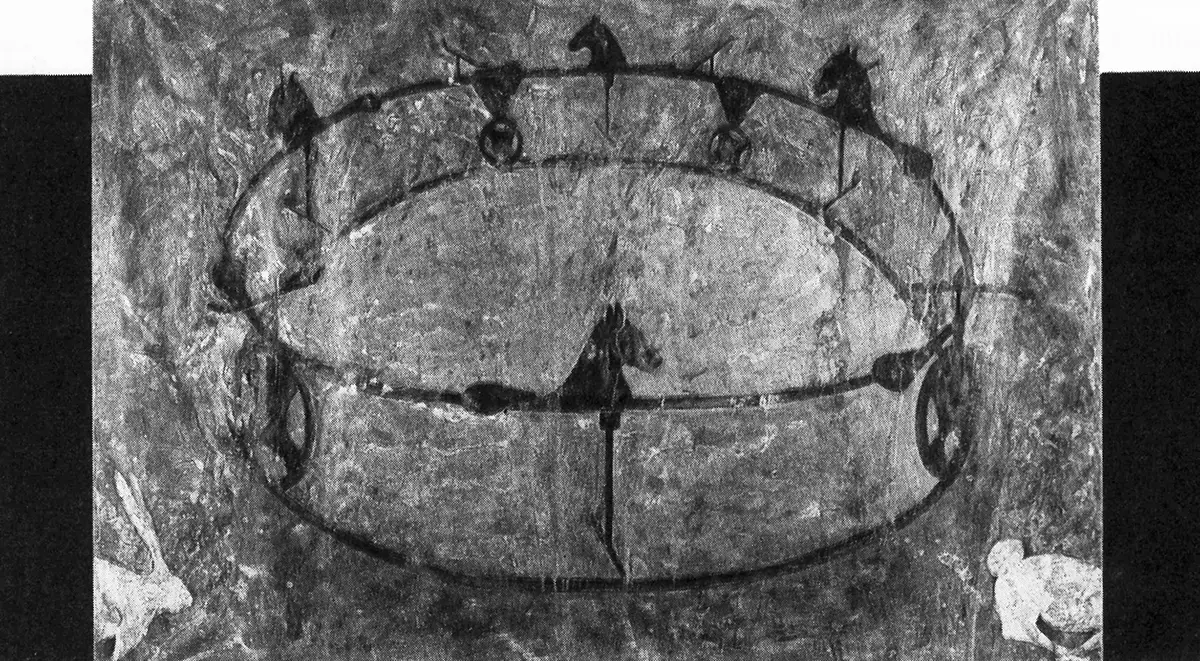
Ideal City summarizes, through diptychs and triptychs, as well as in two installations, the idea of utilitarian art within the symbolic imagination, the consideration of any human event as capable of being transformed into art from the moment of its representation. While the more traditional oil work dissolves in the memory of the figures of the overthrown monuments images of Stalin, the Wall of Lamentation in Jerusalem, and the electric chair-these narrow black vertical panels break the schema of the picture, the octagonal plan of the ideal city of Vitruvius (order, arrangement, proportion, distribution) floats through a black light in a dark room, establishing a tension with the outline of a suspended statue of Lenin on the verge of falling down. Similarly, the corn cobs become inaccessible through their industrial derivative, Maseca flour, placed before an eloquent trapezoidal sign of the ideal proportion based on man as the measure of all things.
Any work which is deemed to achieve a correct order, in this case by reference to Vitruvius and the Renaissance paradigms, inevitably evokes the problem of morality. This is Sesma's utopia, which is not proposed as a plastic matter but one which, through this medium, explores the philosophical backdrop of existence. The utopic city, seen in these terms, goes beyond the work and the artist himself, to involve the possibility of a symbolic language (of course, within the Western imagination, although with certain Oriental reductionist touches). Sesma is Mexican, but does that matter if his production (certainly less well-known in Mexico, as Eligió Calderón has already pointed out) has become part of the collections of hallowed museums, including the Metropolitan Museum of Art of New York, the Musée d'Art Moderne of Paris and the National Museum of Modern Art of Tokyo, and many others around the world?
A global artist? Yes, but not in the sense of obliterating or overcoming regionalisms, but rather as a possibility for cohabitation. Global, because despite his Chiapaneco origin and the 14 years he has spent in Milan, the recuperation of images through electronic and printed mass communication media make him a citizen of the world. Further, he compromises his entire creative work with society as a whole, of which he is a fervent champion.
Between the social and the moral lies the key theme of Sesma's work: the global is also utopic since it begins with something which is always fragmentary, an illusion of union, of a totalizing experience, the impossibility of separating the work from the artist, negating the affirmation of art by art— except in a social sense, as a project of creative exchange between artisans, artists, and society which he has achieved over the last three years in Tecali, Puebla. Intangible creation in a process of constant movement becomes impossible to define—just like the utopias of Raymundo Sesma.
ANA ISABEL PÉREZ GAVILÁN