
Reviewing the panorama of visual arts in Venezuela from the sixties to today, reaffirms, without a doubt how atypical the work of Roberto Obregón has been and still is within the context of Venezuelan art. From its initiation, his work has remained unclassifiable and distant in its essence from the fashions and polemics that have existed in his country. The discussion about how art should be or be made has persisted since the forties. The protagonists of the various artistic currents that appeared between the fifties and seventies believed they had clear objectives and limits: figurative artists of a social realist bent in contrast to the abstract geometricians and the latter, in turn, against the informalists in the early seventies. Meanwhile, the process of modernization of the country advanced with firm steps, and kineticism appropriated it as an integral part of the work itself. A new critical and virulent humanism emerged between the sixties and seventies, sometimes known as New Figuration, and it attempted to recover values that had been lost in the commercial avalanche implied by kineticism. The concept of reality was experienced in a radically different form by all those artists. The work of art as space and time, perceived through real movement, was not of interest to the figurative artists. Nor were problems such as identity, historical memory, or states of intimacy proposed by the kineticists.
In the middle of this struggle over-expressive, communicative, and experimental needs that characterized the artistic panorama in Venezuela in the sixties, is when Roberto Obregón's true story begins.
Between Silence and Reflection
In fact, it was during the first years of that decade that the artist quietly began inquiring into what today is his recurring theme: roses. In parallel fashion, landscape and his passion for botany and seismology form part of his new language just as they produce important formal changes in his work. Left behind was a stage to a certain extent traumatic like his critical and denunciatory painting, accused of being perverse and pornographic, the occasion for scandal for the morals of that time. The result was a long and fruitful silence out of which came a transcendent decision: a rupture with easel painting. And with it, his being involuntarily represented within the tendency called New Figuration.
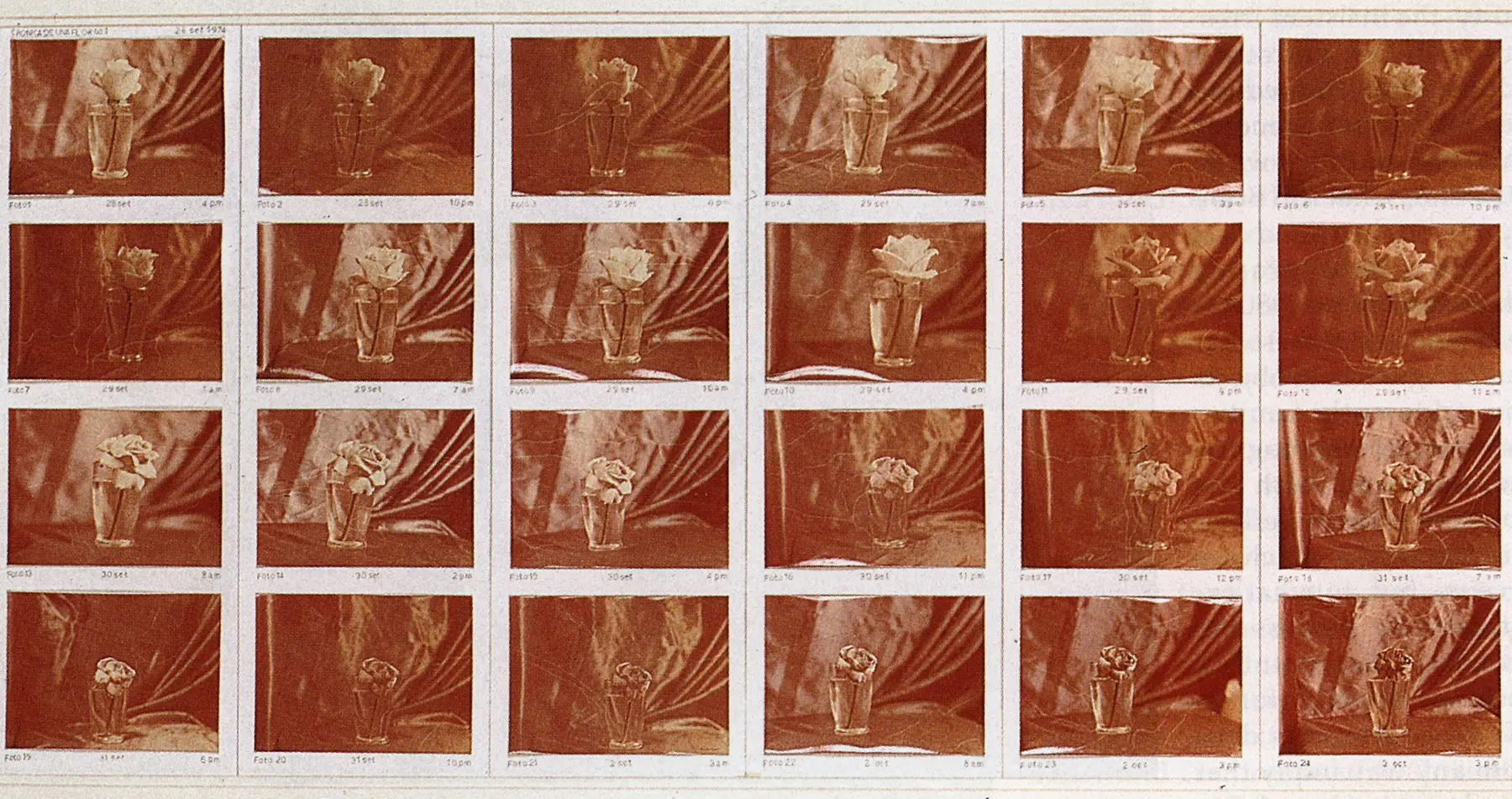
While the kineticists were transcending with monumental works and mass participation involving the audience, Obregón realizes a minute observation of the elements of Nature with the same approach as the Impressionists when they observed the shifting of light over the course of the day. His work is obsessive and meticulous. Drawing and photography are the tools that allow him to establish a language of a testimonial character regarding the phenomena he observed. Works such as Crónica de una Flor No. 1 (Chronicle of a Flower, No. 1,1974), Proceso No. 4 (Process No. 4,1974), and Primera (First), as well as the Segunda crónica de un paisaje (Second Chronicle of a Landscape), 1975 and 1976 respectively, speak for themselves. They demarcate the starting point for a constant in all his artistic production: his interest in recording and documenting the transformations undergone by his studio model. For this reason, he selects a motif of an organic character: live nature, mutable and finite.
This undoubtedly distinguishes the phenomenon of kinetic sociabilization because it requires, both its creative spectator and of the spectator's appreciation and reading, an intimate and cozy space. Obregón rejects the possibility of the work of art as a retinnian fact. On the contrary, his attention is focused on his intimate participation with the spectator.1

Meanwhile, artist contemporaries of Obregón, inheritors of the humanist precepts of their teachers from the New Figuration, began proposing once again works of figuration or abstraction ruled by their interest in human nature and particularly their desire to allow their interior space to emerge. This put a spin on the attitudes they were assuming as artists. On the one hand, there was an important individual development but at the same time, a need was produced to operate collectively, which demarcated transcendent statements in the come and go of Venezuelan plastics. Actions, performances, and even installations were realized driven by a powerful longing for liberty.2
That spirit of the times somehow touched an essentially solitary artist like Obregón. One way of establishing links with artists and friends was via mail art. In December of 1975, several of these people received a letter in which the artist sent instructions on how to make a paper rose. Later, he collaborated as a correspondent with a publication directed by Diego Barboza, published in March of 1976. This publication emerged in opposition to the production of consumable objects, and its intent was to serve as a marginal means of artistic communication (Marginal Media) on an international scale. Its goal was non-competition among artists through collaboration and mutual enrichment. Obregón sent a postcard with the image of a jaguar as a self-portrait: "To Jorge Luis Borges. My best recent portrait."
These participations have been fleeting and quite exceptional in the course of Obregón's career. In general, he works alone. Nevertheless, later on, now in 1980, he comes back to participate in an unusual event in the spaces of the National Art Gallery in Caracas: Arte bípedo (Biped Art), a day-long event in which numerous artists presented their performances to the public. The main garden and the rooms of the museum were animated by the constant actions that were taking place. Obregón proposed the planting of a rosebush in homage to the Venezuelan artist Elisa Elvira Zuloaga (Acción No. 5 Für Elisa . . . Oder Elisa nimm Deine Rose) and with this piece alluded to the roses painted by Jesús María de Las Casas and to the entire output of Marcos Castillo. From its planting and over the course of approximately six weeks, the growth of the plant was photographed up to its blossoming and final pruning. He continues working on his chronicles and dissections, creating the images that testify to the vital evolution of objects and which constitute the fundamental foundation of his definitive language.
Dissections
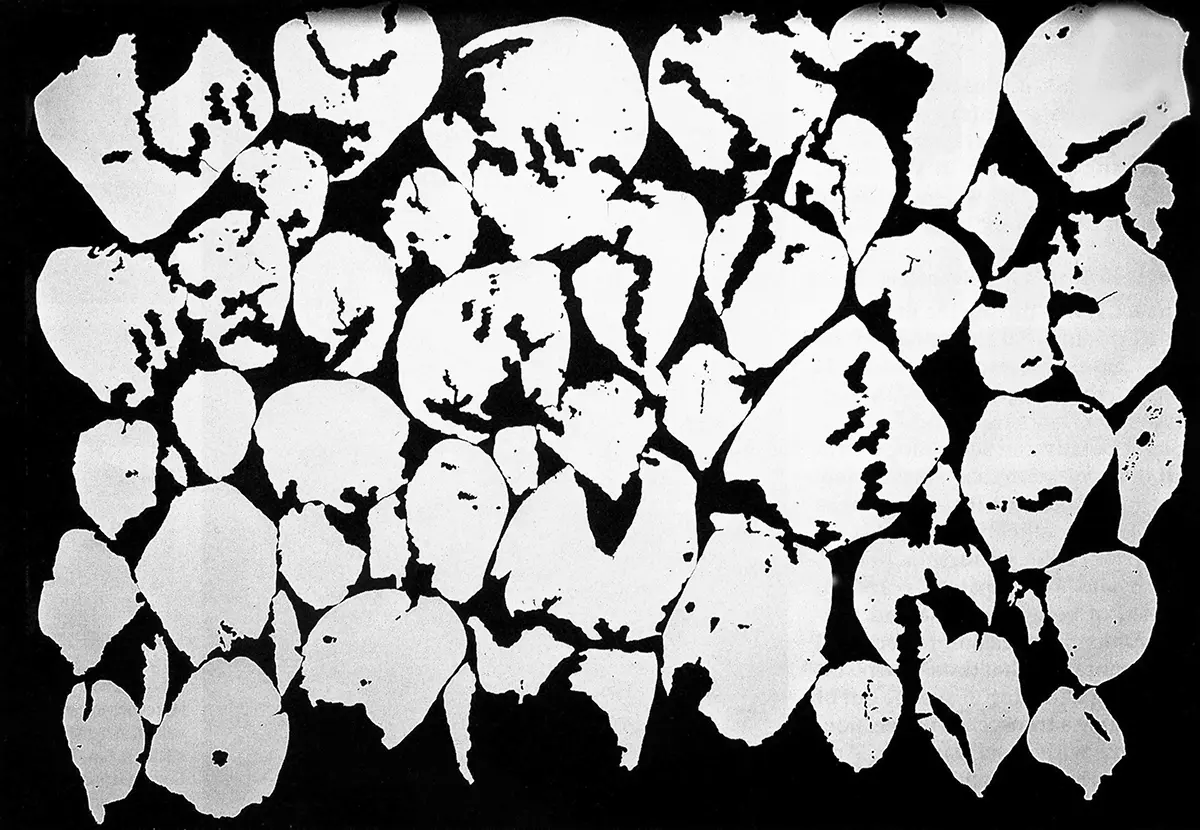
"A year ago (in 1974), after great thought, I attempted to paint flowers. The result was not pleasing and so I decided to study them closer up. I discovered that every flower is unique. Each of its components is different in form and number... First I decided upon a certain flower; it was a pink rose, nearly closed, which I began photographing from the time it was opening until it died. This work lasted one week. During this time I took pictures of it every day until I gathered 24, which represented 24 hours, and therefore, a day... Meanwhile, it occurred to me to dissect another rose. I numbered each one of its petals as I removed them. I wished to reproduce this flower on paper and to that end, I tried a variety of possibilities. I finally decided upon that which seemed to be the best: watercolors."3
From the first chronicles and dissections of the seventies to recent works, several constants are outlined: his interest in the formal aspects and materials of the piece—which implies an interesting perceptive experience for the spectator—, his love for Nature and thus, for life, which leads him inexorably to pay tribute to death.
All of this can be translated in various ways. One of them is the blind obstinacy on the part of the artist to follow his searches to their final consequences: "I want total possession, to get to the genetic material, to see and portray the genes of roses, he confessed recently."4 Passionate about experimentation as a work method, he starts with a faithful recording as the substantial basis for his work. El agua como ciclo (The Water as Cycle) (1975-76,) for example, a series composed of his first chronicles and dissections, came out of a discussion regarding watercolors as a medium and how water, as the liquid agent, determines the outcome of the work. The experience consisted of taking samples of water from a variety of sources; ocean, rain, rivers (Orinoco, El Castaño), etc. Drawings, photocopies, and other various materials comprise this project in addition to painted watercolor cutouts. The artist would later utilize this pictorial technique directly upon the paper support in one of his best-known series, Disecciones (Dissections), which he produces until the eighties.
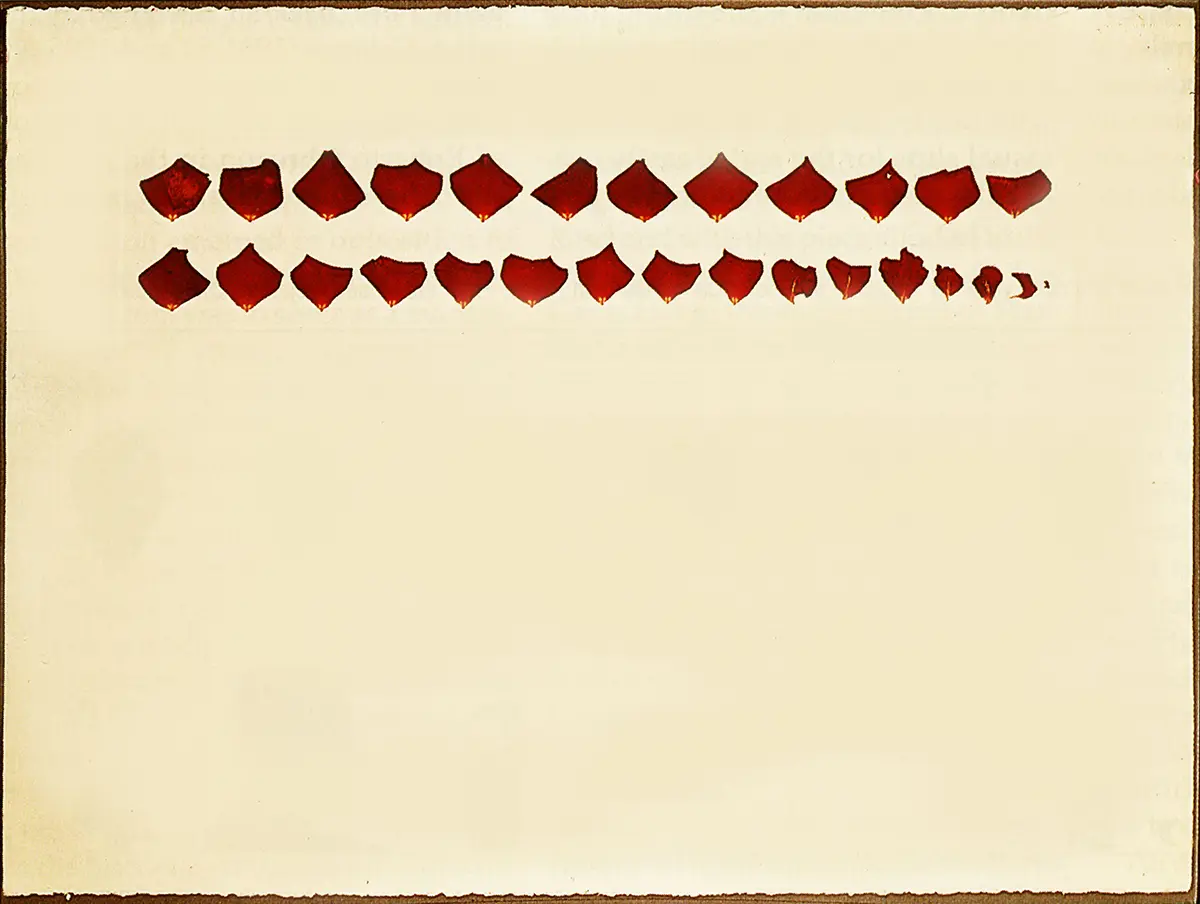
One of the most significant aspects of Disecciones is the way time is treated. In the Crónicas it is blatantly obvious how time passes during the transformations that the object under observation undergoes. In Disecciones this is reproduced through the very detailed reading of a narrative character which such dissections suggest. With the rose plucked petal by petal, the artist as chronicler lays out its anatomical composition. Every rose, even of the same family, is different from any other. Nevertheless, Obregón creates a uniform system to testify to this differentiation: he lays out the petals in a straight line, instead of the actual place they occupied in the natural order of the flower. A logical association is established between the petals, given their sequential layout. The work thus is deciphered through the time it takes to read. The result is an intimate and slow appreciation.
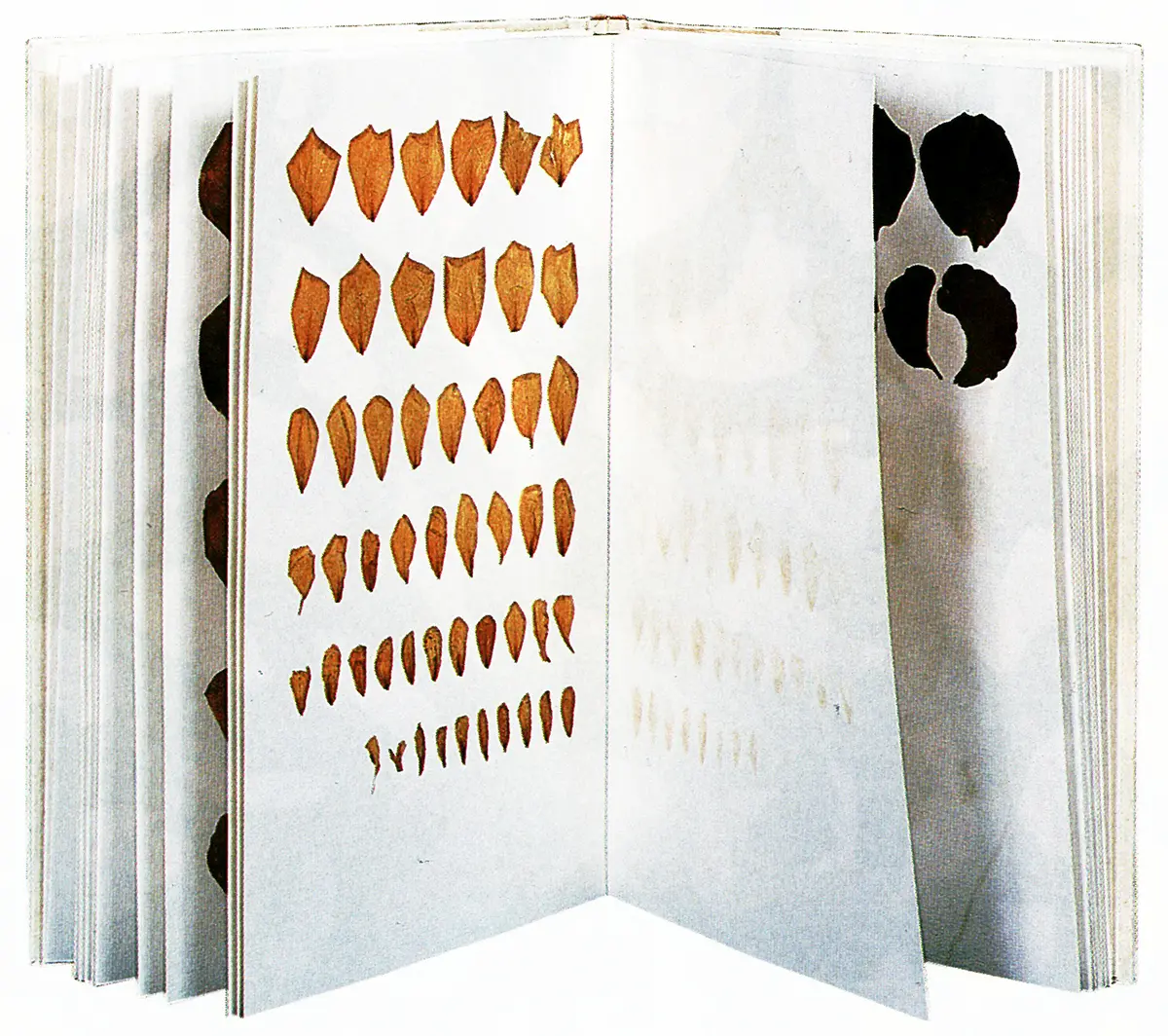
Upon dissecting the rose, the image of a symbol is being violated, the artist is reclaiming the image, stale and conventionalized, to give it back to us as a beautiful object. At heart, it is an important aesthetic reassessment, and watercolors as a medium are the fitting form for representing the fragility and delicacy of the flower. In the same way, with this technique, the artist creates visual slips for the real is easily confused with his representation. To give this greater emphasis, Obregón produces in parallel the Disecciones reales (Real dissections) in which the petals from the dissected rose are placed directly on the paper. He continues to work with this variation to this day and at times incorporates it into some of his installations or presents them in his book objects.
From Color to Monochrome
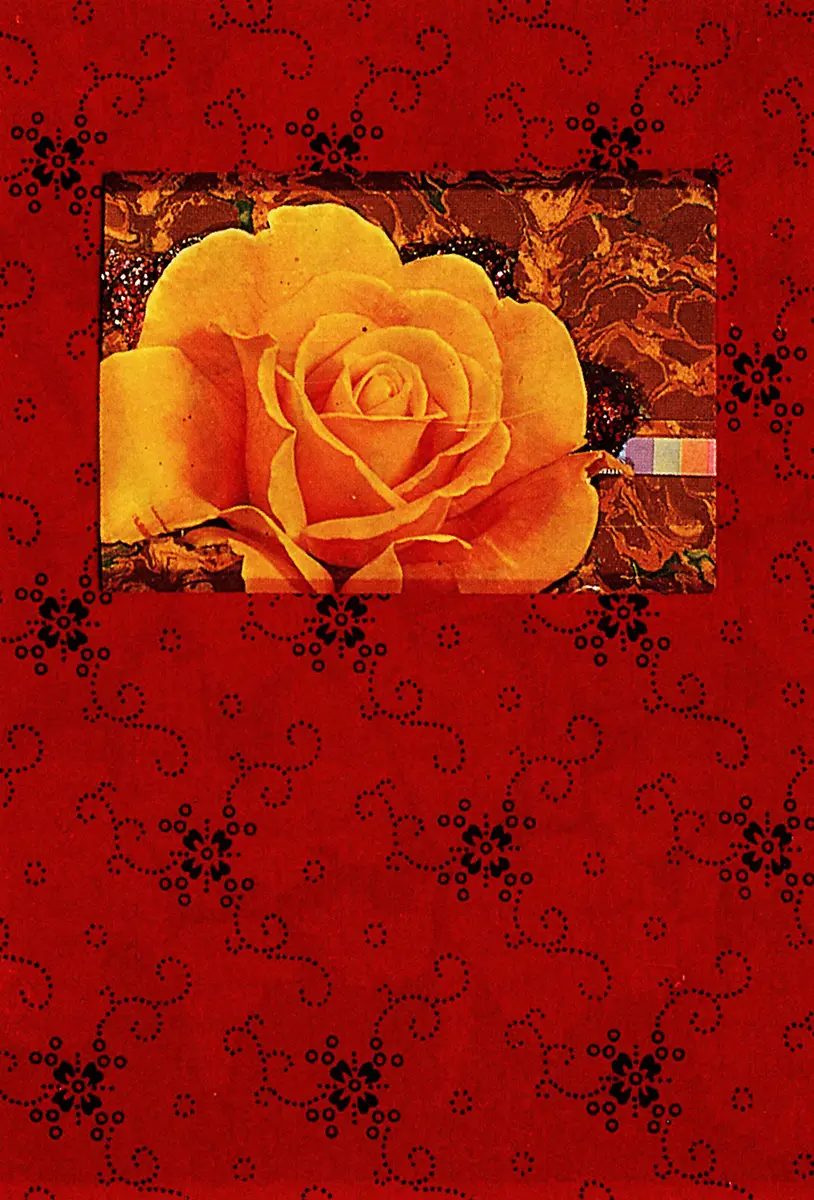
Evoking the book, and more concretely, the cover of the literary magazine Falso cuaderno, designed by the artist, Collages (1981-1982 and 1985-1988) constitute an important transition that will define the future direction of Roberto Obregón in the nineties. With these pieces, a radical rupture is produced with the naturalist effects achieved in watercolor, and important formal changes take place in which typography, design, and emblems of advertising, among others, begin to take on great relevance.
With the Collages, the artist's love for paper is revealed. Cutouts from magazines, book covers, and collected papers are recycled and make up the basic material of these works. Printed photographs of roses and other plant motifs appear through the window created in the upper part of this sort of title page. Disquieting sensorial effects are rendered between color, the printed image, and the textures of the materials being used: sparkling powders, and arabesques such as a small guide to the reproduction of four-color prints. Discords are produced between the tactile sensations of some of these materials and the purely visual element, as between the sumptuous or exuberant and good or bad taste. It is a matter of visual irony, as Lourdes Blanco accurately indicates in the aforementioned text.
The rose of these Collages starts to acquire an emblematic presence. Over time it has become the distinguishing characteristic of a language that functions almost in the fashion of an advertising image. This phenomenon transcends his current work for the elements with which the artist has always worked now seem to have settled after passing through an important process of maturation. The petals of his previous Disecciones are replaced with a less naturalistic and, to say it in other terms, a more contemporary perspective. These petals, now more austere and impersonal, are accompanied by a personal symbolism. Signs, emblems, and words (Campbell's for example) reveal a clear adherence to pop as a communicative fact, very much in the tone of Andy Warhol.
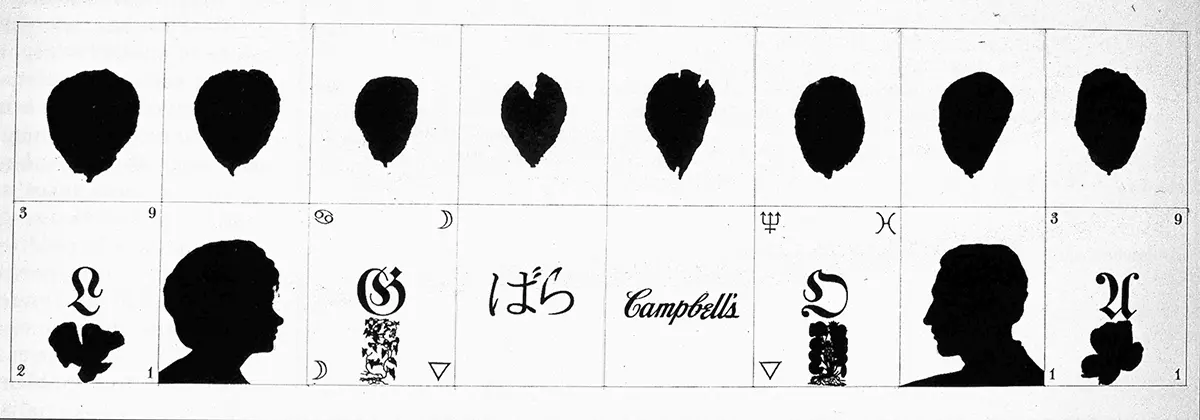
But it is not simply his inclusion of words that allows this relationship. It is also the fact of confronting the profiles of characters who, for some experiential or cultural reason, are important in the life of the artist. If Warhol could paint Marilyn Monroe, Obregón incorporates her as well in one of his pieces that make up the series Niágara. This series, one of the most known nowadays, is made out of six installations (to be exhibited at the Museo Alejandro Otero in Caracas) and owes its name to a film starring Marilyn Monroe herself in 1952, titled Niágara.5 Each installation constitutes a "biography" (or autobiography) in which two characters are set face to face. They are surrounded by signs (astrological, botanical, etc.,) gothic letters, or words that in some fashion are related to the particular emblematic of the characters. Jorge Luis Borges, Marcel Duchamp, Gina Lollobrigida, the artist's mother, and even the artist himself, are some of the characters presented.
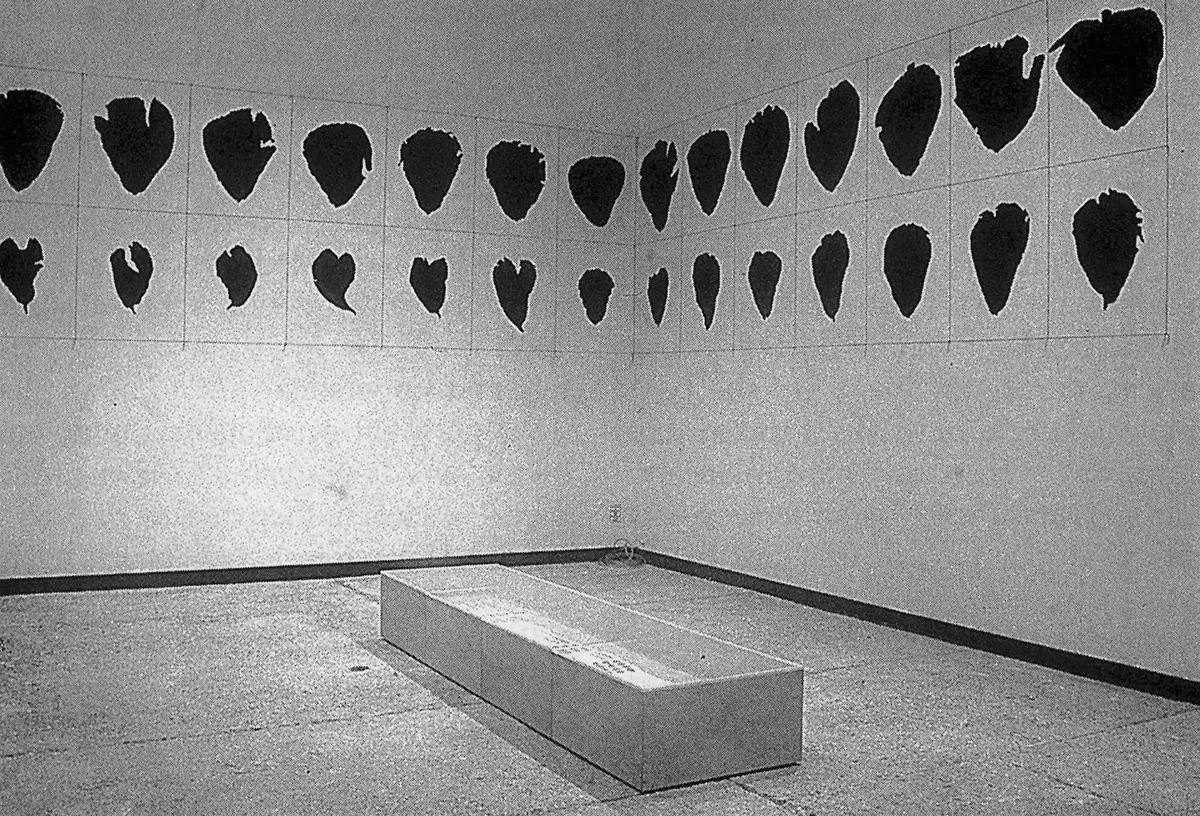
Whereas color predominates in pop art, its complete absence distinguishes this new phase of Obregón's work. The Durasol board cut out with a surgical blade and the use of iron oxide and ruling pens or yam on cement marks a radical shift in the formal conception of his works. The expressive face of the artist is replaced by more impersonal means. The forms are nothing but black silhouettes against a white background divided in turn into grids that function as the basic structure. Spread across each of these grids are the various elements that nearly resemble the emblems of playing cards. The upper section corresponds to the petals, the region of a sublime, celestial character. The lower section to the earthly world, the place where life evolves and characters are connected.6
These pieces retain the idea of a sequential and narrative reading yet have acquired greater complexity. The spectator is faced with having to decipher an emblematic work and as such, an enigmatic one. Effectively, the images are ambivalent. On the one hand, there is a recognition of the meaning of various figures but on the other, their identities remain hidden.7 The monochromatic nature of the flat surfaces, the austerity, and the synthetic quality of the images leave no room for further details.
All of this has repercussions in another sense. If earlier the artist violated the symbol of the rose in order to recover its image and to create a new language, he now takes as given the knowledge of this language in order to complete a definitive emblem. He no longer works with the rose as a symbol. It is the rose as a communicative emblem, almost in advertising terms. The link with pop is deeper than it appears. Taking this as a starting point, Obregón, in a similar fashion, produces his clandestine installations which consist of the appropriation of a space where he sets up his work, photographs them, and takes them away.
The ephemeral nature of some pieces could be interpreted as a way of referring to death. But the treatment of death as a theme is something he has maintained and accentuated throughout his artistic career. Dissecting a rose in some sense implies violating and drawing its parts. To propose a Proyecto para una iconografía sobre la autodestrucción (Project For an Iconography Regarding Self-Destruction) (1979) was a direct allusion to the forms of suicide. His current monochromatic work takes into account the evolution of the life cycle, and the black, in particular, locates us in a space of death. At issue is "showing reality and the fact of living in a more frank manner."8 Death is returned as an inseparable part of life.
In 1992, the artist includes urn-like containers in Cedeefeobe, Sincronización de flujo y reserva (Cedeefeobe, Synchronization of Flow and Reserve), an installation created in collaboration with Alfred Wenemoser. In 1993, he presents La rosa enferma (The Sick Rose), one of his most intense works in this style. It is an offering to the anonymous dead of AIDS in Africa. Twenty-five dissections accompany the piece and one of them is the one that originates this monumental work: a dissected rose, the gift of a deceased friend, infested coincidentally with blight. The original image, with all the particulars of the case, was transferred to the Durasol board with the difference that the background is black and the petals white. For the Venice Biennial last year, he produced a dissection of the entire space, placing an urn as the central element in which was a book of actual dissections. Images that reiterate again and again the life cycle and death as the natural condition of existence.
Art takes the place of the religious ceremony in bringing man closer to his human condition. It is a question of how to induce the acceptance of death as do religions. And that is of special interest to Roberto Obregón. The symbology of the rose refers back to that passage from life to death and the knowledge of that sacred journey corresponds precisely to the religious world. So it is an artistic expression of the process toward the limits of the earthly and the spiritual. The true artistic history of Roberto Obregón.
NOTES
1. A transcribed interview in a press release published in El Nacional on November 11, 1978, on the occasion of the exhibit Crónicas de flores: El agua como un ciclo (Chronicle of Flowers: Water as a Cycle) in the Mendoza room, Caracas, Venezuela.
2. Roberto Guevara accurately notes: "[Roberto Obregón] belongs to a generation that knows all shades of rejection as a strategy for removing the conformity and apathy of age of weariness. Thus he accepts the simple and complete risk of placing himself outside, of proposing other forms of communication, of opting for the uncreated. (...) For Obregón, it was impossible to put off going outside, letting the force flow from an interior notion that reclaims space and property. And something exceptionally important for the young people of that moment, the imposing of a place for the creator and his personal world besides the work." Acordar con Venecia, Venezuela Pavilion, June-November, 1997, p. 17.
3. Words are taken from a letter received by Lourdes Blanco in December of 1975. From “Cincoincidentes," a text published in the exhibit catalog to Cincoincidentes. Museum of Barqueisimeto, July - August 1984.
4. "El hombre de la rosa," Interview by Sonia Casanova, Revista Eslilo, Issue 8, No. 31, pp. 68-71.
5. Rosana Guastalerro analyzes the first of these Niágaras in an as-yet-unpublished essay titled "Niagara al sur del sur. No. 1." In this study, the author notes how these monumental works represent a synthesis of Roberto Obregón's inquiries.
6. Interview in Revista Estilo, op. cit. pp. 70-71.
7. Mónica Amor refers to the partial and never absolute character of the image. Text from the catalogue for the exhibit Alterando historia/Alternando historia, Museo de Bellas Arles, Caracas. October 1995-March 1996, p. 72.
8. Words spoken by Roberto Obregón in 1978 which are still true today, Interview by Margarita D'Amico, "Las flores de Roberto Obregón," El Nacional, (no further information.)
SUSANA BENKO
Venezuelan art researcher and critic. Editorial Advisor for ArtNexus in Caracas.