
Silvia Gruner (Mexico City, 1959) recently presented a photographic project titled Necklaces consisting of a series of pieces that were connected beyond the visual readings which could be made of them. Something more profound thus emerged, “like a sunken galleon or emotional weight that had finally returned to the surface”.1 From the “semiotic saturation”2 in which we are currently immersed almost by force, the images of Necklaces, even when technically printed, reproduced or digitalized, created a space which endowed artifacts with experiences, in which the artist serves as a guide through the narrative.
A necklace is an object which is threaded and which at the same time brings together histories: it thus becomes a metaphor for how the artist moves through time. Silvia joins together different fragments from various portions of her own reality to create micro-narratives that are woven together, intertwining and threading together to form a necklace that is presented as a territory already explored and known, and therefore not discordant. The “beads” of stone, soap, chorizo, or even chewing gum and the tattooed image of a ring around a navel, are fragments of a search that will finally come to rest and become established. The necklace is thus transformed into a meaning of place, space, limit or demarcation. The artist is aware of this attempt at emotional mapping, placing or nomadism combined with a painful experience that obliges one to remain, to be in a place.
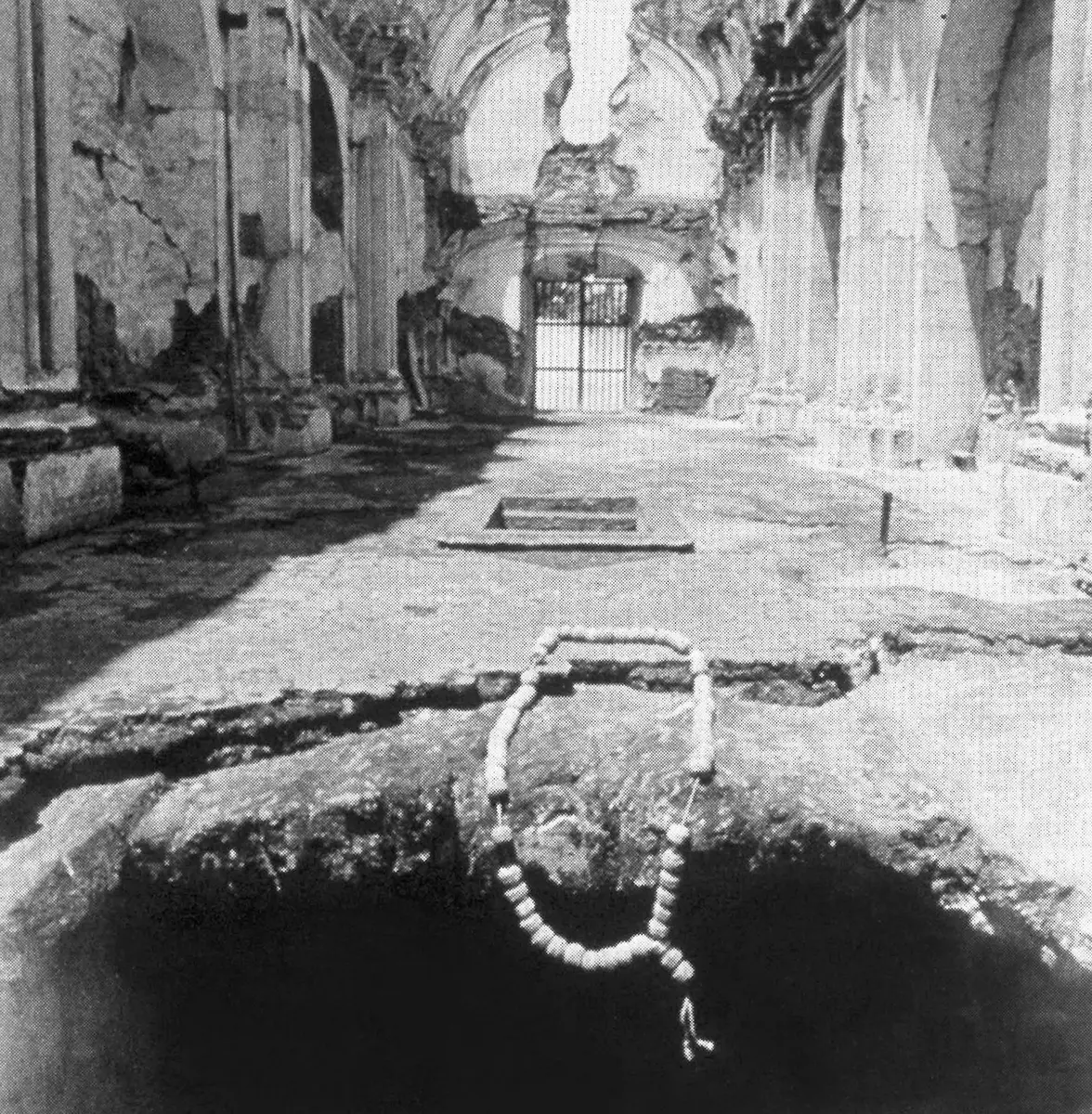
These objects create an interplay with the concept of identity, although the individuality of each bead making up the necklace is linked and bound to the others to create a hybrid dimension in which different and apparently separated worlds co-exist: the metaphysical necklace which speaks of Being and Existence, the necklace as an ornamental element for the outside of the body, the necklace which attempts to make an archeological reconstruction at the level of personal experience and the necklace/the spectacular as an integral part of something not yet completed.
The "pieces presented in this exhibition are the result of two and a half years' work, a synthesis in which the necklace becomes a structure in which different references are woven together: social, archeological, sexualized, perversion and enjoyment, the necklace as an amusement, as a means of articulating time...different mappings of different things, different fragments. The themes presented in this exhibition are those which move me, which make me react, the evidence and the result of an inner search."3
A visit to the (interior) rooms and (outside) patios of the Centro de la Imagen left the visitor with a vague sensation of the atemporal nature of the necklaces - but they are precisely that, a chain of things that come from an ancestral tradition, coupled with the re-elaboration of objects and finished works. Thus Silvia likes to reuse the same pieces in other words: "It is a kind of inner recycling - of myself, my feelings and my emotions and the objects themselves; the necklace will in fact be used in a film in which it will be rhythmically lowered into and then lifted out of the water by a maritime crane, simulating the movement of a whale emerging from the sea only to plunge back into the water, and out again, and back again, and so on."4
From this same idea of timelessness come the next six fragments of the billboard (necklace/spectacular), the essence of which is the idea of integrity in fragmentation, the impossibility of reconstruction, and the restrictions or specificities of the space in which they will be placed, while at the time connecting with the sculptural stone collar which appears on the floor: an idea fragmented and simultaneously and instantaneously cloned. The co-existence of finished works and works in progress might appear discordant with our sense of perception. However, Silvia’s work obliges us to manipulate the apparent division between time and space, image and object, the fragmented idea, and the fundamental concept.
NOTES
1. Interview with Silvia Gruner. by Luz María Sepulveda. Mexico City, 14 January 1998.
2. In the contemporary “information era”, the bombarding of signs, images, and representations has been seen in general by critical theory as a “semiotic saturation” that studies human beings and their cultural life in the avalanche of information produced by the mass communication media.
3. Interview with Silvia Gruner, by Luz María Sepulveda. Mexico City, 14 January 1998.
4. bid.
LUZ MARÍA SEPÚLVEDA