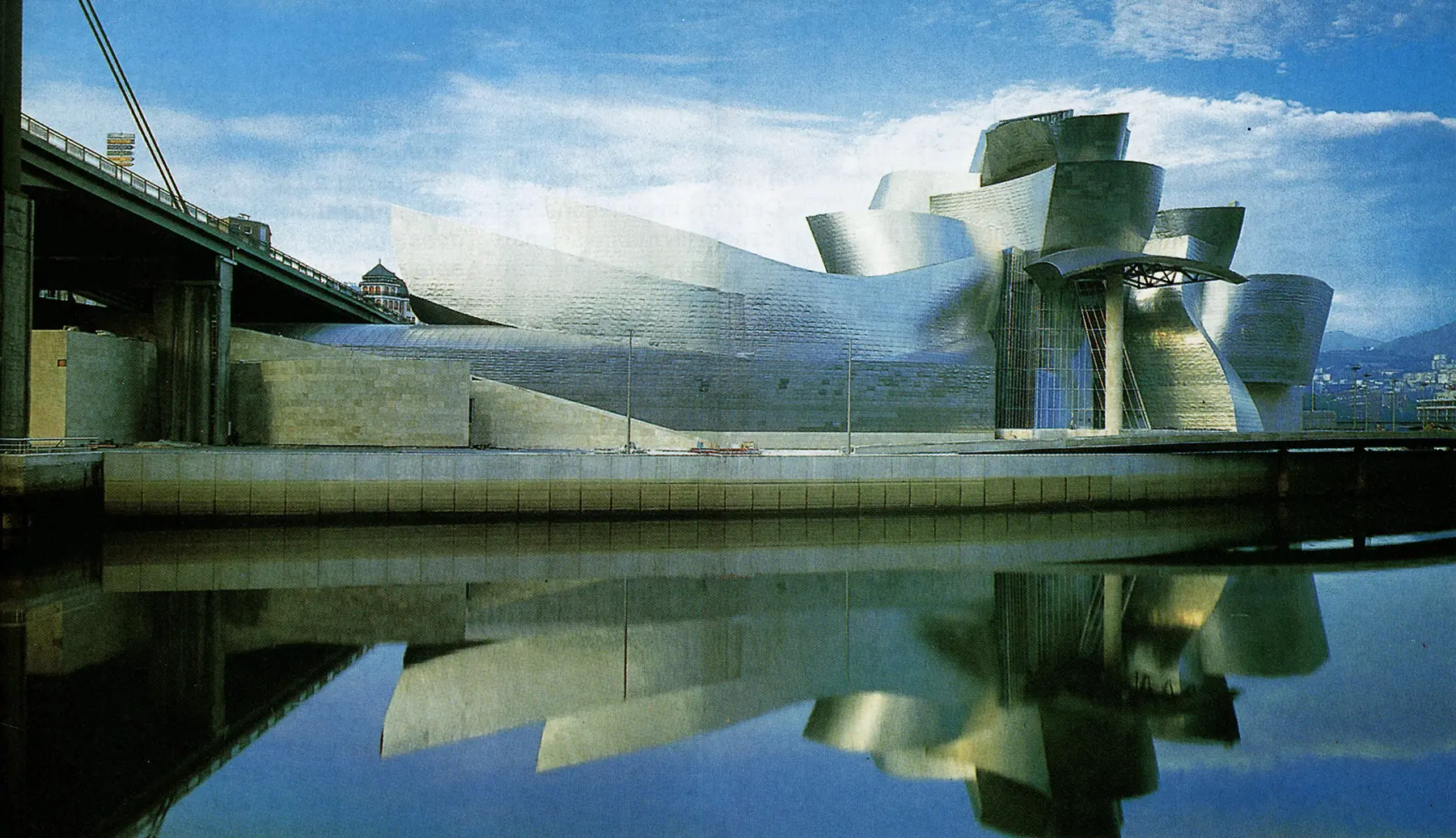
In mid-October, 1997, amid humid blue skies and an unseasonably warm climate, the government of the Basque state inaugurated the Guggenheim Museum in Bilbao with an exhibit titled, The Guggenheim Museums and the Art of This Century.1 The Guggenheim Bilbao is the cornerstone of Bilbao 2001, an ambitious cultural plan aimed at economic diversification and the revitalization of the city center's riverfront properties along the estuary of the Nervion River. This new policy has forged a consortium between the government of the provinces of Biscay, the arts, and the new technologies. An architect at the Ministry of Education and Culture in Madrid observed that Bilbao, like Stuttgart and Frankfurt, has opted for modernity as part of its infrastructure.
Bilbao, or Bilbo in Basque, home to one million inhabitants, is Spain's fourth-largest city and the capital of the Basque State, situated in the Golf of Biscay just south of the French Pyrennes. Since the latter part of the nineteenth century, Bilbao's dockyards along the Nervion had functioned as the premier port in Spain, a haven for heavy industries such as shipbuilding and its related commerce. By the beginning of 1980 the old shipping industries' economic base had floundered, many stood dilapidated, and the great contaminated waterfront had grown to resemble an urban wasteland in the city center. Thus, in an effort to diversify and revitalize the economic base of Bilbao and its surrounding provinces, the Basque government initiated a program intended to foster a new, "white-collar cultural economy." An important element of the new cultural policy included the building of a museum of modern art.2
As part of its own cultural policy, the Solomon R. Guggenheim Foundation, New York, spearheaded by Guggenheim Museum director Thomas Krens, had also sought to build a third satellite museum. The Guggenheim in New York, Guggenheim SoHo, and the Peggy Guggenheim Collection in Venice all form part of the Foundation. The Guggenheim had considered the cities of Salzburg, Graz, Vienna, Osaka, Santander, Seville, and Venice as possible sites for its new franchise but to no avail. In 1991, members of the Basque State Parliament approached Krens and proposed Bilbao as the site of the new Guggenheim. After months of negotiation, both sides agreed to a relationship that would become highly polemical and costly to the coffers of the Basque state. Both sides signed the solemn accord on 13 December 1991, the feast day of Santa Lucia, who, according to Christian iconography, Lucia, on that day, handed over her eyes on a platter.3
The Basque State-funded, with tax revenues, the entire cost of the project was estimated at $150 million. It will also continue to finance the museum’s entire annual budget indefinitely. In theory, both The Foundation of the Guggenheim Bilbao, an organization established by the Basque government, and the Solomon R. Guggenheim Foundation of New York, should oversee the workings of the museum. However, given its expertise in conservation and administration, the Guggenheim Foundation NY will direct the museum and provide the basic collection as well as the future exhibits. This has caused dismay and has disconcerted many individuals in the Spanish Art circuit. In Spain, this is the first time that a governmental entity has pledged public monies for the construction of a museum to a private art foundation in exchange for having the privilege of using the foundation’s logo as part of the museum's name, commented the architect at the Ministry of Education and Culture. This pseudo-franchise is but one example of an expansionist neo-colonialist artistic policy imposed by Guggenheim New York.
The Foundation has yet to name an artistic director for the Bilbao Guggenheim. The everyday workings of the museum are administered by its Director-General, Juan Ignacio Vidarte, a technocrat/politician who holds a doctorate in economics and business administration. Vidarte has spent most of his career reconfiguring the fiscal policies and the regional planning of the Basque Parliament rather than curating art exhibitions. Lamentably, Vidarte was unable to differentiate between a Matta and a Matador. In response to the question, what about avant-garde art in Latin America? he tepidly replied, It exists, doesn't it? For now, New York will continue to conceptualize the thrust of the museum's future exhibitions.
Nonetheless, Jose Antonio Ardanza, the President of the Basque State described the Bilbao Museum as a new facet of this State and its people.
"... through this museum, we want to speak to you of our artistic sensitivity, our wholehearted commitment to modernity, our universal calling, our openness to every beautiful thing created in this world, our wish for cultural and economic regeneration, our desire to learn, to assimilate, to adjust, to continue to be true to ourselves is the only possible way in a changeable and interrelated world. The Guggenheim Bilbao is dedicated to American and European art of the twentieth and twentieth-first centuries."
The Basque government-commissioned Canadian-born Frank O. Gehry, a somewhat dated architect preordained by Krens, to design the museum. With the design of the Guggenheim Bilbao, Gehry has achieved an integration of the art forms present in his structures since the 1960s in what many architects have described as the pinnacle of his career. At the inaugural press conference, Gehry stated he had not wanted to design a deferential building detrimental to art. For Gehry, the tough industrial terrain of the estuary surrounded by green hills saved everything. It even makes my building look good.
It was the culmination of a six years project. "Krens articulated the vision and I gave form to it," stated Gehry. However, the museum itself is a twice sculpted and a twice achieved art form. While the 68-year-old Gehry may have conceptualized the Museum’s polemical and esoteric design in cardboard form, it was the avant-garde technological processes and designs adhered to by a relatively young team of Basque engineers, architects, and modern-day artisans who actually facilitated the construction of the museum.
According to Cesar Caicoy, the Executive Architect of the project, three Basque industries: the industrial, the robotics, and the metallurgic formed the union that facilitated the museum's construction. This new highly-skilled, multilingual workforce has begun to replace the once-dated number of architectural and engineering feats of 'firsts' that have distinguished the construction of this museum.
The application of a software program known as Catia gave form to the contorted and laconic shapes of the structure’s exterior. Catia, an expensive and advanced computer program until now utilized exclusively by the aerospace industry, generated the maps that translated the integrity of the proposed geometric forms into sculpted three-dimensional models, thereby, providing its designers with the points in space needed for the construction of the didactic forms. Thus, the Guggenheim Bilbao is, observed engineer José Lucio Pérez, "the cathedral of the century." The engineers, most in their mid-twenties utilized, in addition to Catia, other unorthodox building scaffolds in the construction process, such as mountain climbers —who as modern-day artisans hung from the building's exterior having affixed the different sized panels of titanium, glass, and stone that form its skin.
This is also the first time that titanium, a light metal like aluminum though denser and more resistant than steel, has been used as an exterior shingle. In total, some 33,500 panels, fifty- percent of which are different, provide the building with a stunning pewter glow that changes with the color of the sky and the intensity of the sunlight. Another 2800 pieces of glass, cut into triangular shapes or parallelograms, nearly all of which are different in shape and size, form the glass curtain walls that encompass the museum’s central atrium.
The Guggenheim Bilbao, reminiscent of a gigantic sculpted ship sits anchored on an irregularly shaped lot on the south side of an estuary along the Nervion River. The Salve Bridge, one of the principal routes into Bilbao, meanders over the easternmost apogee of the lot. Gehry deliberately incorporated the posterior side of the museum into and under the bridge into the building’s composition. The building, 24.290 square meters in volume (256.000 square meters), is composed of some fifty singularly shaped structures, one resembles a whale while others appear in the form of a rose and a boot.
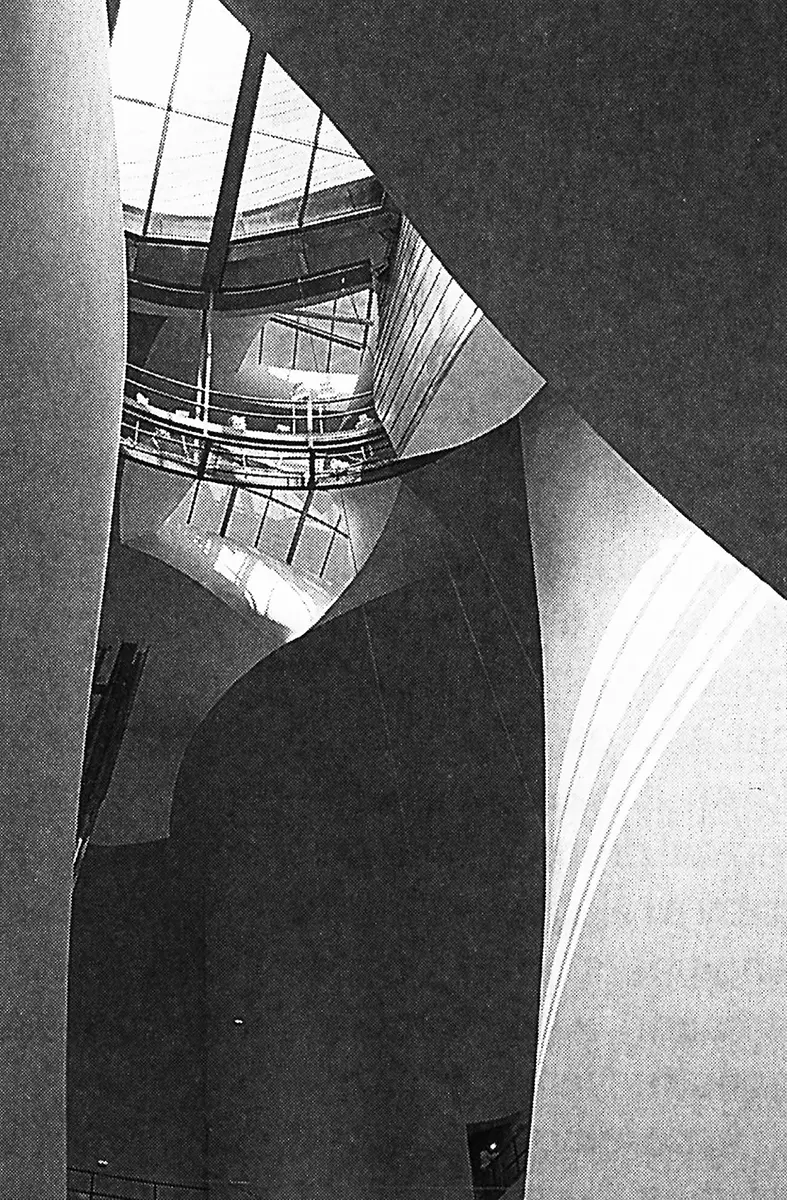
The glass curtain walls that form the vast part of the 54 meters high central atrium interconnect and enclose the metallic and contorted structures of titanium. The multiple structures gyrate around the atrium are united by the glass walls that permit the entrance of light rays into the heart of the museum. The atrium, inundated with light from a blooming metal rose above, is one and a half times higher than the rotunda of Frank Lloyd Wright’s Guggenheim Museum in New York.
Three levels of galleries pirouette around the central atrium of natural light. This is the principal point of entrance and orientation. A series of unique galleries are designed to house works of large scales or different installations. The largest gallery, 130 x 130 can accommodate installations not capable in more conventional spaces. The exhibit space encompasses 10,560 square meters (110,000 square feet). The labyrinth of interior walls and supple pillars are bathed in white carton gesso. They form into ever-changing silhouettes against the grey-colored exposed steel walkways, stairways, and elevators, some shielded by the contours of the multiple glass panels. Concrete and wood floors compliment the white gesso or the walls of stone, cut to resemble the assemblage of the exterior titanium. Apart from the different galleries contained within the different structures, one also finds a 300-seat auditorium, a cafe, a restaurant, and a boutique. A water garden just beyond the posterior 'canopy' filters into the estuary underneath the museum's walkway.
The inaugural exhibition of the Guggenheim Bilbao titled, Los museos Guggenheim y el arte de este siglo, including collections of its proper holdings, and other works out of the Guggenheim NY and Venice.
Krens viewed "the collection of the museum as an encyclopedia of major works of European and American art of the 20th Century, installations and other works specially commissioned for the opening." However, only two of the 253 works exhibited in Bilbao were by Latin American artists. Wilfredo Lam’s Estruendos de la tierra (1950) and Zambezia (1950) stood among the works of Willem de Kooning, Jean Dubuffet, Yves Klein, Jackson Pollock, Mark Rothko, David Smith, and Clifford Still-all exhibited as part of the European and American abstract expressionism or informal art of the 1950s. Why the paltry representation of Latin American artists? Are they not considered part of the modernist movement?
"The problem —asks Head Curator Lisa Dennison— is how do you define Latin American art? Is a Cuban-born artist now living in the United States considered a Latin American artist?" The foundation, Dennison added, does possess Latin American works obtained in the emergence decade of the 1960s. Most notably, the collection includes works by Lam, Matta, Botero, Tamayo, and Félix González-Torres of the early 1990s. However one should not dismay. Alluding to this dismal representation of Latin American art in the collection and the role of the Guggenheim Bilbao in rectifying it. Dennison noted, "Now all that will change since we have a foothold in a Spanish-speaking institution ... in the future, the Guggenheim Foundation does have a major exhibition of Latin American Art planned." In addition to this proposed exhibit, three other shows are scheduled for Bilbao: French Culture and Art in the 1960s, Robert Rauschenberg: A Retrospective, and China 5000.
At the press conference, Krens readily acknowledged the need to exhibit the work of more Latin American artists. Bilbao, he stated is now the bridge between Europe and Latin American Art. From an institutional perspective, this bridge over the Atlantic might prove somewhat difficult as only 100 out of 6000 works of art in the Guggenheim Foundation’s collection are by Latin American artists. For now, the Guggenheim Bilbao stands prominently along the Nervion without an artistic director, and in the words of Dennison, one will not be named until the appropriate moment. But as the same architect in the Cultural Ministry aptly stated, A museum is much more than a structure. Its works of art also comprise its definition.
NOTES
1. I extend my gratitude to José Ignacio Lucio Pérez, one of the lead engineers of this museum, and to Miren Begona Arceo, an instructor at a private school in Bilbao, for participating in numerous interviews and providing information and particulars about Basque culture.
2. The Guggenheim Bilbao is part of an S1.5 million project of revitalization that includes the expansion of the port, a concert hall, the new metro designed by Sir Norman Foster in 1995, expansion of the airport, and a new bridge designed by Santiago Calatrava, as well as an urban project of 94,000 square meters designed by César Pelli to be located between the museum and the concert hall.
3. For an excellent critical appraisal of the negotiations processes based on interviews with the pertinent individuals involved see, Joseba Zulaika. Crónica de una seduccion: El museo Guggenheim Bilbao (Madrid: Editorial NEREA, 1997)
FEDERICO GARZA CARVAJAL
Researcher and historian at the Centro de Estudios y Documentación Latinoamericanos (CEDLA). He is actually making his doctoral thesis on Spanish and Mexican Cultural History of the XVI and the XVII centuries.