
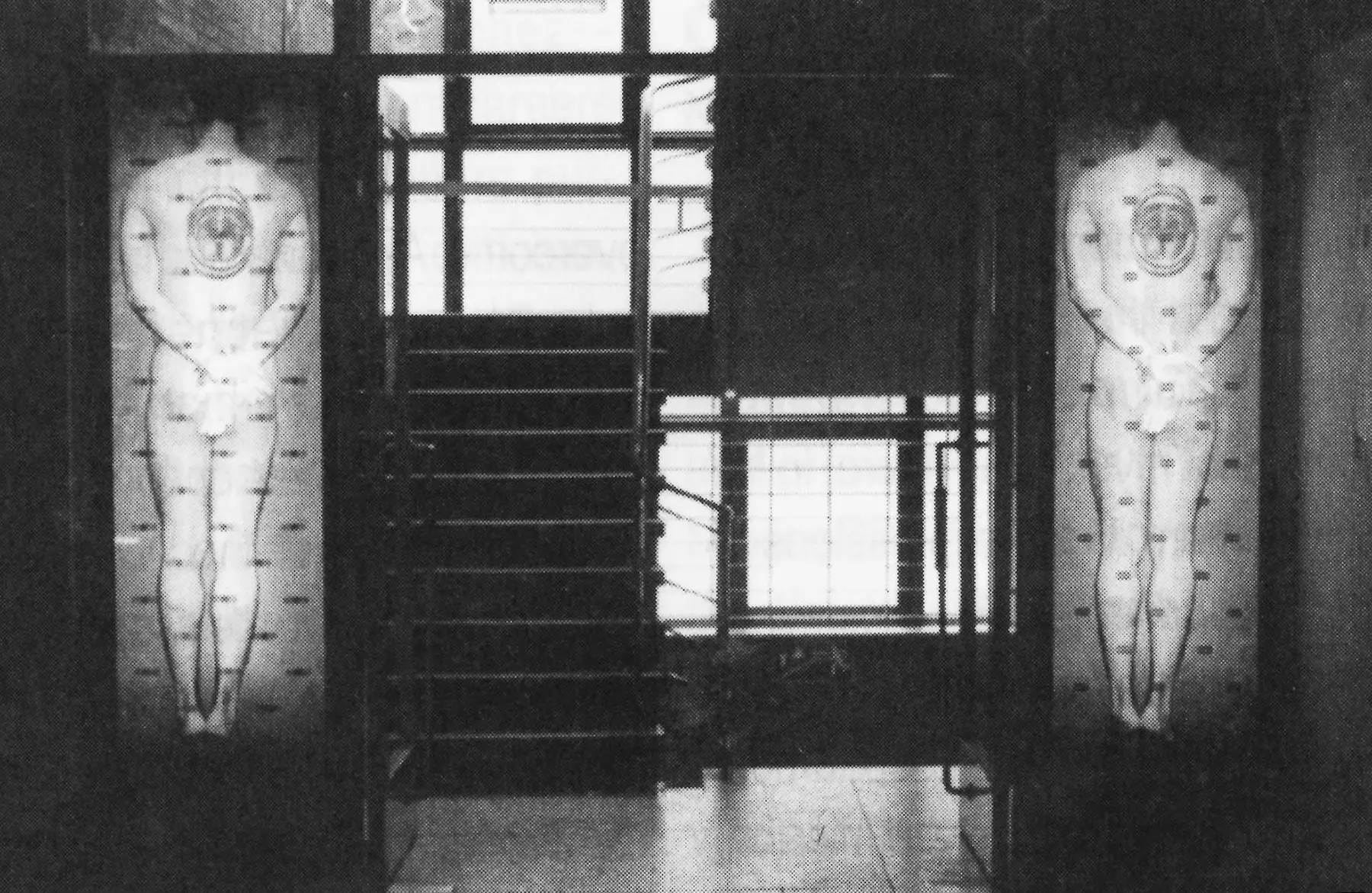
It is important to distinguish between the project titled Inside and Documenta X and to give it its own definition. This will help avoid frequent confusion. Both events are held at the same time in the city of Kassel, and there is no question about the deliberate scheduling of the show by the Stoffwechsel project group, from the University of Kassel, both in 1992, the year of Documenta IX, and again this year, 1997.
But the two events have totally different philosophies and scopes. Documenta, whose director changes periodically, is perhaps the most sought-after and talked about gathering in the art world. Most of its direct invitations go to artists from Europe, the United States, and Japan, and it has a very particular and deliberately restricted orientation.
Stoffwechsel, conceived and regularly directed by the Egyptian- German professor Hamdi El Hattar, focuses on the preservation of “minority” and beleaguered cultures, through the presentation of their contemporary plastic expressions. The invited participants, who are carefully selected, usually come from Latin America, the Caribbean, Africa, and the East. Professor El Hattar is a utopic, controversial, and somewhat mysterious figure. In his commitment to the expressions of the “peripheries” and his determination to provide them with a space in Germany, his university department is fulfilling a kind of cultural mission, through artistic exchanges-probably the only of its kind open to the South in the Europe of the North.
The so-called major figures of Western art are not represented and are of no interest to the university organization.
The current version titled Inside (Innenseite) was not focused (like previous editions) on any precise region (usually regions not included in the Documenta and other major “Eurocentrist" art shows). The project director invited artists from all the continents and from countries with different levels of socioeconomic development. The only requirement was that their works should reflect their “inside”— their authentic and profound sources of cultural inspiration, whether vernacular traditions, crises suffered or problems to be overcome. A national and individual selection was made on the basis of these criteria. The format proposed —with a few rare exceptions, such as the painting of the Australian aborigines— was installation art, which El Hattar believes to be the most appropriate for the communication of aesthetics and messages. The works were presented both in the open air and in one of the University buildings in Kassel. They subsequently traveled to nearby Gottingen and may be seen next year in Toulouse, France as well.
Most of the installations are painting a minority medium in Inside. were satisfactory; several were handsome and refined. They certainly expressed the "inner” sincerity which was the goal of the show. However, many referred to qualities of seduction and impact based on form, space, and color; others added elements of a folkloric, ritual, or traditional kind.
There was little in the way of deep reflection, questioning, or an “encounter with others" (to paraphrase the title of the 1992 event), except in work that referred to countries facing war and terrible suffering.
In a work dealing with Bosnia, the black colors, chaos, screams, expressionist brushwork, and the motifs were truly startling, reflecting the anguish and despair of the war-torn citizens. Mention should be made here of the tragic and bloody iconography of Alma Suljevic, the signs of disorder and pain of Nusret Pasic, the helplessness of the birds, and the witnesses in Fikret Libovac, and the dark room with the war videos of Dejan Vekic. There was an air of cultural anonymity, but there was also a memory of events sustained through the work of art —a reading that the spectator should also take as a warning.
Surprisingly violent, and championing the cause of others, was the installation/performance by the French artist Serge Pey, Tomato Attar for the Indians of Chiapas, with its beaten, destroyed fruits smashed into a reddish, foul-smelling pulp on the floor. Something is happening in France: it was one of the few countries asking questions and questioning itself, in ways that were often unpleasant, as in the primitivist and excremental piece by another French artist, which clearly bothered our own Belkis Ramírez.
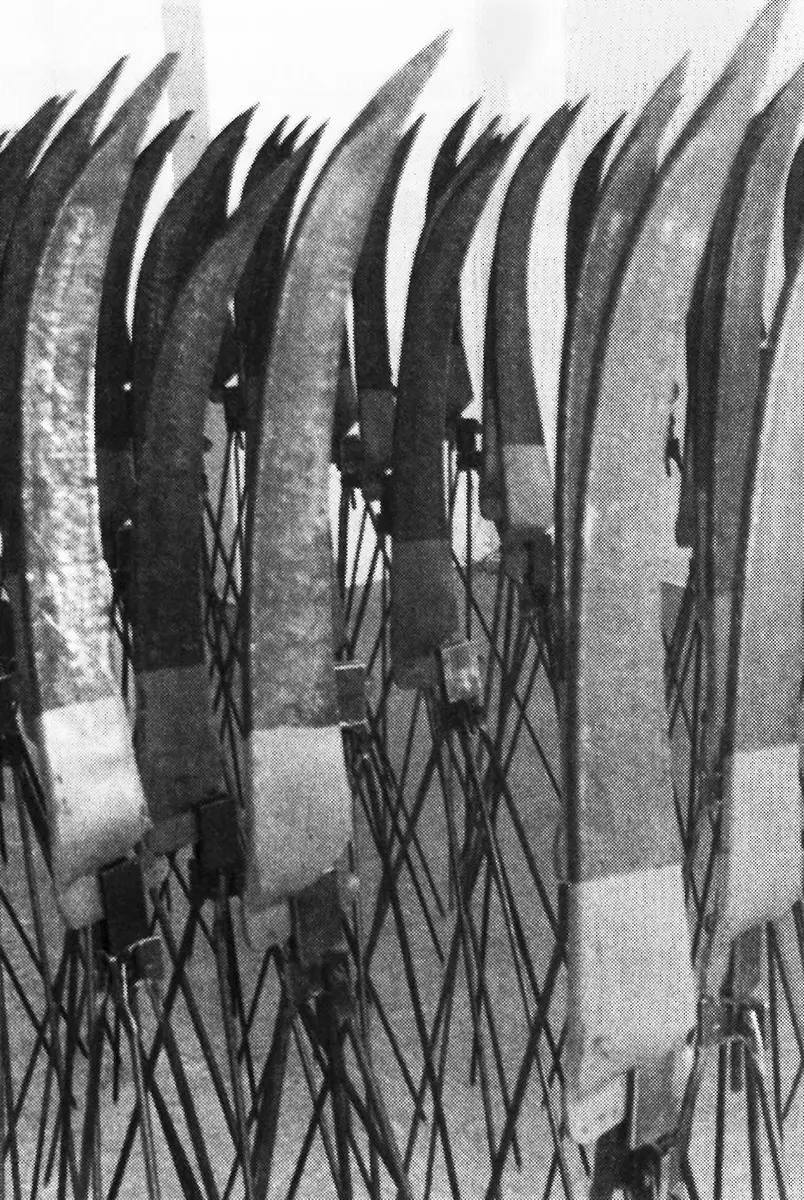
Aesthetics predominated in the works from Italy and Germany. Playful and humorous was the work of the Italian Di Cocco, with his "animated" fish and sharks, showing their teeth toward diminute drawings of old temples. Very impressive was the gigantic structure in greenish plastic by the German Oefelein, who made very intelligent use of adhesive tape, which looked like bursts of sparkling lights. It was rather surrealist, fascinating, and poetic, quite different from the threatening and sharp field of scythes by Paul Pfarr.
Special mention must be made of the Swedish artist Stina Opitz. She displayed women's clothes, rose, fell, and rotated in a crazy fashion (powered by motors), and even splattered the wall with paint. Her work functioned as an encounter between old and new myths.
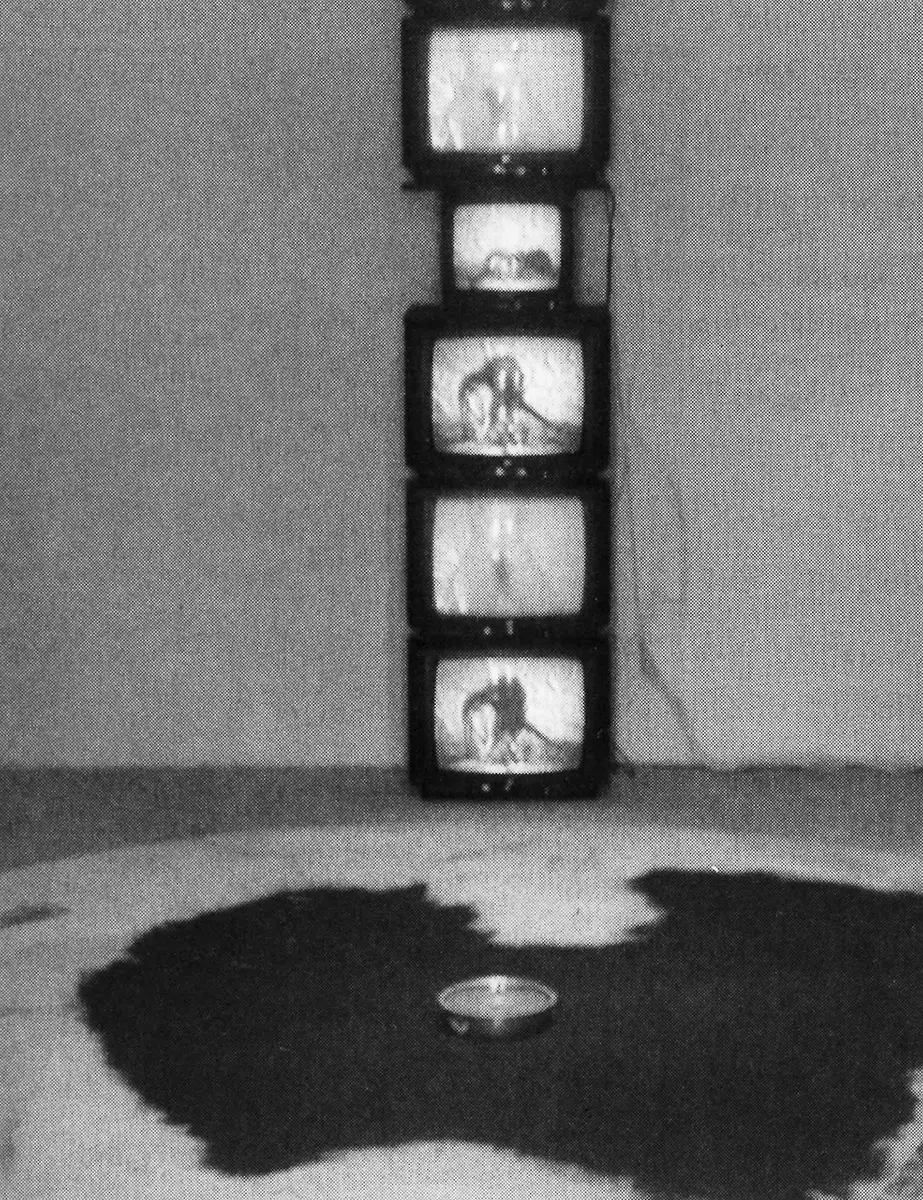
Finally, the Old Continent, and Greece. There was an installation made up of 108 houses of sugar and musical boxes by Nikos Tranos hanging from the ceiling, the melodic combination of which became a devastating cacophony. Both ritualistic and demystifying was the magnificent installation by Aris Prodomis, a "religious” precinct in the form of a patiently elaborated blue circle, full of penetrating incense, in which video screens proposed a female eroticism, probably very different from the real condition of traditional Greek women.
On the basis of local curatorship and approval by the project director, the Dominican artists Tony Capellán, Pascal Meccariello, Jorge Pineda, Belkis Ramírez, and Fernando Varela were selected to participate in the show. They had proposed to present their installations in a park, with the individual works forming a whole, titled Steeping City, a group of three-dimensional meditations on life and death. Unfortunately, the Dominican artists were able to arrive only four days before the official opening, their working materials arrived late, and the site did not have any electrical connections. Except for Fernando Varela, who did the main part of his work in Santo Domingo beforehand and sent it on to Kassel, the other artists were unable to prepare their work in such a short time. In the end, there was no collective installation outside, but rather five individual works, with those of Capellán, Meccariello, Pineda, and Ramirez placed in separate inside locations, although that of Fernando Varela was located in a green area at the entrance to the University building.
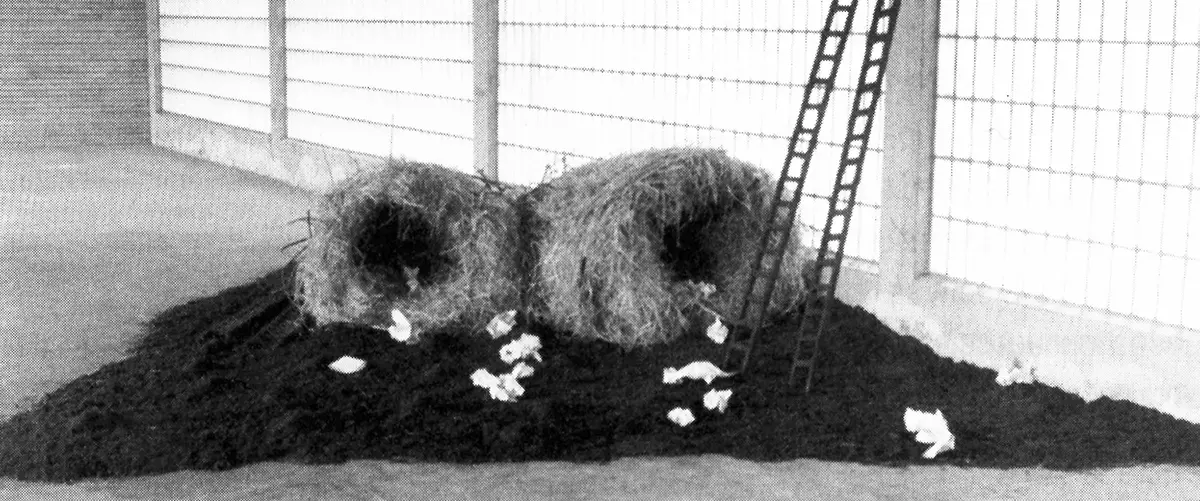
The works were unanimously praised for their expressive power and their ability to communicate social messages in which identity had nothing to do with folklorism. Totally devoid of any regional or vernacular touches, the works referred to a local subject that is also of crucial importance at the global level: the abuses and violence committed against adolescents, in the work of Pineda and Capellán, and more broadly, in the work of Meccariello: the condition of women in the work of Belkis Ramírez; and the dilemmas of death and life after death in the work of Varela.
Among the Latin American artists, Manuel Cholongo from Ecuador surprised visitors with his lectern constructions, full of books that were open and burned in the center. This committed, and some say rebellious, artist thus questioned the repeated attacks against the arts, literature, and culture in general. Néstor Otero, from Puerto Rico, who presented one of the best installations in the São Paulo Biennial, and won a prize in the second edition of our own Biennial of the Caribbean, here worked with poor materials based on the theme of habitat and memory. However, the Cuban representation did not live up to expectations.
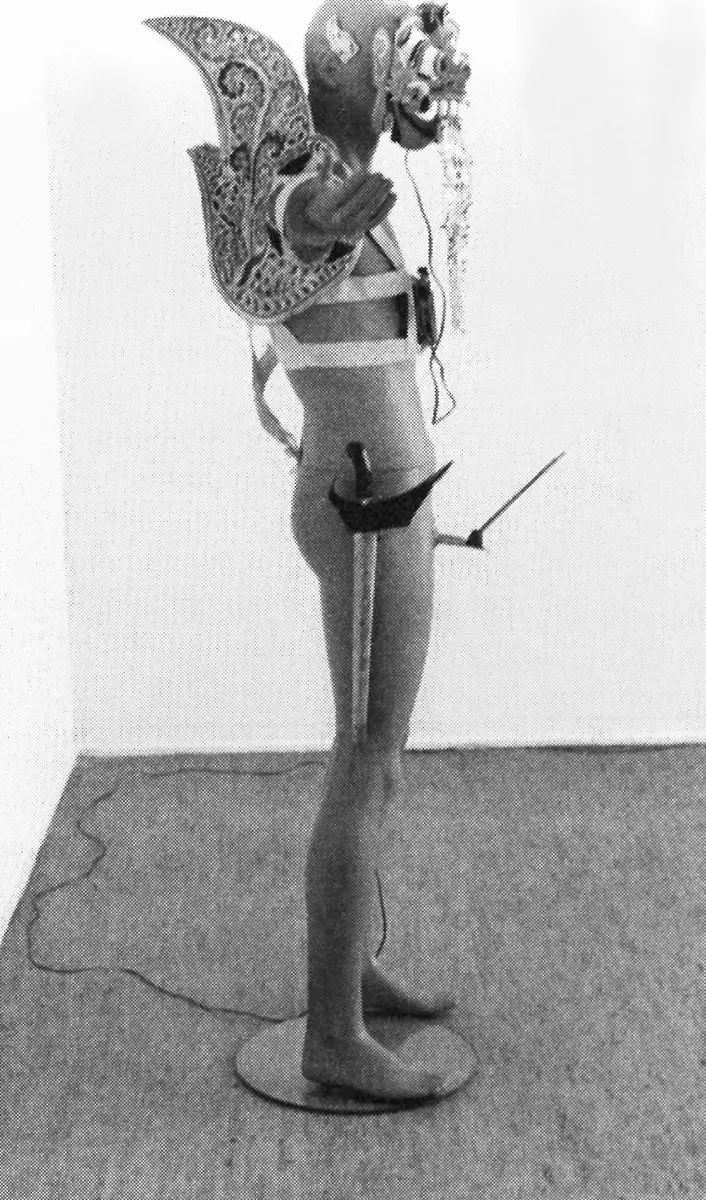
Of the Asian installation artists, one work that caused considerable impact was that of Heri Dono from Indonesia, who used popular and traditional marionettes and masks to create a contemporary atmosphere. As is often the case, the Japanese representation-Japan had partially sponsored the event through the Japan Foundation-was large, with a number of successful pieces, such as the iron bars of Mamoru Abe, the unexpected vertical/horizontal constructivist confrontation by Koichi Ebizuka, the disturbing gigantic worms of Gaho Taniguchi, and above all, the extraordinary spiral construction in wood and brick by Takamasa Kuniyasu, who erected his unusual monument, which was typical of Japanese culture, in the University Park. Nine people worked non-stop for almost a month in order to complete this allegory of time that produced the greatest effect (and was the largest work) in the entire show.
Australia had the largest number of exhibits. I do not know the reason for this - perhaps it was due to the almost continental size of the country. The objective here was to establish a dialogue between two cultures. There was the "first world" Western element, with some varied, ingenious, and well-executed installations, and the "winged" stones by John Turier and Nicola Hensel though for the most part, the message and meaning were not much in evidence. There was also the impressive and handsome display of bells, in part of the basement, by Nigel Helyer.
Paintings by 56 Australian aborigines were done on canvas, a "modern" approach for a growing market (originally they would have been done in colored sand). There were some handsome designs, lines and structures, ranges of color, and soft tones which recalled the earth with a dominant topography characterizing the morphology of the paintings. Some were landscapes, almost landscape ideograms, with a scriptural element in many of the works: Here the artist was still clearly very close to nature.
These are the paintings of anonymity or paintings by artists about whom we know nothing as regards their past and present production. They have complicated names mixing between the indigenous and the anglofonous. But the most contundent last name, maybe an artist's nickname, was Helicopter.
With the exception of the aboriginal artists and a few painters from Kassel, and the exhibition in the factory (which I saw very quickly), the installations were the most impressive part of Inside.
Without a doubt professor, Hamdi El Hattar is a very unusual personality. What he and his collaborators in Kassel are doing for the “others"— for the cultures and expressions of the so-called “peripheries" is of immense and marvelous value. His repeated and successive achievements demonstrate that in a time of high technology and globalization, there are still some triumphant individuals around and utopias left to aspire to.
MARIANNE DE TOLENTINO