
For Víctor Hugo Irazábal (1945), a work of art is a long process in which both work in situ and meditation in his studio not only allows a precise formulation to be determined but provides a coherent basis for the discourse that has evolved over the various stages of his career.
As an artist, Irazábal has worked in drawing, design, and collage using different and modest materials, as well as in figurative painting. But from the time of his first exhibition in 1987, the figurative referent has been in crisis: rather than the fidelity of the object, what he was interested in was the climate that the latter generated, the code which made it up, the presence of drawing, color as a language involving a possible subject.
Soon Irazábal made the decision to explore territories whose isolation from the dynamics of the country went hand in hand with their cultural importance. First, he traveled through Paraguana, which resulted in the work of his exhibition in 1990. He then began his research in the Venezuelan Amazon, which has marked his work and nurtured his vision of the world and art. It was this southern region, where the artist still spends long periods of time, that gave rise to such exhibitions as The Route of Humboldt In the Orinoco (1992), in which the imprint/writing, in water, stone, and the body becomes evidence of living kingdoms in a process of exchange. This was a painting that proposed a different version of the synthesis of the figure and the relevance of the material. There followed another individual exhibition, Amazonia: Sensitive Signs (1994), which first of all reaffirmed a sense of continuity with himself, and second, an understanding of the Amazon which had nothing to do with anecdote or rhetoric. Thus we come to Sakedi, which as the artist explains, is the Yekuana word for painting.
Sakedi is a painting of the essence which is language. The indigenous communities use geometrical design as the basis of their referential and decorative world. The abstract lines symbolize beliefs and represent nature. The learning of this writing and its transformation into a contemporary plastic language are characteristics of Irazábal’s research in the 1990s.
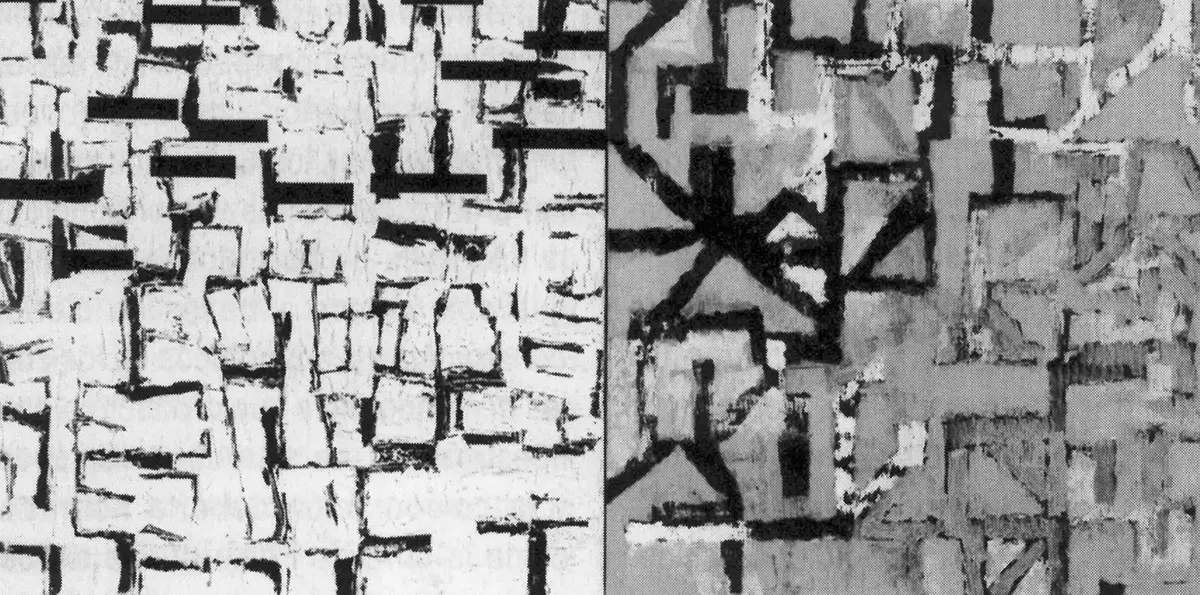
The work is presented in the form of diptychs, triptychs, and polyptychs, most of the time based on an opposition between images. There is an intense interplay between drawing and painting, pencil drawing and another drawing in other technical resources; between the line of the surface and that deeper line resulting from fissures, "prints" whose gesture is the work. In the same way, there is an important dialogue between the image associated with contemporaneity in the idea of the computer screen and that which refers back to the ancient cultures.
The general tone of the exhibition was monochromatic, with dark, muffled tonalities, burned reds, and an evident interest in texture, things done by hand, and the concept of programmed art. The work titled Caura provides a link between the earlier and the new period, with earth, the control over pictorial elements, and the evocation of indigenous instruments acting as the axes of the piece. In Madaawaka, the language is based on signs. When Irazábal uses acrylic lacquer, he manages sometimes to pay a just tribute to the Coloritmos of Otero. If that were the case, then the novelty of his work would become part of the tradition of art in Venezuela. But Irazábal burns, alters, and breaks the preciousness of the finish. In Medofedi, the image on the left recalls a computer screen, while the one on the right recreates the concept of stone and rupestrian painting. While Konojo is a triptych that condenses the artist’s entire process—the closed and labyrinthine signs, the texture of earth and purity, and the thick black strokes establishing another kind of aesthetic order.
Finally, the idea of the alphabet, that is, both painting and art, was present throughout the exhibition. This could be seen in Manaade, where the elements of this possible alphabet are enlarged and joined together and therefore presented illegibly— they were interesting as a visual event, rather than as a text in particular. Yododai shows on the right coupling of texture, the verticality of lines, which are fine and half-hidden and half-inclined, unlike those on the left, which are brief, luminous, and semi-upright. This work may well be seen as a tribute to Gego.
Lastly, in the Ishi series, the process of which goes back to at least 1994, the narrow strips, carving, and printing acquire enormous importance. The height may exceed three meters and the arrangement outside the two-dimensional plane suggests that the artist feels increasingly attracted to the presence of volume in space.
JUAN CARLOS PALENZUELA