
The first period in the work of Viviana Zargón (1958) reflects the influence of minimalism. This is the result of her experiences in the Faculty of Fine Arts of Barcelona at the beginning of the 1980s. On returning to Buenos Aires, she entered a different current, the post-modernist "new image." The minimalist purity of her early "calligraphies," in which order and the search for the sign predominate, gives way to the need to depict a contradictory world in which figures from the past, present, and future cohabit. These erratic actors, sometimes presented as enigmatic fetishes of childhood, circulate uncomfortably alongside elements taken from the classical tradition —columns, fountains, pedestals— as the strange occupants of a motley and chaotic setting.
At the beginning of the 1990s, Zargón introduced quite a few changes in the methodology of her works. As in her early "calligraphies," her paintings from the 1990s, with their more natural and tranquil tonalities, are governed by a rigorous sense of order (the elementary square pattern). This resulted in the series of —urban landscapes—, in which she questions the traditional notion of the frame as a fixed and unmovable limit. The edge thus becomes integrated into the main body of the work.
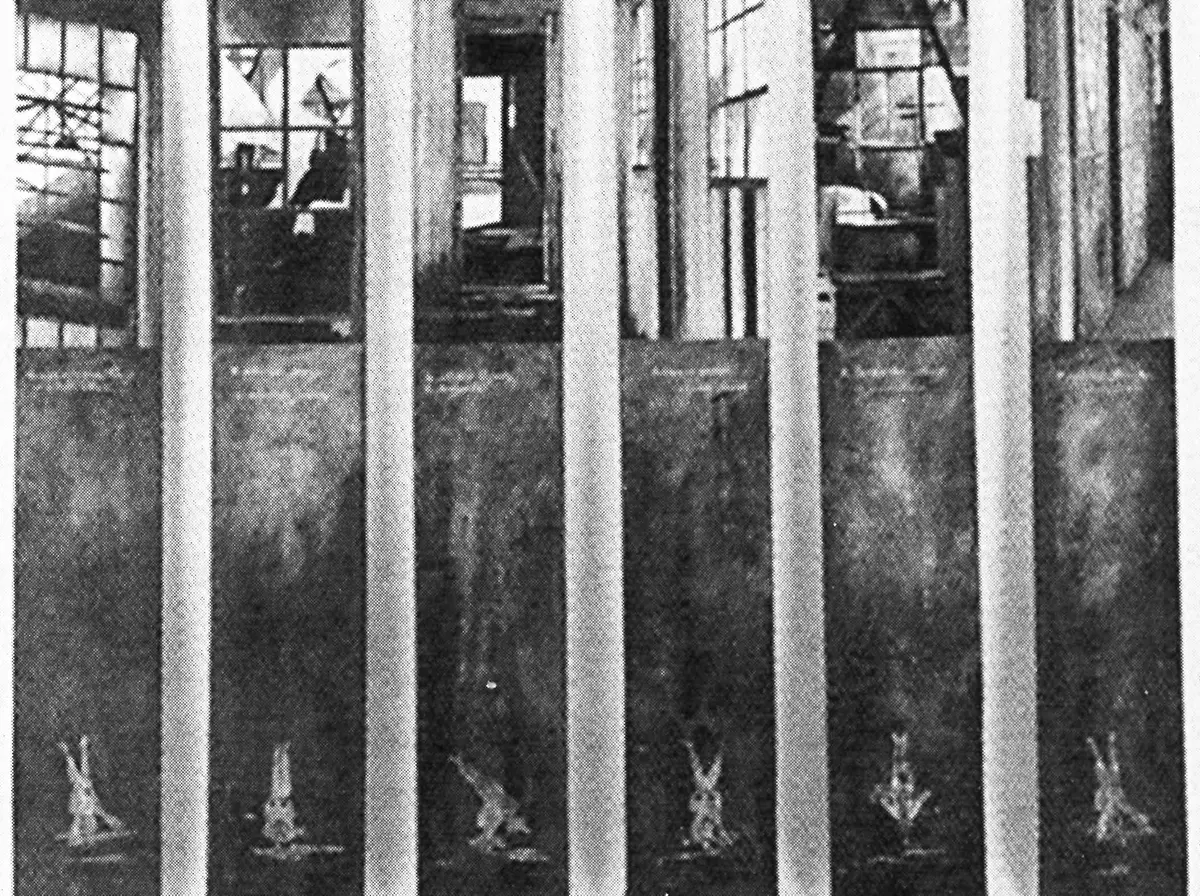
The transgressing vision of Zargón explored new solutions in the series of paintings that she recently presented at the Filo Gallery. The questioning of the canonic idea of the singleness of the pictorial support and the continuity of reading is expressed through the division of the picture into two apparently unreconcilable parts. In the upper part, which has a photographic appearance, there is the same architectural motif: the front of a house in a state of semi-abandonment, and the interior of which is also visible. The lower part does not match, in general terms, the iconographical code: it is the space of the text.
In these works, Zargón alludes in general to the inseparability of the image and discourse. She highlights the condition of thought as a complex made up of statements and images, although the traditional iconographical canon obliges us to “clean” it up and eliminate the "word." In this way, process and work come together as a “final” product. If there is something that characterizes this new stage in Zargón's work, then it is its deconstructive character, the way it foregrounds the mental process of production, in which it is impossible to think without images or to imagine without concepts.
But Zargón's paintings do not talk only about painting. The artist also digs into her personal memory. She speaks about the house and home as a place of belonging, different from non-places (Marc Augé), and in doing so, there emerges the feminine vision of care for such a place, obsessively captured in different planes and from different perspectives.
Curiously, it is not in the upper part —of the house— that we find the human presence. The habitat, when uninhabited, is thus defined in terms of solitude and the sensation of emptiness.
The human beings, schematically drawn in positions of precarious equilibrium, appear in the lower part of the picture, alongside numbers, formulas, mathematical equations, and texts which attempt to define concepts concerning both painting and the external world: harmony, equilibrium, lightness, gravity, order, and proportion.
The spectator is invited to relate the two parts of these original compositions, uniting what is divided. In
the process, space must be left for the spectator’s subjectivity and the free play of associations. From the area of the images and the connotations suggested, the spectator can move to the area of the text in the search for confirmation of some vague hint or suggestion of meaning. In some cases, this meaning will be clearer than in others, as when we are able to corroborate the connotation of solitude in the image with the transcription "absolute lightness" in the text area. However, in most cases, the function of the word is more directed towards disseminating meaning than establishing any definitive confirmation.
This show, which was initially presented in the Filo Gallery, will subsequently be shown at the Sicardi-Sanders Gallery in Houston, Texas, at the beginning of 1998.
ELENA OLIVERAS