
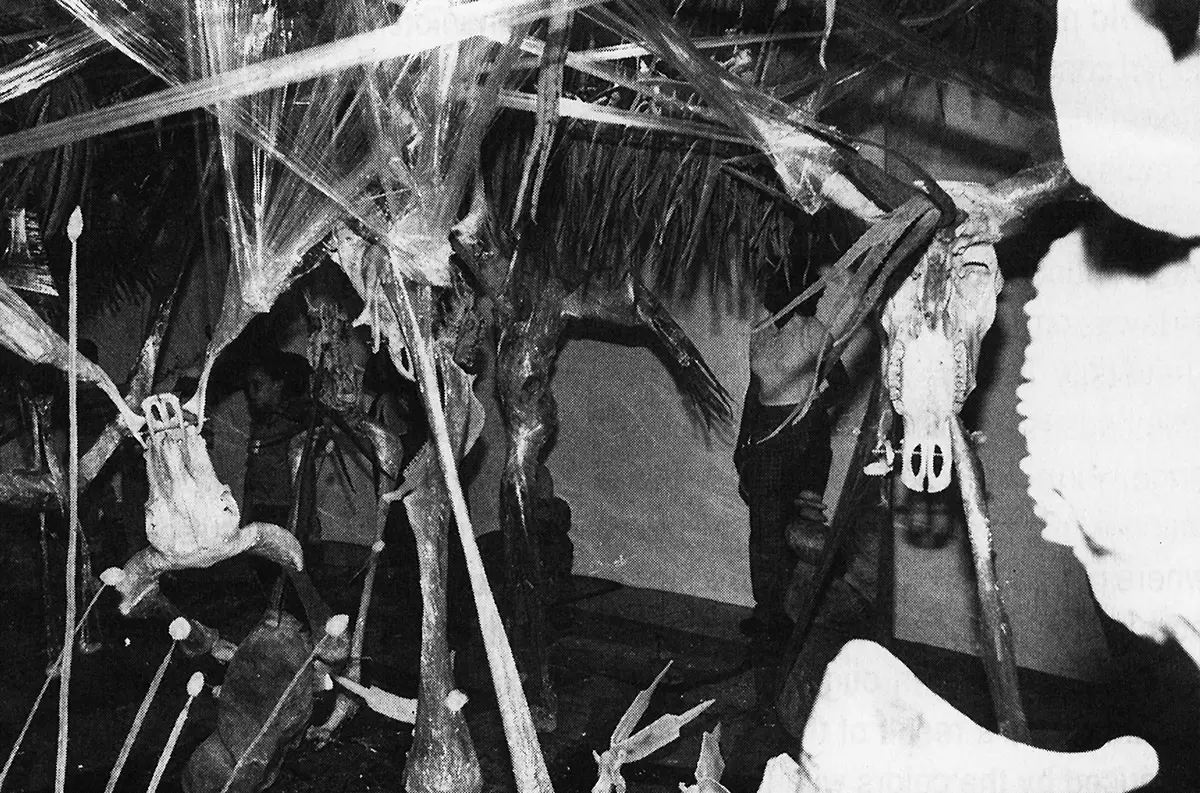
The intimacy and introspection of an almost secret undertaking, as well as laborious research over a wide register of materials, accompany the profound authenticity which characterizes Ali Hernandez’s Purification Cabin, recently presented at the Alejandro Otero Museum. The artist reveals his mastery of the most rigorous requirements of an installation. This begins when the visitor is enveloped by and trapped in an authentic micro-universe that, in the midst of its diversity, offers an atmosphere that is unusual, absurd, and unknown. This is not merely an aesthetic experience, but rather a moving sense of something felt which is totally different. Experiences emerge from relationships structured according to exclusively rational criteria. On the other hand, what is felt here is the result of intuitions and sensations which are too intriguing, hidden, and mysterious to conform to the logic of an exclusively intellectual interpretation.
The spectator does not feel that he is in a strange place but rather that he is submerged in an ecosystem of which he too is part. The sensations produced by the breaking, cracking glass, as well as the sounds produced by the water, combine with the dissimulated sonority of astonishing elements which breath with the fullness of someone who feels at home in their natural environment.
An installation is more than just the gathering together of pieces in the manner of an individual exhibition. It is also something greater than the establishment of relationships between different elements of the same discourse. An installation is not a window, a stage set, or a screen. In other words, an installation is not the formal sum of a group of works or the diligently sought combination of speculations. Rather it is a synergy in which the whole is greater than the sum of its parts, and which the testimony of the whole evokes the atmosphere and nature of something which cannot be presented. As Lyotard said: "the sublime is the presentation of that which cannot be presented. With the sublime, rather than the search for pleasure and aesthetic enjoyment, there is a sensation and feeling of displeasure."
Hernandez's Purification Cabin has the characteristics of a micro-space that is transformed, through the artist’s craft and grace, into a micro-universe where many things happen in which we become the protagonists. The sensation is absolute and at the same time moving, so much so that "we feel that we are the support of something which is actually supporting us, the limit of what is actually limiting us" (Octavio Paz). For this reason, the apparently uninhabitable saturation of the work becomes the best kind of invitation for us to join this meta-diversity which involves the enigmatic co-existence of bones, aloes, glass, stones, water, bottles, plastic, and other waste materials. To paraphrase Jean Baudrillard, we might say that Ali Hernandez achieves the "metamorphosis" of his elements through relations associated with "metastases" and the generation of a plurality of "metaphors." Within this framework of metamorphosis, metastases, and metaphors, the different resources cease to be waste materials and acquire reversibility within a multi-faceted discourse.
The synthesis could not be any other: here, there is invasion mingled with ambition, as well as aggression and commotion, where everything is brought together and harmonized within a contradictory and chaotic environment. This is the great paradox that enables us to recall the disruptive, unpredictable, and complex nature of our contemporary world. Ali Hernandez establishes a strange kind of cohabitation between the peace of a settled ecology and the rarefied aggression of what is absurd. Dreams, fetishes, and archetypes, combined and confounded with everything within a powerful syncretism, make up a work that was born out of the humility of effort, but which has now acquired the highest ambition of a novel proposal.
VÍCTOR GUÉDEZ