
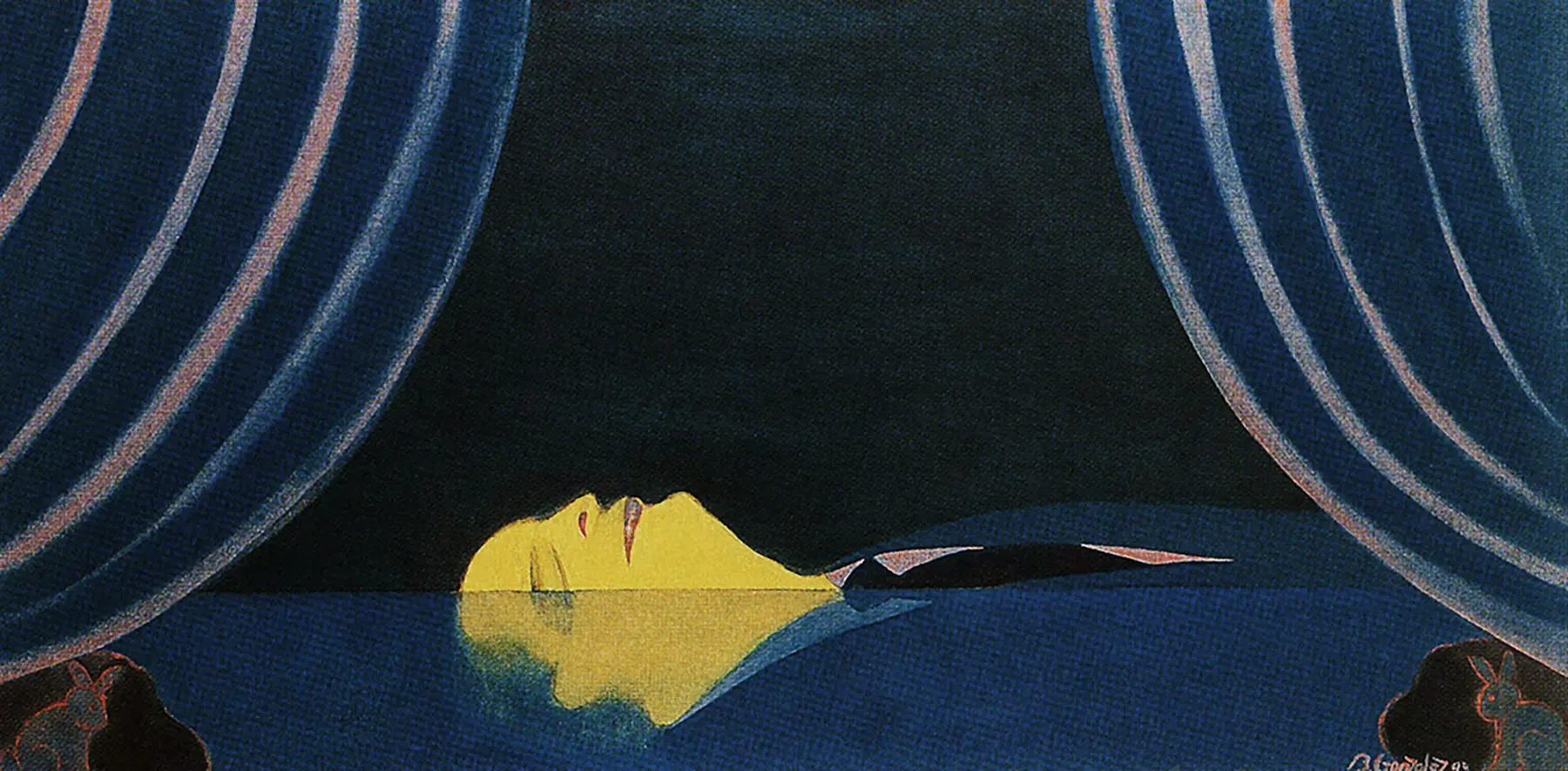
Throughout the history of art in this century, the powerful and crude realities of the countries of Latin America have frequently conflicted with the aesthetic models from the centers situated in the northern hemisphere of Western culture. From the constructive universalism of Torres-García or the anthropophagous utopia of Oswald de Andrade to the most recent cultural surveys of identity and difference and multiculturalism, a good deal of the best in the continent's art has been produced in the context of the questions raised by these contradictions.
The equation proposed in the work of the Colombian painter Beatriz González, in this retrospective show covering more than thirty years of her production, is startlingly effective, and its terms examine the problems, from the standpoint of painting, of many layers and folds of meaning at the aesthetic and political levels.
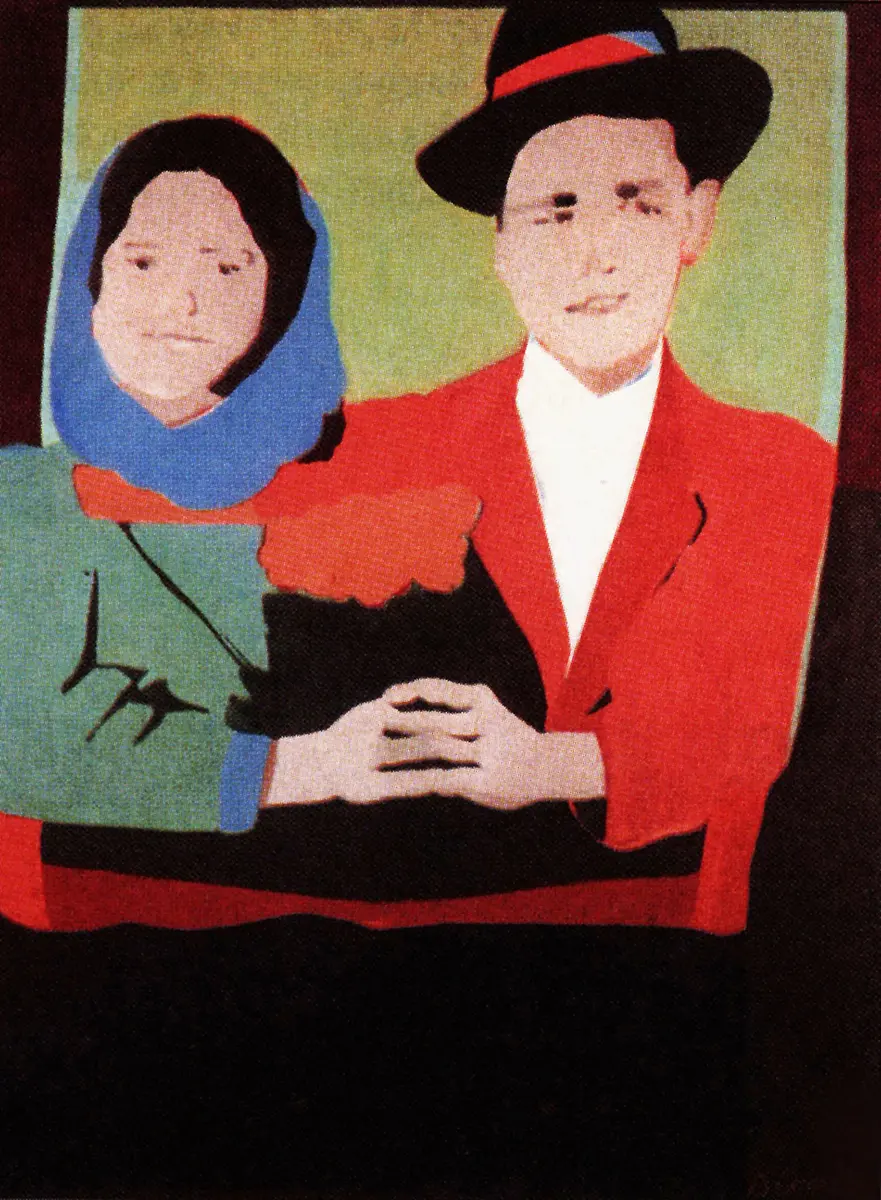
Colombia is a country full of tragedy. The period of its history (in the 1940s and 1950s) corresponding to part of González's childhood and adolescence has been purely and simply labelled The Violence in the history books. The work from 1965 that opened the exhibition, The Suicides of the Sisga, already established coordinates that were to define the rest of her work. The painting is flat, the colors are strident, almost joyful, and the image is based on a preexisting representation, a photograph published in the local press—a feature that distinguishes the entire series. It is a painting developed on the basis of an iconography intended to expose, in a sharp, acidic manner, the relations of class and the permanent presence of death, which often becomes sentimental or spectacular in the mass media. The innocently happy appearance of the pictures, resulting from the lack of volume of the cutout figures painted in festive colors, paradoxically reproduces the distancing effect that the permanent repetition of dramas in the press causes among readers. The titles are often the same epigraphs used in the photographs published in the newspapers, in accordance with a system that the artist describes as the representation of a representation. This group of works that look forward to her later production is also characterized by two other elements, the exaltation of vernacular kitsch and the politicization of visual strategies of pop in local terms- features that characterize the period from the 1960s to the middle of the following decade. Some artists who during this period used the same procedures and who might serve as a context for the work of González in the south of the continent include Antonio Berni, León Ferrari, Jorge de la Vega, Nelson Leirner, and Antonio Dias, amongst others.
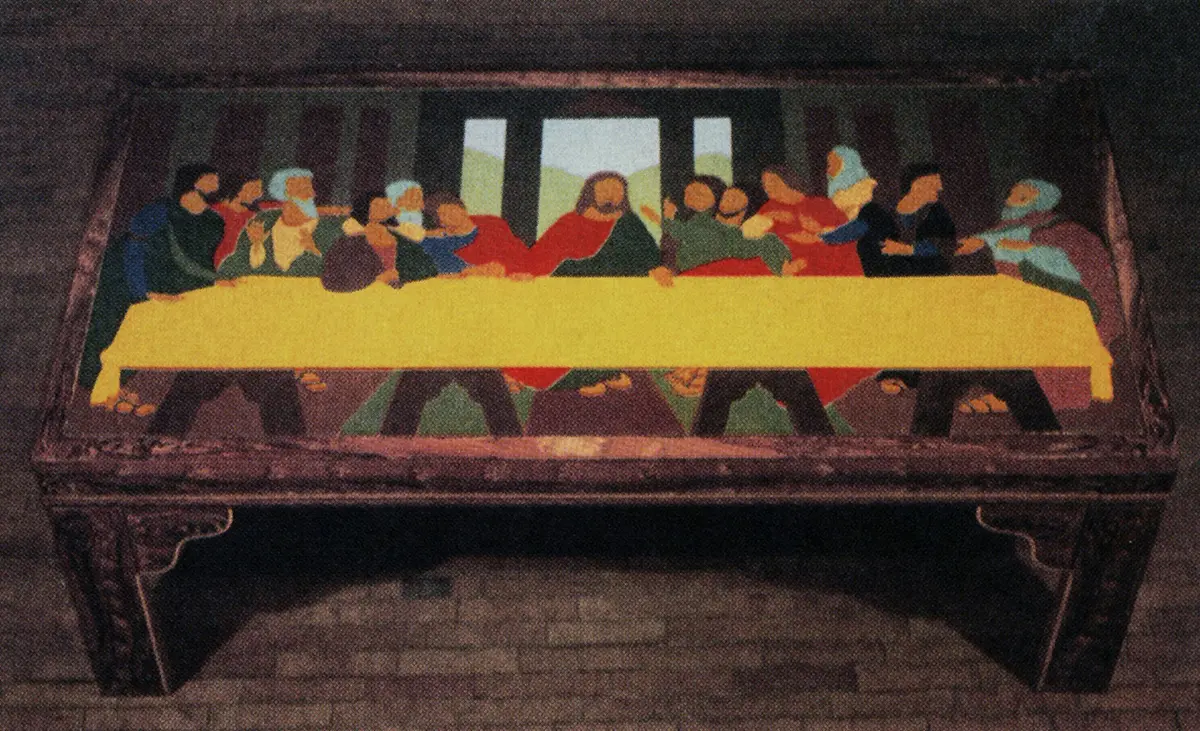
The biography and resume of Beatriz González are those of a committed intellectual. She founded the Department of Education and the School of Guides of the Museum of Modern Art, devoted several years to the study of the nineteenth century, and worked as a curator. This concern with history and education is also clearly reflected in what is perhaps her most brilliant series, represented in the second part of the show, consisting of different pieces of furniture and objects. To label them merely as pieces of painted furniture and objects would be to simplify the process carried out by the artist during this period. The pieces of furniture are in painted tinplate, with the grain imitating luxurious and inaccessible kinds of wood, or constructed in cheap wood obtained in popular markets. They are already imitation and desire, and the parodic bankruptcy of other model kinds of furniture dreams of aspirations towards refinement and "good taste" out of the reach of the masses. The surface shows impersonally painted enamels of key works of the history of universal painting, executed with the manual labor typical of underdevelopment replacing industrialization, and with the same cacophonous colors and representation systems as in the previous paintings. The object or painted piece of furniture has a decisive function in the narrative depicted on it; thus we see The Last Supper on The Last Table (1970), or a female nude by Degas bathing herself in the tub on which it is painted in Degas' Tub (1971). The goal is no longer the critical definition of national idiosyncrasies through the dissection of mass communication media (and their mechanisms), but the reinsertion and rewriting of the history of universal painting in terms that are absolutely codified by the local culture.
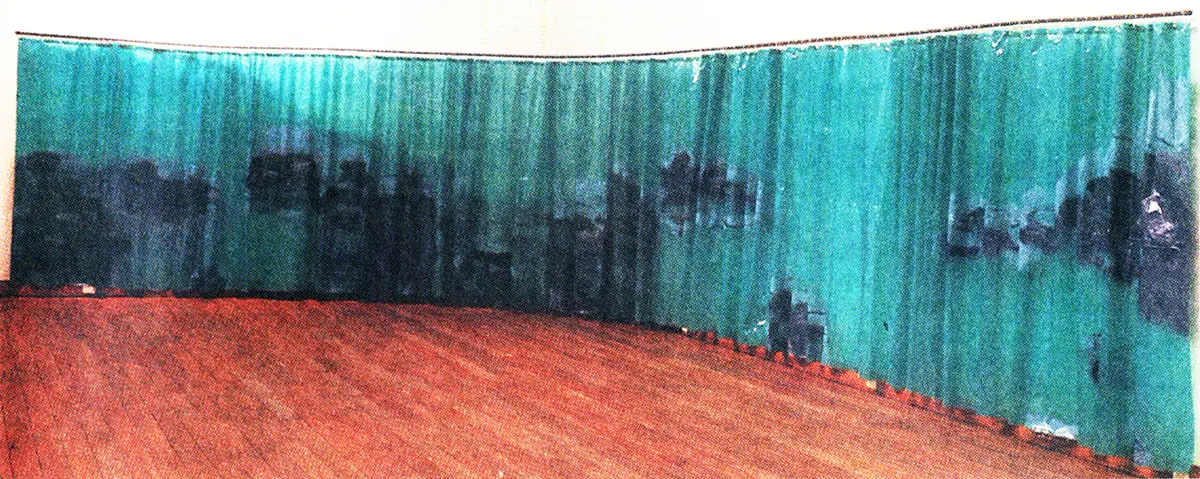
The artist pointed out at the time, "My painting is a sub-printing for underdeveloped countries." The neologism reflects a subtle mocking of the prefix "sub", as well as a more caustic mocking of "painting" itself. It is important to note that the collections of Colombian museums have practically no European works and at the time no shows were being organized to bring representative works to the country; it is easy to imagine the effect of this lack of contact on education and debate. The most daring projects of these appropriations-insertions were not in this exhibition, which presented only one-tenth of the artist's output. Mention might be made, amongst other approximations to the limits of painting and its circulation, of a twenty-foot plastic bath curtain reproducing Monet's water lilies; Ten Meters of Renoir, a version of Renoir's Le Moulin de la Galette painted like a print on paper, cut and sold by the square centimeter in 1978, and a Mural for a socialist factory (which is in the Museo de Arte de la Universidad Nacional), that reproduces Picasso's Guernica in furious color, totally deviating from the original.
The destabilizing conceptual machinery proposed by González functions by entropy at all the levels that it encompasses. Its relationship with the "history" and "universal" vectors is as amusing or distortedly mortuary as its links with popular and political elements. Two little tables show the smiling and irreconcilable figures of the North American democrat John F. Kennedy and the old creole fox Carlos Gardel. Their common denominator and their passport to idolatry: their tragic deaths.
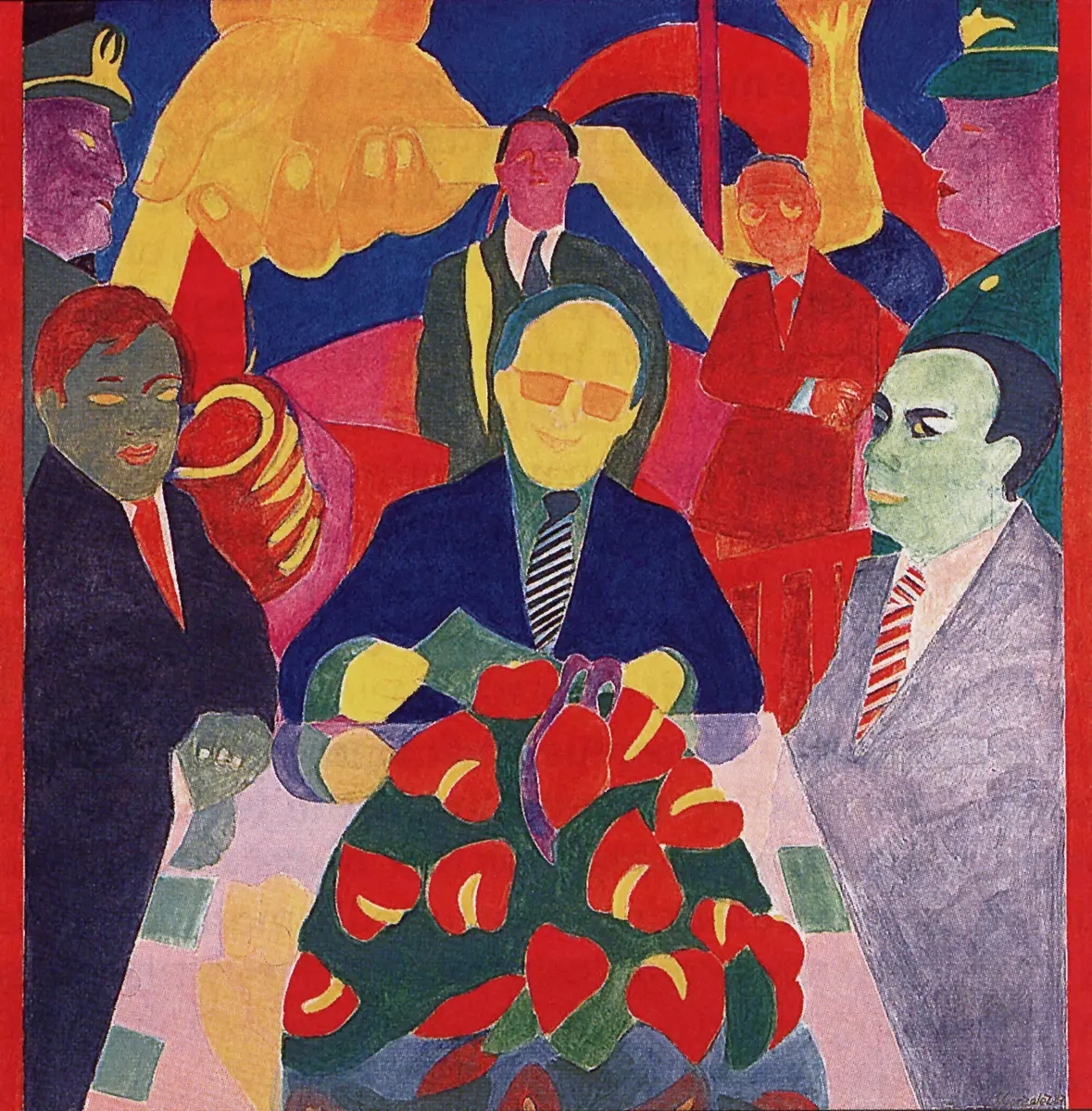
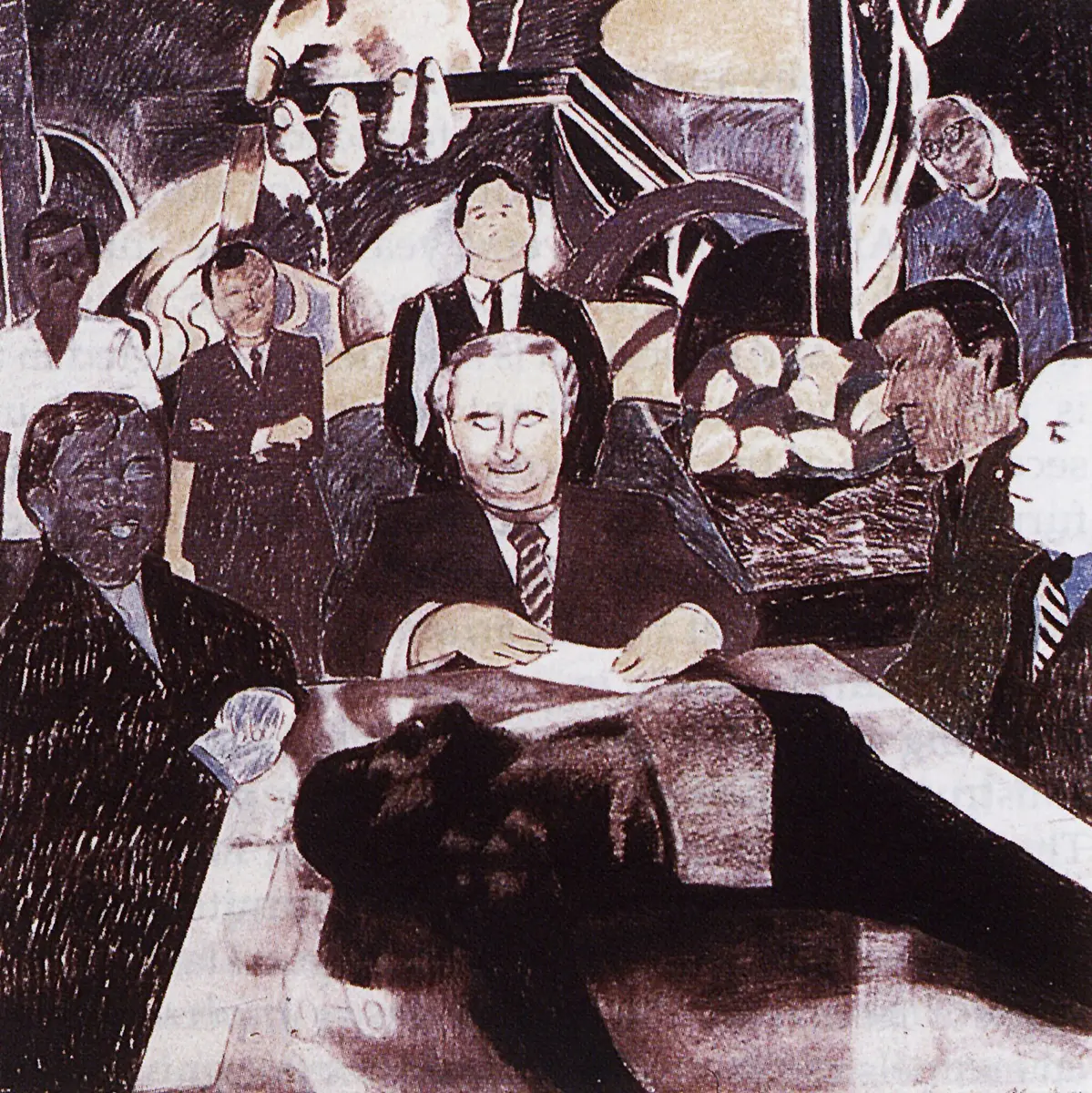
The presence of death, loss, and violence was to characterize, almost exclusively, the aspect of González's work which we might describe as a diary, or documentary, based on a key political event in the history of Colombia. In 1985 the Palace of Justice was taken over by a group of guerrillas. The intervention of the army caused a bloodbath and opened up a period of horrifying decomposition in the political life of the country, which continues today. The work used in the title of this exhibition, Mr. President, What an honor to be with you at this historic moment, is a testimony to the event and introduces the third segment in the chronological cataloging of the artist's work proposed by the curator Carolina Ponce de León. Around a table presided over by the then President of Colombia, the cabinet of ministers is meeting. In the center of the table, we can see futile, colored flowers, done with the artist's typically joyful and innocent sense of flatness. The work is completed with a panel of the same size and a black-and-white charcoal drawing. The composition and the smiling figures are identical to their colored counterpart. Occupying the place of the flowers, an incomplete figure, calcinated, ravaged by fire.
The works of this last decade bear witness to events or specific problems of a political-social kind, although paradoxically they function more as a universal reflection on the tormented nature of the human condition or violence than as a historical, documentary account of a pamphleteering or denunciatory kind. Once again González's use of the erudite field of citation generates other levels of reading. During the nineteenth century and at the beginning of the twentieth-century European culture, led by that of France, begin to make use of other cultures, mainly those from the territory of its colonies. It was during this period that the concept of the "modern universal" was constructed in terms of a central perspective, in which difference would become the defining element in the identity of the other. An exoticizing Orientalism informed the prose of the early Flaubert and the painting of the rivals Ingres and Delacroix (a journey to Morocco and Egypt was a must for this generation of artists). Decades later, Japanese prints brought back by the Goncourt brothers, which explored the possibilities of flat color, would lead to van Gogh's own Japanese series. Gauguin withdrew into his retreat and praised the idyllic hedonism of Tahiti and finally, Picasso fragmented space and de-hierarchized the value of the pictorial-linguistic sign (such as the eye, mouth, ear, etc.) in the style of the African idols. It is the most paradisiacal of these visions of the other, the most stereotyped, that González chooses as the formal vocabulary for the embodiment of her phantasms and trauma: the saturated planes, the compositions with multiple figures (of noble savages), and the ambiguous spaces of Paul Gauguin. The superimposition of colorful exoticisms, that of the citation of the post-impressionist original and that expected of an artist from the land of magical realism, rarefies and dramatizes at the conceptual level what is depicted on the canvases: dead people, members of the military, coffins, women crying, the artist herself in tears.
NICOLÁS GUAGNINI
Artist born in Buenos Aires in 1966. lives and works in New York.