
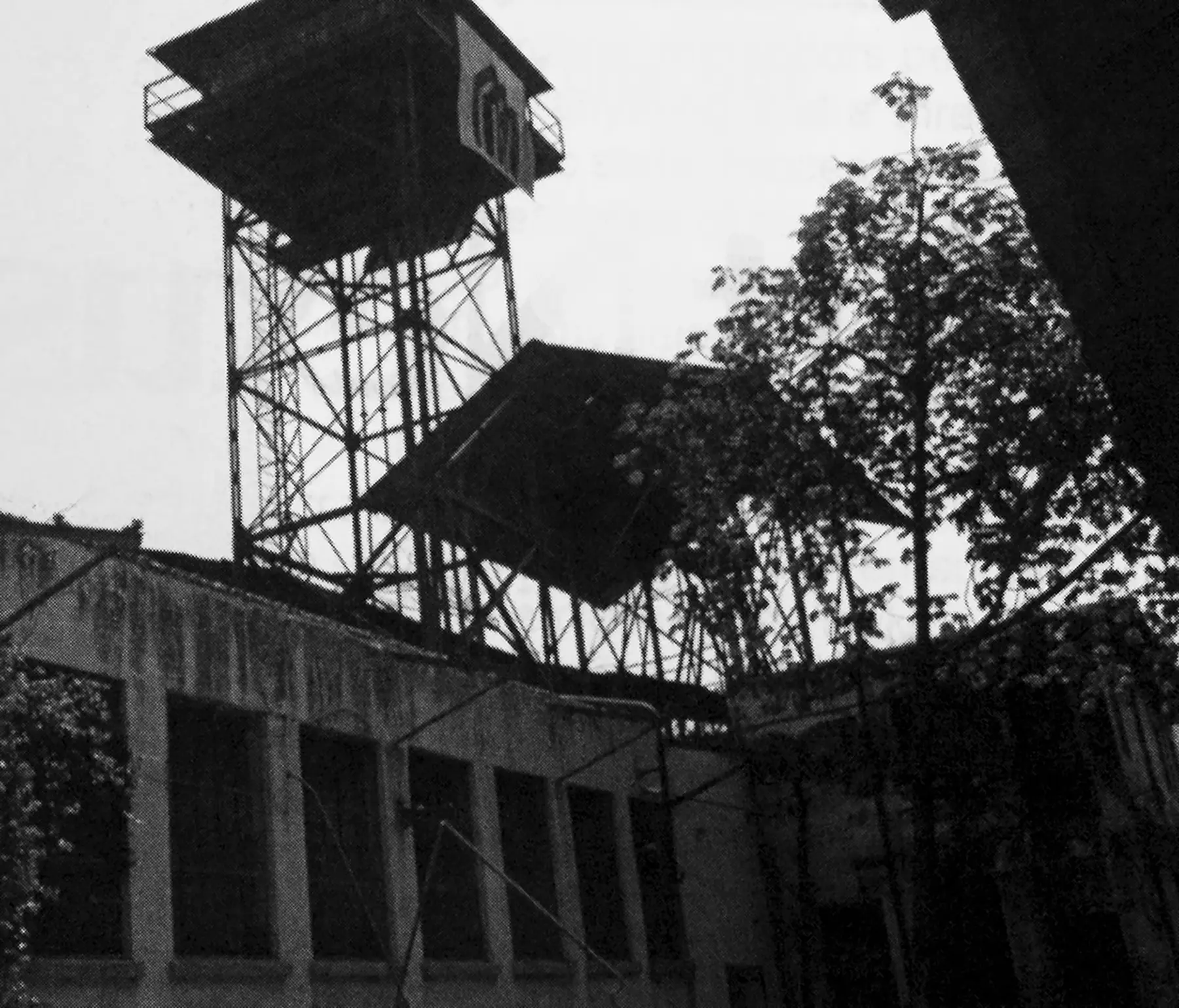
This exhibition is titled Discreet Authorships. Cuba and Venezuela: New Poetics was the first international event of the MACMA held on the premises of the future headquarters of the institution, a former abattoir abandoned in 1958 following the collapse of the dictatorship of General Marcos Pérez Jiménez.
This spectacular location was the venue of the Workshop of Artists in Residence in which four Cuban artists; Tania Bruguera, Luis Gómez, Carlos Garaicoa, and Sandra Ramos; and four Venezuelan artists; Alexander Apóstol, Magdalena Fernández, Juan Nascimento, and Alfredo Ramírez; were invited. The artists were between 29 and 31 years old and all have been recognized for their contributions to contemporary art. Over a period of four weeks, the eight artists were able to share their experiences in the majestic setting made available for the event, thanks to the initiative of the MACMA and the curatorial direction of Nydia Gutiérrez.
The “Ganadera” had a powerful impact on the artists. On the basis of a prescribed project, several ended up producing two or even three installations. The richness of space (including the niches, holes, old machinery, abandoned objects, and enormous storage vaults, in addition to the interesting iron structure itself) fascinated the artists, as well as all those who visited the place.
The exhibition implied a symbolic occupation of the place, in anticipation of the future establishment of the museum. This was one of the reasons why Discreet Authorshipsms is such an interesting event in Maracay. Whereas before the “Ganadera” heralded the arrival of modernity in a city —and a country— that had lagged behind the technological and social progress being made in Europe, this occupation signaled the consolidation of contemporaneity within a museum that is transcending its “provincial” status and participating nationally and internationally in the development of contemporary artistic creation. Previously known as the Model Abattoir of Maracay, there is no doubt that it will henceforth be referred to as the Model Museum of Maracay-industry transformed into a museum.
Visitors to the show found the entrance flanked by a provisional chicken market and a meat market, separated constructions in an area that will form the future reception and security facilities of the Museum. It was here that Juan Nascimento carried out his work. Those who came to buy their chicken and meat perhaps did not notice that their purchases had been placed in bags bearing the name and logo of the Museum. This action lasted for approximately two weeks and involved the dismantling of the traditional role of the museum —and thus the artistic tradition— through the incorporation of humor and banality, turning everyday elements into a work of art.
Before the visitor entered the Ganadera proper, he or she encountered an old abandoned wagon used by Sandra Ramos for her installation. Inside it, she redecorated a bedroom (bed, mattress, lamp, wallpaper, bedside table with a vase, etc.), within a glass enclosure placed around it almost at the height of the bed. Ramos filled the “bedroom” with water as if it were a fish tank. Then to the stupefaction of everybody, dried blood —thirty years old— began to infiltrate, releasing into the air an odor of old meat, a smell which also impregnated other areas in the “Ganadera” and in a sense re-activated the presence of the abattoir.
In the entrance hall, the visitor was presented with a luminous and cleanly finished work-a “penetrable" by Magdalena Fernández (1998), made up of large white pieces of fabric, hanging high up, that proposed geometry of space, verticality, and movement. The installation formed a pure and luminous contrast to the two other works in the next room, deliberately chosen for their lack of light, by the Cuban artist Luis Gómez. Digested Sun and Drying all the tears offered an interesting reworking of the theme of light. In the first piece, in terms of fire and energy; and in the second, through the subtlety of the resources used-water, shadow and light. In the case of Digested Sun, the artist opened a large deep hole to reveal the various layers of the ground. At the bottom, he placed bright lights, with iron covers. The effect was that of intense, solar brightness, similar to that of an eclipse of the sun. Equally forceful and poetic was Drying all the tears, which consisted of a huge boiler found in the abattoir, which the artist used as a water container. A constant dripping motion created subtle effects of light and shadow on the water which were in turn projected onto the ceiling.
In one of the storage vaults —whose walls were still covered with ocher-colored resin, the residue of the frozen meat from the past— Carlos Garaicoa recreated an environment with lamps brought from Havana. Placed on the walls, they provided a very soft light in the space. The work was titled Project for lighting the Saturno Hotel. On each side of the lamps, there were photographs taken at the time when the lamps were recovered, which served as documentation. Similar material brought from Cuba was used in other installations by the artist, such as the video titled Four Cubans, in a side corridor, and the images used in the installation Garden, in one of the final rooms in the show.
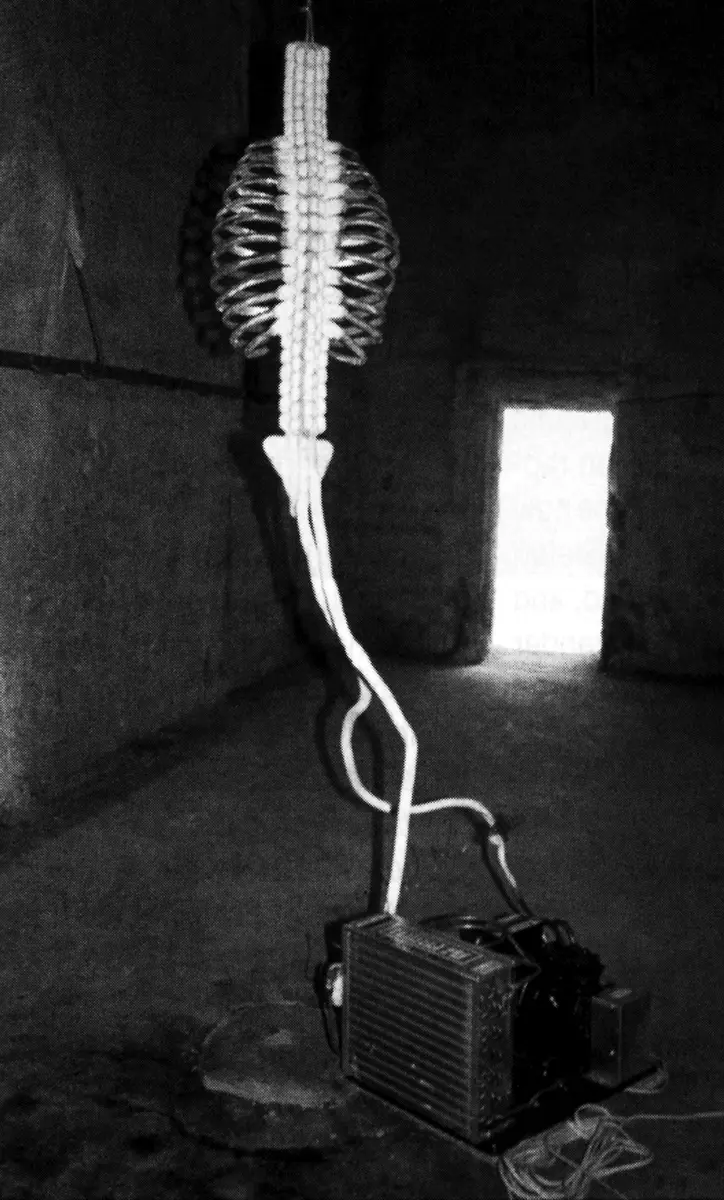
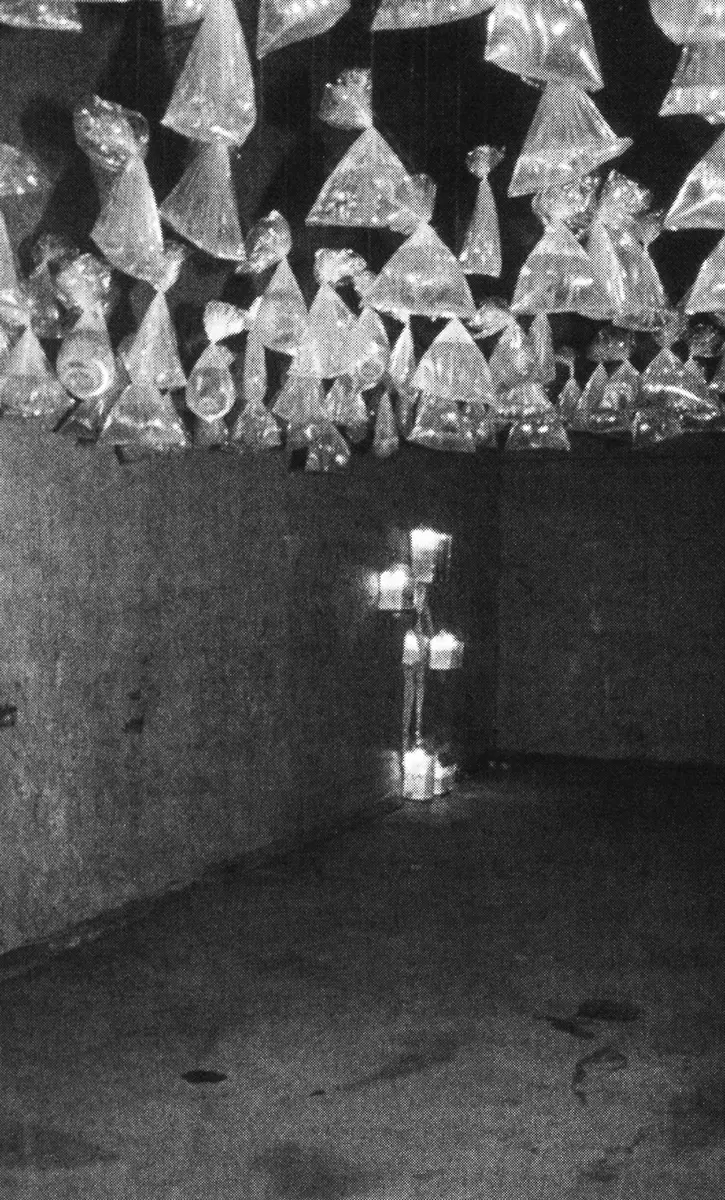
Two works by Sandra Ramos also made direct use of water. Self-recognition of the fish was a self-portrait, with each extremity ending with a fish bowl (containing live fish). Rain, a collection of plastic bags hanging from the ceiling, full of water and with toy babies inside, explored the meaning of life and death by reference to the human body. In a side corridor, shrouded in darkness, was a vertebral column by Alfredo Ramírez, made of bronze which revealed the marks of torture and ill-treatment. This time, with account being taken of the context of the work, it was covered with white frost and ice, a reference to the image of the dead flesh —and carcasses— frozen in the storage vault.
In the following room, one of the most spacious and airy in the building were two works by Magdalena Fernández and Luis Gómez. Between the enormous ceiling rails used for handling and moving the meat carcasses, Fernández presented little red balls hanging from an almost transparent thread, forming a tenuous straight line (21998). Luis Gómez on the other hand managed to start up one of the old machines of the abattoir, revealing to the visitor how it worked, through a mechanism that made its elements move up and down. The work of these two artists formed a contrast between lightness, opacity, and a sense of heaviness.
Equally aerial and creating an almost “levitating" effect was a work (31998) in the adjacent room, one of the most beautiful and handsome pieces by Magdalena Fernández, consisting of red tubes suspended in space and which moved around when touched by the visitor.
Tania Bruguera presented works that explored the imagery of flight in an intense and lacerating manner. Along with two Araguenan artists (Luis Loveraand Roberto Notar Francesco), Bruguera proposed a performance in which the three artists bound themselves with straps inside a structure. This work (Costo, from the series Labyrinth or the empire of salvation) was directed toward a vanishing point of light in the air. As Nydia Gutiérrez said, it created an existential sense of flight and permanence, sensations that in one way or another related the work to the situation and context of the country. In Decision, from the same series, Bruguera continued her exploration of the imagery of flight by tying herself to a kind of machine with wings above the space through which the cattle passed into the abattoir.
At the entrance to the “Ganadera", Alexander Apóstol was present with his inscriptions painted on the wall, which placed the visitor in the position of pieces or counters in a game of Monopoly (Monopoly Abattoir). As the visitor proceeded towards the various rooms, he became caught up in the ups and downs of the game, sometimes winning, sometimes losing. Apóstol's work is a constant critique or mockery of certain established conventions in the world of culture, and more specifically, the museum. He does this through signs and signals, panels, and photographic representations that offer an ironic commentary on the pre-determined roles of individuals and institutions (Building and Representation respectively).
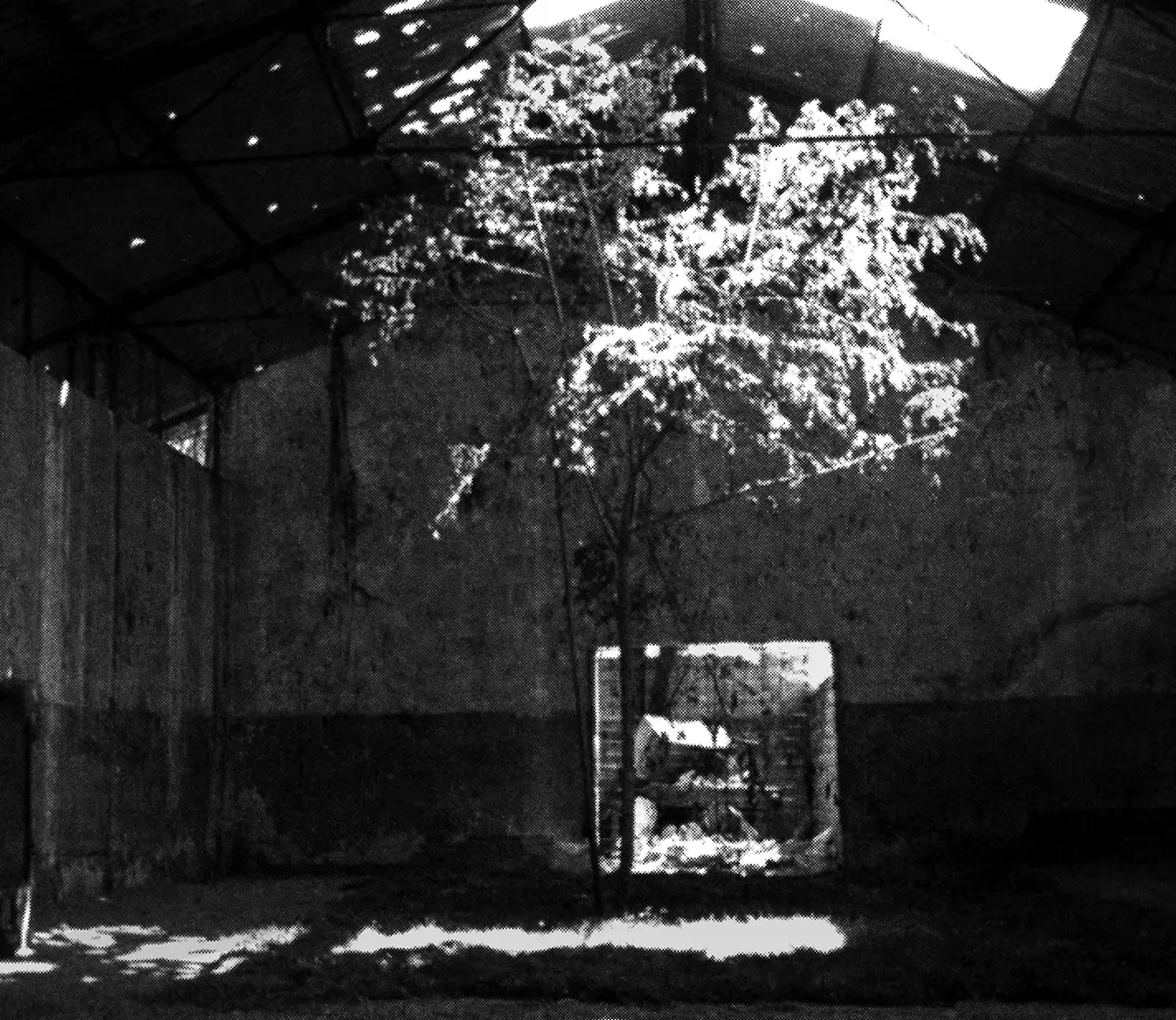
Finally, the show concluded with a work entitled Garden, by Carlos Garaicoa. This installation required the transplantation of a tree from the outskirts of the abattoir, which by chance was similar to one photographed in Cuba (a digitalized, enlarged photograph placed on the ground). Surrounded by the fresh grass, the image was contrasted with the ruins of a city.
Discreet Authorships. Cuba and Venezuela: New Poetics was the result of an interesting curatorial proposal. The starting point was not one of the pre-established concepts but emerged through the cohabitation of several artists within a prescribed space. The exploratory and analytical workshop established the bases of the exhibition, and the creativity and criteria of the participating artists were fully respected. The event was followed by a Training Seminar, at which I5 invited artists from throughout the country to exchange ideas on artistic creation at the end of the millennium.
SUSANA BENKO