
A new series of works by Doris Salcedo is traveling between New York’s New Museum and New Mexico’s SITE Santa Fe. Although her work has been exhibited extensively since 1992, this is the first one-person museum show for the artist who lives and works in Bogota.
Following Salcedo’s work, this review takes locality and distance as points of departure. Transport also inspires the form of this review; it is a postcard from New York. Although these lines will travel some distance, the view they present is inevitably a local one.
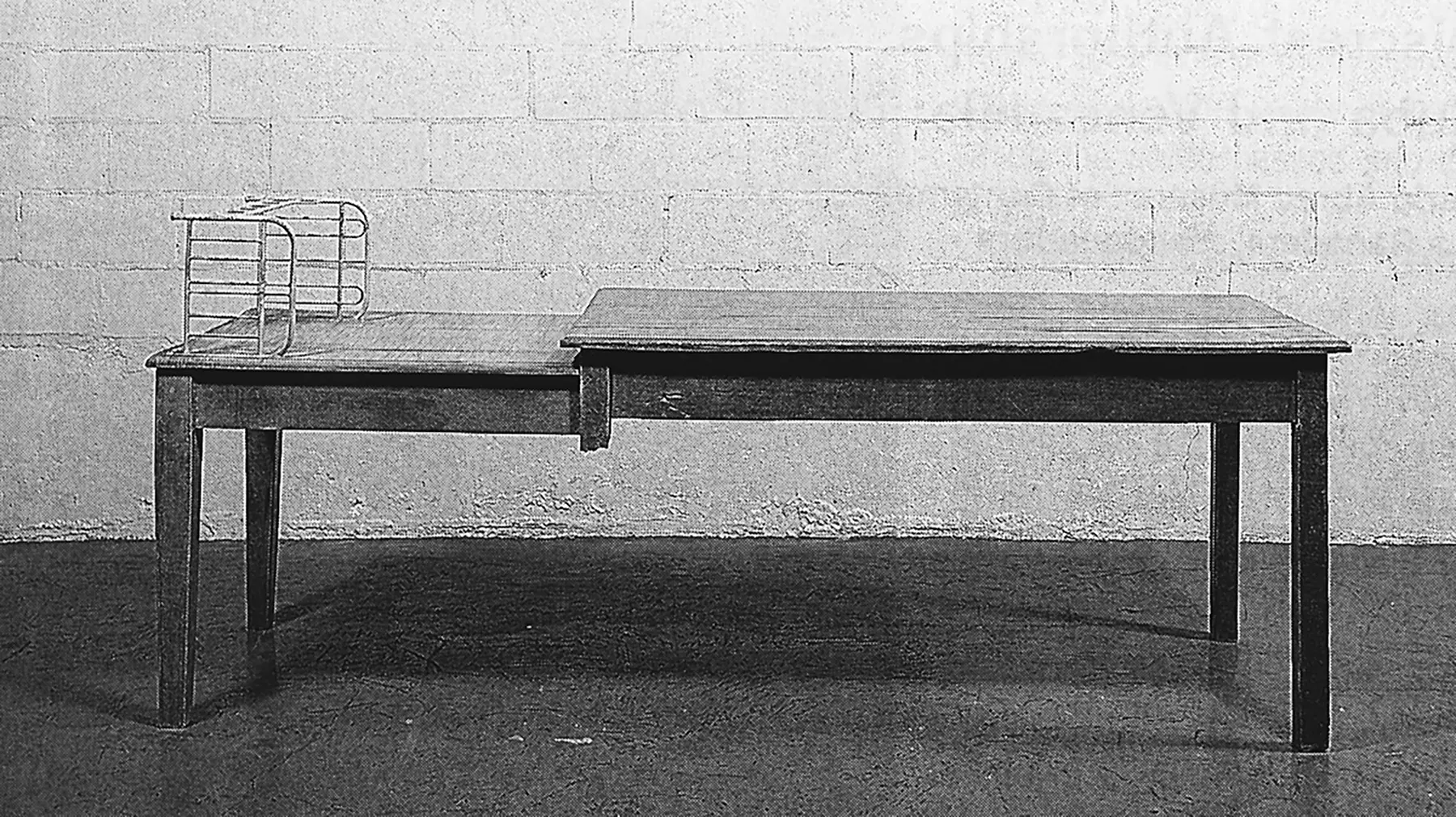
Since the best part of a postcard is the image, a caption is in order. Photographs of Salcedo’s works pale in comparison to the experience of viewing them. What the photographs miss is the relationship of Salcedo’s forms and materials to their surrounding environments, and their context. Salcedo alludes to Robert Smithson's non-site in her title Unland. Simply put, the non-site is not a location but a process. The substitution of the prefix also references the uncanny. The German word unheimlich defines the familiar turned foreign and haunted. The non-site and the uncanny are both spatial concepts; one travels an exterior and one inhabits an interior.
In the New Museum installation, the three Unland works are placed on the far side of a single gallery. Salcedo tends to make her viewers feel that there are certain places in a room that are more important than others. This is a constant in her installations. It is often after traveling some measure of distance that the viewer arrives at the work. The space left empty, the negative space, takes on the connotation of a passage.
Each of the three Unland works is formed by the combination of two mismatched table halves. The tables are long and low. Their type is closer to institutional tables than domestic ones, but they are neither in particular. This mismatch between the two halves is more reasonable than expressive. Their join is a seam rather than a collision as if two images have come together, or two thoughts.
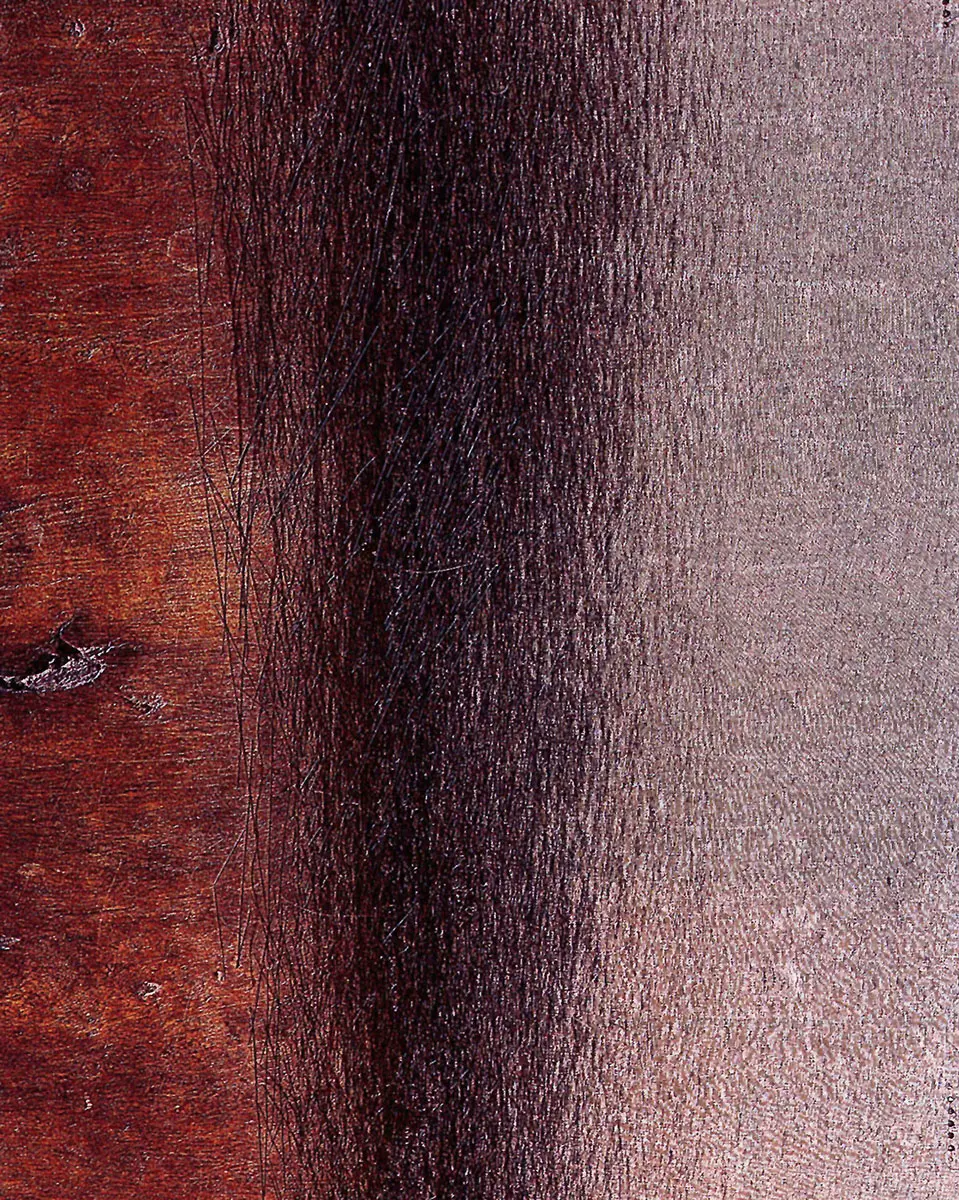
Each table bears a surface that is made from layering fine strands of hair, thread, and silk. After a period of looking at the surfaces, the tables lose their connotations as objects found or made, and begin to take on the quality of structures. Each is a field that organizes information. The surfaces are wrought from real materials, but they also read pictorially. Visually, the passages of dense and delicate handwork dissolve into sheer washes of texture. Other critics have noted the obsessive process. Individual hairs are woven into nearly invisible holes. They imagine a picture of so many hours of hands working. I was surprised by the outcome of this arduous procedure. Although the handwork remains visible, the surface is strikingly opaque. The making turns over on itself, effacing all that the threads tell us must have happened there. In this way, the marks are both literal and abstract.
Each Unland work records a limit: in the cracks of the tabletops, at the borders where the two halves meet, or at the table’s edges. For example, Unland: the orphan's tunic represents a transition from dark hairs to white threads in a stripe. The sewn mark sits just beyond the seam between two table halves. Through it, two monochrome panels meet and merge. The brown and white strands leave a trace like a watermark. These surfaces are not organic metaphors per se. If they depict anything it is a threshold or a dynamic state. Processes such as the condensation of moisture and the fading of a photograph come to mind.
The tiny hairs, threads, and holes in the surfaces activate an extreme shift in scale. Viewing these works involves a splitting of vision into two bodily positions. The sheer, woven surfaces require a close-vision looking. The size and placement of the works direct an ambulatory viewer around their perimeters. Here is where the photographs fail us. The gap between the two distances keeps the camera from conquering the objects. The photograph is an apt analogy for the flickering of two kinds of vision in Salcedo's Unland works. The thinness of hairs and threads allows a crossing of the threshold of image and material, weaving together the virtual and the substantial in the viewer’s field of perception. Like in photography, where presence is recorded as an absence, abstraction and figuration intersect.
Sculpture since minimalism uses the power of real space and literal materials. Its forms and structures can be abstract, its materials are not. This kind of sculpture occupies space in a physical sense and displaces it since an extension of the experience of the work occurs in the viewer’s perceptual field. What happens in the Unland works locates itself along limits, through cracks, and across surfaces. How does my postcard address Salcedo’s public meaning? My close vision is meant to illustrate Salcedo’s dialectical understanding of aesthetics and politics. in some versions of modernism, art occupied an autonomous sphere, defining itself in social terms only indirectly. Here the corresponding physical plane is the detached eye of the optical function. Salcedo’s art is hardly autonomous, but it borrows the two kinds of vision, optical and bodily, to sculpt an aesthetic language for her activism. The unspeakable violence in Colombia that Salcedo's work records are shot across great distances. How could a collision of the catastrophic and the artistic be otherwise?
Smithson writes in a letter of May 1969, "The non-site... discharges history, abolishes site, annihilates the present existence through the last existence..."1 Paradoxically, the words Salcedo remembers from victims’ testimonials form the basis of her work. Some objects are recovered as well and reused in her sculpture. However, duration is Salcedo's process. Narrating her work too quickly fixes the process of haunting into mere ghostly images.
Salcedo’s vision is dialectical. It oscillates in the vast distance between individual memory and collective historical consciousness. A detached eye experiences the physical power of her sculpture, just as the uncanny haunts the eye that is closed. The public reading of Salcedo’s work discharges in powerful, literal terms. But each release is private. In Doris Salcedo's Unland works, the force of historical memory rushes into the narrow field of visual art.
NOTE
1. Facsimile of a letter from Robert Smithson to Dan Graham, May 1969. Robert Smithson, Pierogi 2000 (1997). Op cit.
RHEA ANASTAS
Candidate for the Graduate School doctorate at the University City of New York. Contemporary art writer. New York.