
Enio Iommi is one of the most
outstanding figures in the Argentine sculpture.1 His prestige has been
uninterrupted. In various stages, from the forties to the present, he has developed
an extensive production of work that took into account the historic changes he
lived through, always open to the transformations they required.
Because of this attitude toward art and life, Iommi is a creator who has retained an unusual relevance. His thinking—young, vital, rebellious, and critical in the extreme—leads him to reject the comfort of easy gratification as well as conformity with his own choices. On more than one occasion he has turned upside down earlier concerns, achievements, and artistic resolutions for which he had been amply recognized.
The Fourties: The Phase of Concrete Art
Iommi’s production is typically divided into two large phases that are not only distinct but, at least in appearance, antithetical. The first of the two—that of concrete art—spans the years 1945 to 1977, while the second begins in 1977 and extends, with some deviations, to the present. Taking critical reductionism to the extreme, one might say that if in the first of these phases there was an imposition of style; then in the second, the cry erupted as a consequence of the urgent need to bear witness to the injustices, the violence, the moral contamination, and other latent or manifest terrors existing in society.2
In the forties, in line with the principle that “nothing is more concrete than a point, a line, or a geometric shape,” the artist conceived his works based on mathematic relationships, excluding all types of “figurative” illusions (of depth, volume, perspective, or movement) that abstract artists tended to call upon. This exclusion eventually became the conceptual axis of the Inventionist Manifesto subscribed to by the members of the Invention Association of Concrete Artists which in 1946 was composed by Iommi, Tomás Maldonado, Alfredo Hlito, Raúl Lozza, and Manuel Espinosa, among others.
Separating themselves from illusionism, the concrete avant-garde, in synchrony with the European avant-garde, was responding to the desire to integrate the art of everyday life, mainly through architecture and design. In this way, they took part in the optimism that followed the end of World War II when it was believed that Argentina was destined to occupy a privileged place in the international arena.
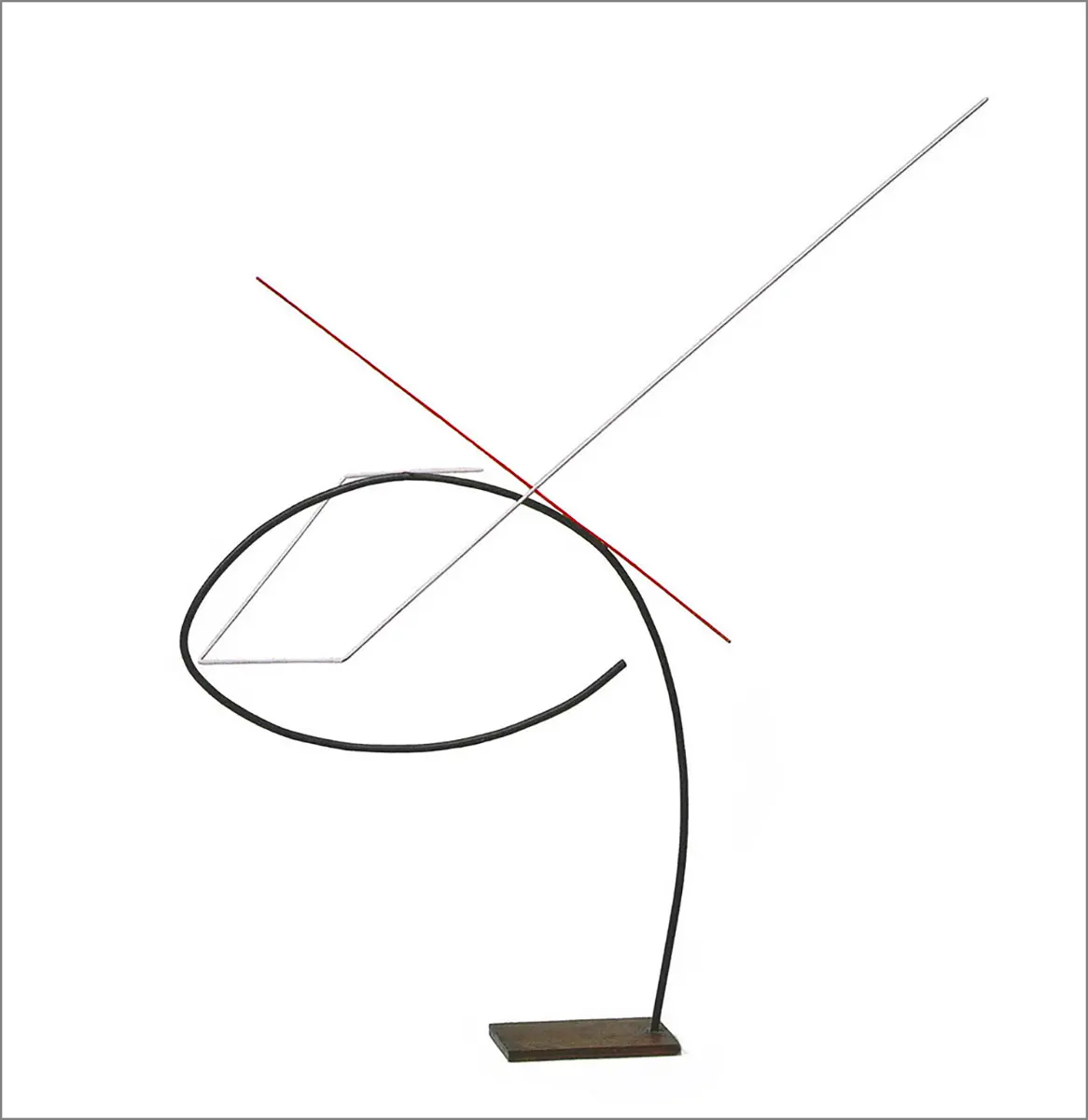
The pieces Iommi produced in 1945 mark the beginning of concrete sculpture in Argentina. One of them, Direcciones (Directions), is a construction made of wire in three colors (white, black, and red) in which the traditional concept of sculpture as a massive object or a tangible mass is rejected. As a consequence, space becomes a privileged (immaterial) material, drawn in thin metal rods. This leading role was given to space provided specificity for his works in the years 1945-50, which he calls “linear continuities.”
In this first phase, as in the following ones, Iommi perceived space as form and not simply an empty stage awaiting reception of solid materials.3 “Sculpture,” he explains, “always needed a form. Nowadays, on the other hand, it is important to think and feel spatially.” This does not then imply taking up space but rather activating it as a principal material.
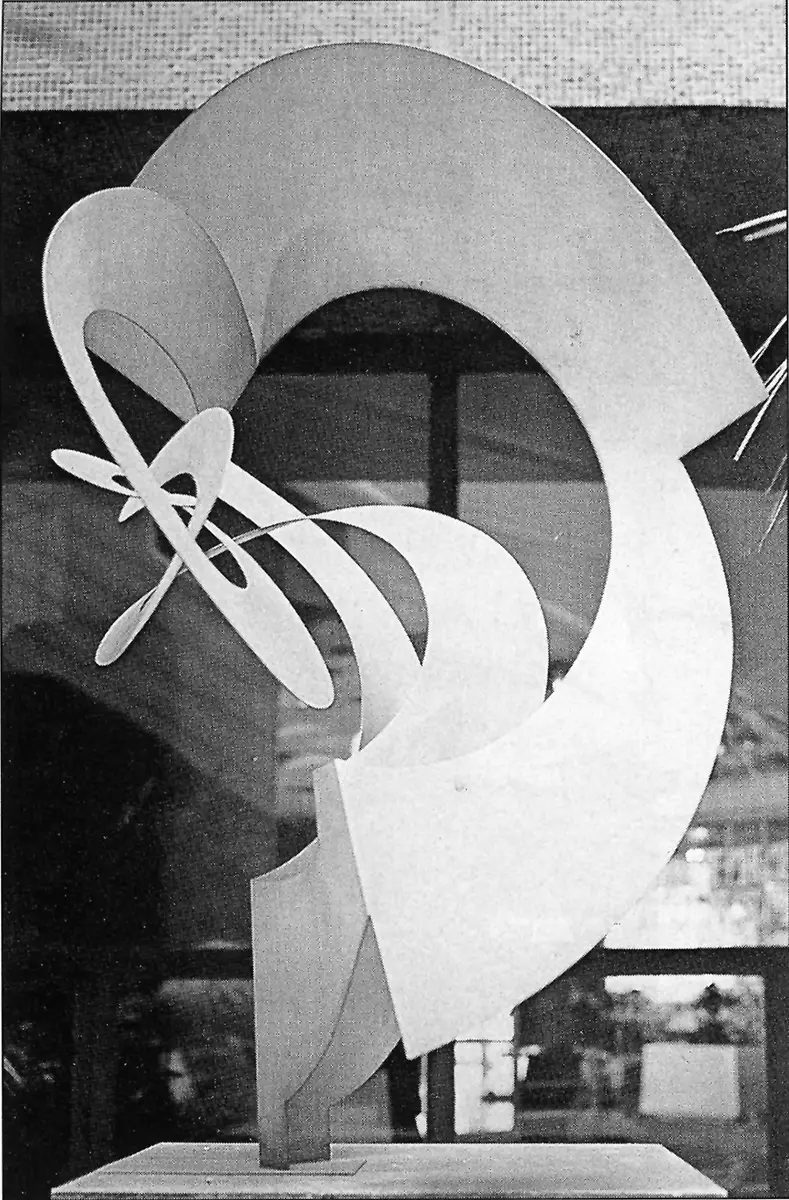
Around 1951, a period begins of constructions with stainless steel, anti-corrosive, or aluminum planes that lasts until 1976. It is characterized by a marked tendency toward monumentality. Space is no longer drawn with metal rods but is instead enclosed by cutting, twisting, and distorting the metal sheet upon which play various lights, shadows, and tonalities.
The value is given to space as an immaterial material joined with the spirit of synthesis belonging to the concrete phase, reaching an extreme degree in Visión momentanea (Momentary Vision). In this stripped-down installation from 1971, Iommi circumscribes sectors of gallery space, articulating them with the minimal indications of a cord.
1977, Farewell to an Era
As a representative of the concrete avant-garde of the forties, Iommi received the recognition he deserved. His works were exhibited in Argentina, Europe, America, and Japan and were permanently installed in public spaces including the Hakone Museum in Tokyo. On the occasion of the First Visual Arts Biennial of Mercosur in 1977, one of his monumental sculptures was erected in the city of São Paulo, thus becoming part of the urban landscape.
Among the numerous distinctions, he has received was his designation in 1975 as a full member of the National Academy of Fine Arts of Argentina. But two years after this important recognition, he presented an exhibit in which he moved away from a brilliant and celebrated path. He emphatically questioned the purist assumptions regarding geometry that he had adhered to in the forties, moving from a sort of aseptic abstraction to figuration of biting content.
Forward to 1977, one year after the military coup in Argentina that initiated one of the most painful phases in the country’s history. This bloody period —marked by extreme violence combined with ideological persecution—lasted until 1983, the year in which democracy was newly reinstated.
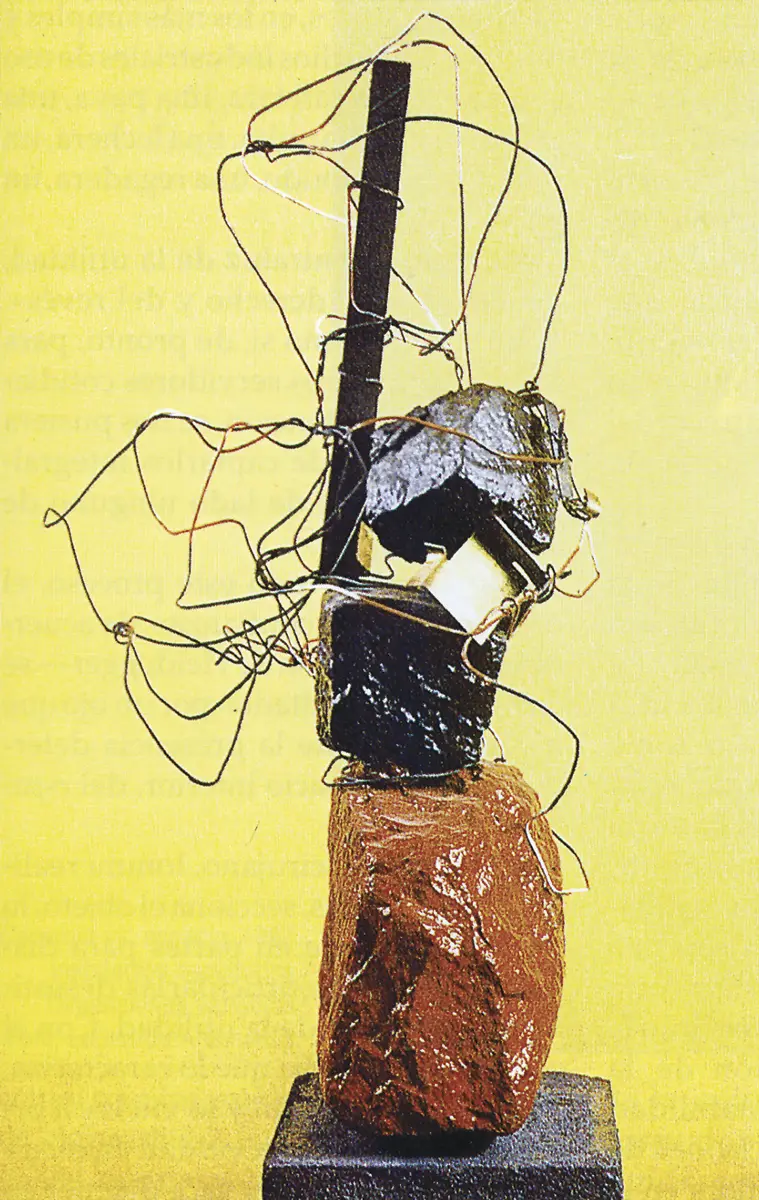
Under the title Adiós a una época (Farewell to an Era) Iommi exhibited works that were entirely foreign to the splendor of “the beautiful form” associated with the geometric canon and “noble” material. The contemplative pleasure of viewing the carefully built metal structure gave way to the pleasure of deciphering the contents of a conglomeration of “ignoble”, “base”, or discarded elements like paving stones, wires, and cardboard boxes, and broken bottles. Yet it is important to observe that if in fact, his initial geometric formalism disappears by the second half of the seventies, his interest in construction remains. Throughout—as we see explicitly in his works from the nineties—the stimulation of found material, significant in itself, will be associated with the pleasure of the construction.
In his show of 1977, Iommi presents Un rectángulo de acrílico y basura (A Rectangle Made of Acrylic and Trash) that would belong to another Argentine artist—Antonio Berni—accustomed, like Iommi, to “not make concessions.” 4 The piece consisted of an acrylic receptacle 1.8 meters high containing all sorts of objects that people throw into the trash.
Following the acrylic rectangle, other pieces will accentuate the change of 1977. Thus, in the series El desgaste (Wasting Away), a variety of materials—Portland Cement bags, travertine marble, paving stones, and iron sheets joined by wires—allude to the damage produced by time as well as by human action.
1992: Not Forgetting
Profoundly engaged in the time in which he lived, Iommi conceived in 1992 the installation, No perder la memoria (Not Forgetting). While memory “chooses” what it will forget, the artist recovers that which should not be overlooked. To do so he appeals as much to the direct testimony of the photograph or the newspaper article, which gives literal information about what happened, as to the indirect message of the symbol, the allegory, or the metaphor.
Outrage, destruction, and the loss of moral integrity are recurring themes in this installation. The idea of destruction takes shape, for moments, in the imperfect figure of wood or of broken, splintered glass. A chair with one leg shorter than the others serves as a representation of the idea of instability while the idea of decadence emerges from the deliberate negligence of “the sculptor’s craft.” In Iommi’s dystopic vision, the man ends up being identified, on more than one occasion, with the figure of the mannequin.
As in Plato’s Republic, the artist invites us to move about—no longer in an imaginary fashion but rather physically—in a sort of secret cavern. In this fashion, we might reconnect the forgotten links of a recent historic chain from the years of military dictatorship beginning in 1976, right up to the present time. But the space containing the sense of the piece is not spent on a specific historical reference specific to events in Argentina. Iommi’s allusions to power and corruption know no borders.
1997: The Poetics of Common Objects
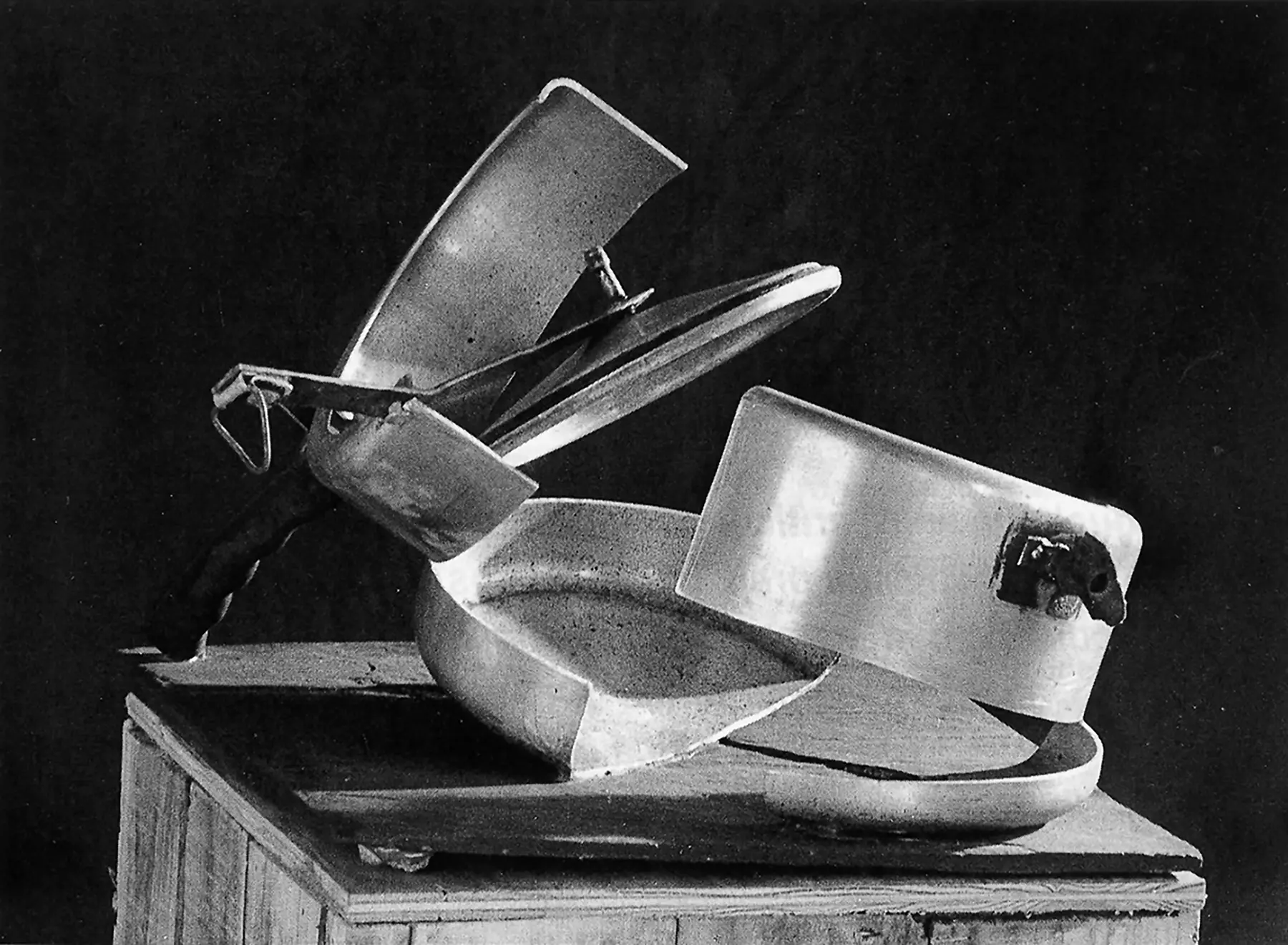
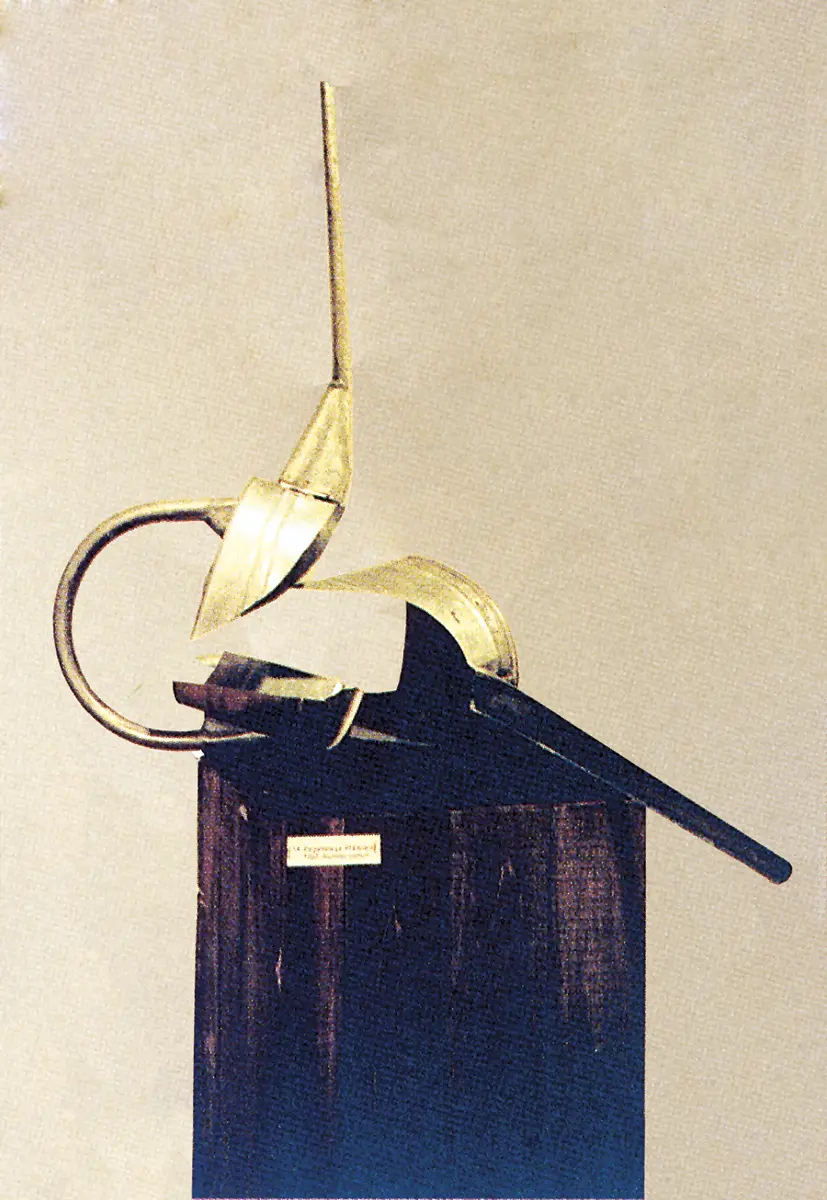
In 1997, Iommi produces a new series of sculptures in which he looks to the domestic environment to break the inertia of our day-to-day perception (that which lets us see only the utilitarian aspect of objects). In this way, he interrupts the expected sequence of an “administered” world dominated by functionality. We can then take note of the most simple and humble industrial utensils that we use on a daily basis: a coffee pot, a kettle, a casserole dish, a pot, a milk pitcher, a grater, a funnel, a watering can, a pail.
Looking at these objects against the light of utility, we see these objects “backward and forwards.” It seems that everything happens suddenly—as if to compensate our common servants for so much inattention, we are placed in the position of beholding them in their integrity without missing any of their aspects. Throughout this process, the utensil—that “trustworthy being “according to Heidegger’s definition—is distanced, “osculated” by an eye that probes and senses the determinant presence of interior space, of space as form.
Almost like a surgeon, Iommi makes precise incisions, divides the object into sections, slices it, splits it into parts to then disperse them and articulate them—he disorders the world and orders it again. In this way he offers us “his truth in sculpture” and by doing so makes us stop in the sculpturally fundamental play of the concave and the convex, in the perfection of a contour, in the mystery of an unexpected rough patch.5 Turned away from the corrosive spirit of the sculptures of the seventies and eighties, these recent works reactivate, as did those of the forties, fifties, and sixties, the pleasure of contemplation.
Presence of a Constant Spirit of Transgression
Throughout the 53 years of his career, utilizing every kind of material, from “noble” ones (in his concrete phase) to base and discarded ones (from 1977), and humble materials (as he uses currently), Iommi never stopped being a sculptor. That is to say, he never ceased to exert control over materials in terms of space. Not even in the phase beginning in 1977 does the quota of spontaneity associated with all kinds of pre-existing materials and objects annul his interest in construction. In this way, if there is something that remains constant throughout Iommi’s artistic career, it is the presence of a constant spirit of transgression. We find it not only in his actual production, or in the beginnings of his second phase in the seventies, but also in the forties when he violently opposed the siren song of a certain kind of decorative figuration quite highly regarded at the time. We should not forget that what is today valued in terms of beauty and harmony, of the intelligent use of materials, in its day was the object of hostility and attacks.
In opposition to the reigning figuration, concrete art did not please the senses and did not seek to be liked at any cost. “The people seated in fluffy armchairs”, says Iommi, “we're afraid we would cause them to lose sales. We were offering new ideas and that was dangerous”. In the shows organized by the Invention Association of Concrete Art, visitors even came to write insults on the paintings, a violent sign of rejection.
With the passage of time, concrete art was accepted. Iommi did not hesitate in 1977 to transgress against his own choice, just as today he doesn’t think twice about turning away from an overturned option of social or political criticism in favor of another more “sculptural” one. Different from the way he worked in the seventies, the accent in his work nowadays doesn’t fall on sociological or political questions but rather on the world of the individual, that of the small things of domestic life, of daily actions shared with our families, our close friends.
By contrasting utility (the utensil) with “uselessness” (that of art), Iommi alludes ironically to the modernist concept of art.6 Engaging a corrosive sense of humor and a profound self-criticism, he places before the viewer the frustrated intention of the historic avant-gardes to insert themselves into vital practice, an intention that can be found, for example, in the concrete art of the forties.
We could conclude that, in a nearly “methodical” fashion, Iommi has not hesitated to contradict himself. He demolished the image of oneself, that is to say, the expected order of continuity of style, to make room for his new and genuine concerns. This is why he turns out to be, above all a new generation of artists, a paradigmatic figure.
NOTES
1. Enio Iommi was born in Rosario in the province of Santa Fe, Argentina, in 1926. He relocated to Buenos Aires in 1939.
2. Michel Seuphor’s expression gives title to his book Le style et le cri [Style and the Cry] (Paris: Seuil, 1965).
3. El espacio como forma (Space as Form) is the title of Iommi’s last solo exhibition in the Ruth Benzacar
Gallery in Argentina (August 1997)
4. See Elena Oliveras, No hacer concesiones, catalogue from the exhibition/homage to Antonio Berni, Klemm Gallery, Buenos Aires, 1996.
5. It was Paul Cézanne who, in a letter of 1905 addressed to Émile Bernard, wrote, “I owe you the truth in painting and I will give it to you.” The famous expression was taken up again by Jacques Derrida in La vérité en peinture (The Truth in Painting) (Paris: Flammarion, 1978).
6. Separated from “the stupid falsity of the practical,” the uselessness of art, suggests Adorno, “the more it can act against the current of the tendencies of an organized, functionalist society, the more useful it will be.” from Teoría estética (Aesthetic Theory), (Buenos Aires: Orbis) 315.
ELENA OLIVERAS
Art critic. Adjunct Aesthetics Professor of the Philosophy Department at Universidad de Buenos Aires.