
Fabián Marcaccio was born in the city of Rosario in 1962, but his exhibition at the Ruth Benzacar Gallery in April marked the first formal presentation of his work in Argentina since he moved to New York more than ten years ago.
In addition to a few objects, and other wall works, the show included three works done on plastic fabric, hung on the wall by means of a rope and tensor system, like tents or a boat's sails. Two of them were separated from the wall by a half-hidden metallic structure which gave them volume. The surface of the fabric remained taut, resisting the pressure of irregular and deformed bodies that stretched and inflated them.
These works, as well as other “paintings" in the show, shared the same initial difficulty. Despite their apparent destructive impact on certain pictorial conventions (and in particular, certain canonical elements of abstract expressionism, such as the brush stroke), these works were not the battlefield for some kind of conflict, but rather a histrionic field of demonstrations and proofs which revealed a series of citations (from art history as well as some of the most powerful symbols of the century: the swastika, the symbol of peace, the sickle and hammer, etc.) as extirpations or absurd ruins.
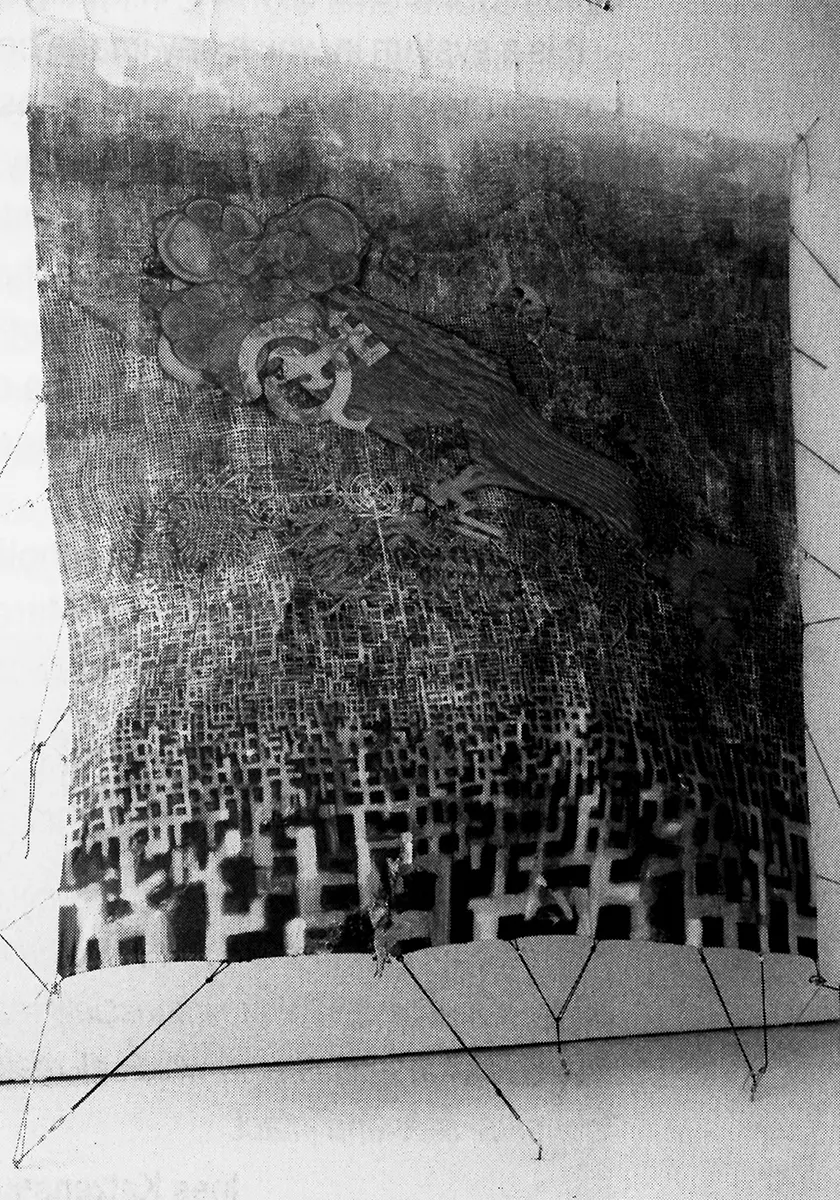
It is in this difference-between battlefield and a field of demonstrations that the high point of Marcaccio’s work can be found, particularly in his paintings, which seem to be the result of some laboratory experiment. His projects involve a repertoire of subversive and burning ideas about pictorial elements in general, and the history of abstraction in particular, that results in actions that are in principle wild and uncontrolled, but which finally prove to be dry, ever modulated by technical processes, almost never derived from the direct, pulsating action of painting.
In the design of these excesses and the delirious flux of transformations, the mutations between figure and background, and the buzzing of chaos, there is a brutal kind of self-discipline: the terrible, hygienic perversion of exercising the maximum violence over dead matter. (For this reason, it is so impressive to see how, for example, in one of the lower edges of Paintant Grounder (1997), Marcaccio seems to be addressing a problem in the canvas, as in an act of plastic surgery, only with paint. In this way, the oil seems to act as if it were an open wound as if it were exhibiting the viscous insides of a body.
Perhaps because this was his first exhibition in Buenos Aires, the central work in the show was also the most didactic. On a small iron table or pedestal, the artist placed a piece of meat appearing in the form of a thick red brushstroke. This event-which seemed to illustrate some kind of Deleuzian agencement —this symbiosis and alliance between different kingdoms, was like a center from which it was possible to conceive of a work that examines painting as a body. And in the presence of this body, Marcaccio’s work can be seen as a posthumous and necrological action. This organism which is a painting is dissected, as Carlos Basual, do has written, “from the standpoint of the forensic specialist.” The texture of the canvas appears like a piece of textile fabric, with patches in various degrees of close-up; the brush stroke is “liberated", with the illusion of liberation characteristic of suicide, and experiments with the unexplored and absurd (it reverts onto itself, is cut in half, bifurcates, becomes knotted, changes consistency and becomes symbolic, etc.). The collage combines with the symbols and the symbols engender themselves. But as I noted earlier, none of this takes the form of action. Action is frozen by technical mediations and theatrical artifice that definitely exclude any sort of vitality.
It is a system in which any image becomes rapidly exhausted and transformed into another which is always abject. And the flow of these accidents extends to such a point of ruination that it might be compared with Blanchot's idea of desastre—though the sense of threat is always present, the danger has been overcome.
In the midst of still melancholic grief over the death of the painting, Maracaccio advances over its body and acts out a version of its decomposition and sinking, in line with the concept that Blanchot attributes to writers: You should write not only to destroy, not only to conserve, to not transmit... You should write under the attraction of the impossibly real, that part of the disaster in which all reality founders, safe and intact.
INÉS KATZENSTEIN