
Fernando Varela, an extremely complex and fascinating artist, recently presented a magnificent exhibition at the Museum of Modern Art, which clearly confirmed the conceptual and aesthetic maturity achieved by this artist whose next one-man show will be a challenge to himself. The show was mounted on the street-level floor-a difficult space to use because of the elliptically shaped walls and double height. The museography, which was carefully studied as in all Varela's work, managed to establish a formal dialogue with the interior structures of the works. A subconscious harmony? There was at all events an exterior/interior correlation at the museographical level that was one of the show's main sources of expressive potential.
Two-dimensional works are alternated with three-dimensional pieces. In the case of this artist, as with many others, there is no reason to distinguish between drawings and paintings, both of which were present and carefully worked in terms of line, color, and texture. Neither is there any reason to distinguish between sculptures and installations which, in both cases, are vehicles of volume, surface, substance, meaning, and symbol. The same applies to the abstraction/figuration intertextuality and the relationship between letters/structures. Varela is a total artist and works on the highest step of "open" art.
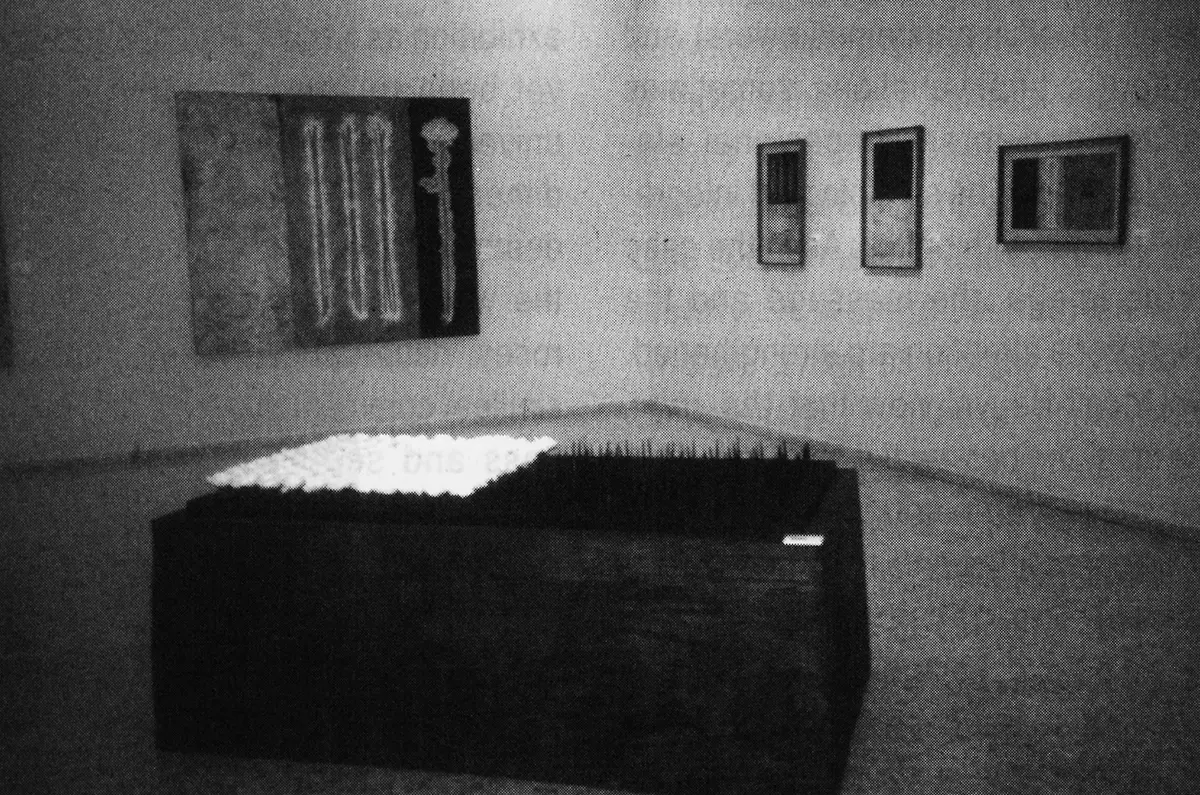
An analysis, confirmed within each work and endorsed by the critics, points to the necessary relationship here between Varela’s iconography and the higher mythical and mystical worlds, with religious postulates that are almost as open-ended as his work. Indeed, the first reaction-from the time of the palimpsests presented at what was at the time the Gallery of Modern Art some time years ago-is one of identifying these ancestral, primordial, pre-historic images with the Judeo-Christian tradition, a kind of paleo-Christian language, a neologism which has been used for Joseph Beuys. In the context of Varela's constant development and the spiritual bipolarity of his work, we cannot limit his concerns and allegories to any dogma or precise doctrine. The convictions expressed on the paper, canvas, terracotta (a real symbolic element here) are in the final analysis syncretic, transmuting Western concepts, but also Oriental, like the supreme balance of combined energies. This is particularly evident in the artist's perfect compositions, the tonal harmonies of the works, and the embracing of space, which is both vital and vibrant, whether it be inner space or the surroundings. This was evident in most of the works on display, such as the installations Karma and Vestiges, paintings such as Genesis, and the series of Nocturnes, all of which have considerable potential in terms of form and expression.
Fernando Varela has been working with and developing the polyptych format. Although the show included an extraordinary triptych, Duality; and Kyrie Eleison, a picture in four parts (the biblical content of which suggests four fab/es)which constituted two of the strongest, purest, and structurally most simple works in the show, the artist generally uses vertical or horizontal diptychs within the same support (as in the series) or individualized panels. This formal, symmetrical arrangement, based on the number two, reflects a meticulous conception that favors bipolarity: equivalences, complementarity, or opposites, with optional reading order.
The link between the two works or interior structures becomes a sign (man/woman), a symbol (infinite/creation), an allusion(stems/flowers), and matter (textural variations, sometimes collage and three-dimensional elements, nails). The semiological integration merges with optics. As in the case of the image, the message and the spectator's attention are strengthened. We recall Beuys' view that the spirit, the idea, the personal aspect, the soul, the intellect, and thought all make use of corporeal elements to express themselves. The physical element, in Varela’s diptychs and other works, offers a strict and handsome vehicle for the psychic and spiritual.
I have already mentioned Joseph Beuys, to whom Varela pays homage in one of his “great” paintings. Despite the great difference in technique, the creative process, and the tangible plastic reality between the two artists, one of German origin and the protoform of universal art, the other Latin American and undoubtedly gaining in strength, there is nevertheless a considerable affinity. In both cases, religiosity extending to the realm of Gnosticism and plural mythologies, specific Biblical allusions, the indissoluble role of the word, the faith in love and harmony, and other values are all common denominators. It has even been said that Beuys used to place a fresh rose on his table every day, and once it wilted, he would trim its stem.
Beyond the ideological level, everything changes performance, rough objects, strange and even monstrous ugliness in the case of Beuys vs. aesthetics, refinement, sublimation, and careful finish in the case of Varela. In the painting that pays tribute to Beuys, Varela not only includes the proverbial head with the felt hat but tries to show the illustrious and mysterious German as a shaman, a guide and master, carrying his walking stick of authority. We even see the matte colors of the grease and the felt-basic materials in Beuys’ work, here represented in oil.
Fernando Varela has pictorially developed the theme of the rose and thorns which caused such an impact in his installation presented at the Inside show in Kassel in 1997. The work was reproduced exactly in this new exhibition as the original piece has not yet been returned from the German university. Both in this (finally) three-dimensional triptych, full of life and death, stasis and punishment, as in the works on canvas and paper, the roses, deliberately “natural" (like facsimiles) communicate their air of freshness and seduction. The tips and thorns (including those which subtly perforate the circuit and support) evoke less an impression of death than the vulnerability of man; they are a warning and source of reflection.
This exhibition of the work of Fernando Varela was the splendid result of a long process of meditation and can be described as an example of some of the best contemporary art. I concur with the opinion of Maria Luisa Borràs, who described Varela's work as one without concessions, "an open-ended work which achieves its ultimate finality through the communication between the painter and the others." The communication is unanimous, the consensus visual.
MARIANNE DE TOLENTINO