
The title of this exhibition, The Sound of the Woods, reflects the poetics inspiring the recent work of Florencio Gelabert. The “sound" is in fact a cry of alarm, a calling of attention to the destruction of the environment—a destruction that is both deconstruction and construction, a cycle unfolding within the framework of the relationship between man and nature. The Woods in question evokes the idea of nature, with wood continuing to provide the raw material of the artist’s work.
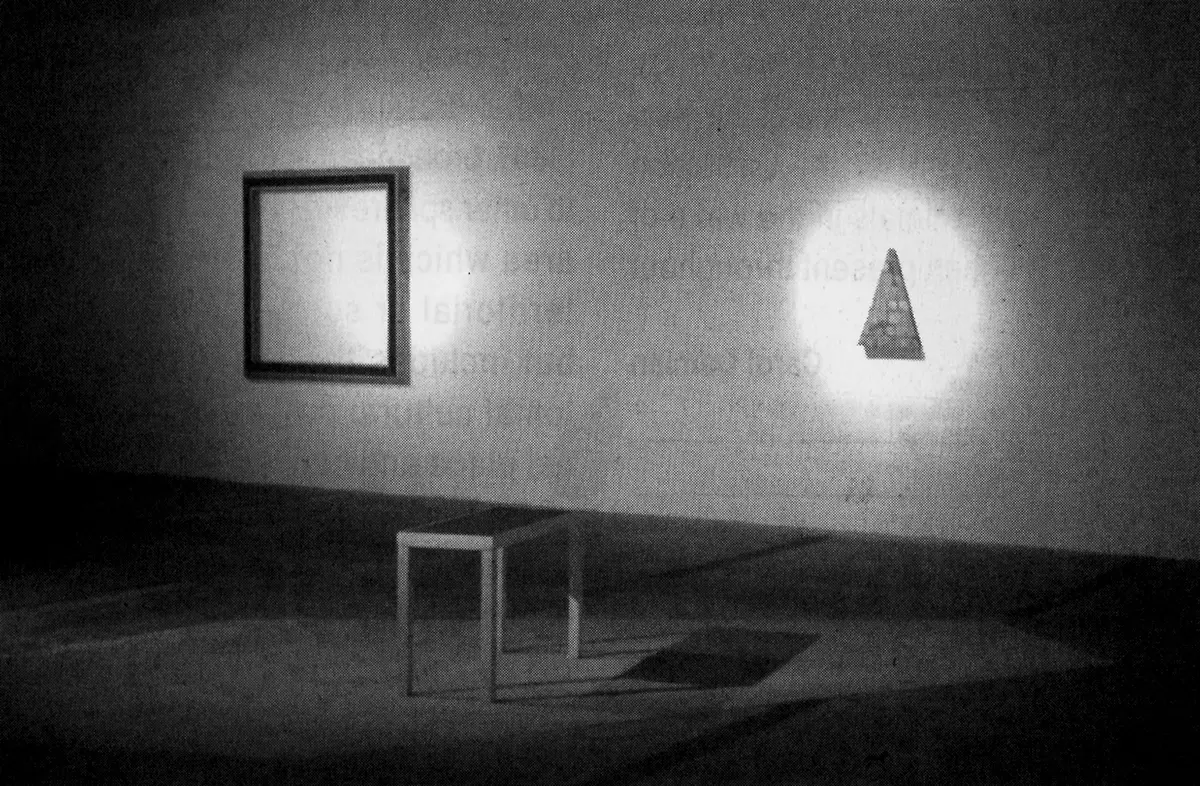
A polished wooden table, placed against a sawdust silhouette in the form of a coffin, is a perfect illustration of this new proposal. The Sense of Relationship (the title of the work) is clear: we must destroy in order to create. The original form must be altered in order to create "practical" objects (destruction is justified if a new object is created if the object in question has a specific function). The table, covered with green artificial grass, reflects another aspect of the relationship—the dichotomy between life and death, the destruction of nature, the wood, the tree, and the creation of a dead, artificial nature—a plastic nature in the strict sense of the term.
In this plastic garden, tools are redundant. Perhaps for this reason Gelbert hangs them on the wall and frames them as if they were fine antiques (they are oxidized). The Poetics of the Garden is an installation made up of seven frames enclosing various garden tools: a shovel, three scrapers, a knife, a hammer, a small hoe, a pair of scissors, and an inverted hatchet. The work questions the role of gardening, as far as it destroys the original nature (weeds and undergrowth) and replaces it with an artificial one. Sometimes gardens are even created with artificial plants and plastic flowers. It is therefore not surprising that the artist has decided to alter the roles of the drawing. The frame is converted into a simple line with the image (the tool) becoming a three-dimensional object.
The idea of changing the role of the frame is repeated in Total Content, a visual combination of the two previous pieces. A large square frame in wood and artificial grass (equal in width to the outstretched arms of the artist) surrounds a white space. In theory, the work continues the discourse of the destruction of raw material and the creation of a new object. In practice, however, Total Content frames a large void— perhaps the one left by deforestation and the resulting erosion.
The next work in the show consists of a pile of tree logs, an image that is emblematic of the deforestation process. Based on anthropometric calculations (the piece hanging on the wall is a triangle whose measurements coincide with that of Gelabert's own trunk), the work calls into question the relationship between life and death, man and nature. The fact that the triangle corresponds to the artist’s own inverted trunk is a further element in the interplay of alterations and relationships established by Gelabert in this exhibition.
Another work, Contained Forces, involves a similar visual interplay. A steel base supports a wooden saw covered with artificial honey (made of plastic, not from bees). Normally, the saw should be made of steel and the base in wood. By changing his materials, Gelabert creates new relationships and new elements (for example, with the wood replacing the steel and the plastic the aloe. The same idea appears in an untitled work in which a log placed on the wall in the form of a pipe produces a transparent plastic substance that falls to the floor, like a cascade. The plastic contains the figure of an axe that has been frozen in time (atemporality is another of the ideas which Gelabert addresses in his work).
Natural Relationship is a totem made up of thirteen wooden logs, set in beeswax and based on the measurements of the body (the height of the work is twice the artist's height, plus one foot for reasons of proportion). The subject matter, form, and materials combine to form an interesting work at the visual level. The final installation to some extent summarizes the overall proposal of the show. Nine logs, each one-foot long appear on a shelf of oxidized iron. Natural Relations (the title itself is inclusive) presents the final result, burnt logs (which recall the sculptures of an earlier period), inert pieces which conjure up an image of desolation and the smell of death. Perhaps construction on the basis of deconstruction is nothing more than an illusion, a justification that masks the enormous danger posed by the destruction of the ecological balance.
This exhibition will subsequently travel to the Museum of Contemporary Art of Panama (August-September 1998), the Jacobo Borges Museum of Caracas (February-March 1999), the Museum of Contemporary Art of Guatemala (April-May 1999), and the Museum of Art and Contemporary Design of Costa Rica (autumn 1999).