
The Luis Caballero Prize, established by the District Institute of Culture and Tourism, was open to artists over the age of 35. Each month, one artist showed their work in a solo exhibition at the Santa Fe de Bogota Gallery, before the final prize was awarded to one of the candidates. Eleven artists were selected to exhibit: Luis Fernando Peláez (Jerico, 1945), Nadín Ospina (1960), John Castles (Barran- quilla, 1946), Jorge Ortiz (Medellin, 1948), Gabriel Silva (Bogota, 1955), Hugo Zapata (La Tebaida, 1945), Ronny Vayda (Medellin, 1945), Víctor Laignelet (Barranquilla, 1955), Rodrigo Facundo (Ibague, 1958), Álvaro Barrios (Cartagena, 1945) and María Teresa Hincapié (Armenia, 1956). The jury awarded the prize to Víctor Laignelet.
One way of approaching recent exhibitions might begin with the definition of style which, for some time now, has been avoided and sometimes seen as a meaningless idea. Perhaps with the fragmentation of, and non-belief in a single vision of the world, the artist no longer tries to create a style. But as was argued many years ago, another view that is now being revisited and renovated can also be proposed: style is a way of seeing, one that is materialized in time and space. This might be a good starting point for analyzing this group of five installations, where the artists presented more clearly than some of their predecessors exactly that—a way of seeing. Their works showed that they are placed within a piece of reality, in an aspect of sensibility, and they gave form to that in space. For this reason, this convocation was important because, at least in these final works, the spectator came face to face with an interlocutor whose ideas were being developed, rather than just existing as amusing and diverting occurrences. The spectator may or may not agree with them, but all merited careful observation as each revealed an aspect of the different sensibility that most spectators generally keep in abeyance in their everyday life. What is clear is that this real fragmentation, which points to the independence of the parts with a single whole, makes one fragment the equivalent of another. The artist, by colonizing a part of that sensibility, allows the spectator to recognize and recuperate it. Historically, the style was a word that was set against the mode of being. Today, it appears that the mode of being has itself become a style. Three of the works could be seen as a gesture in space.
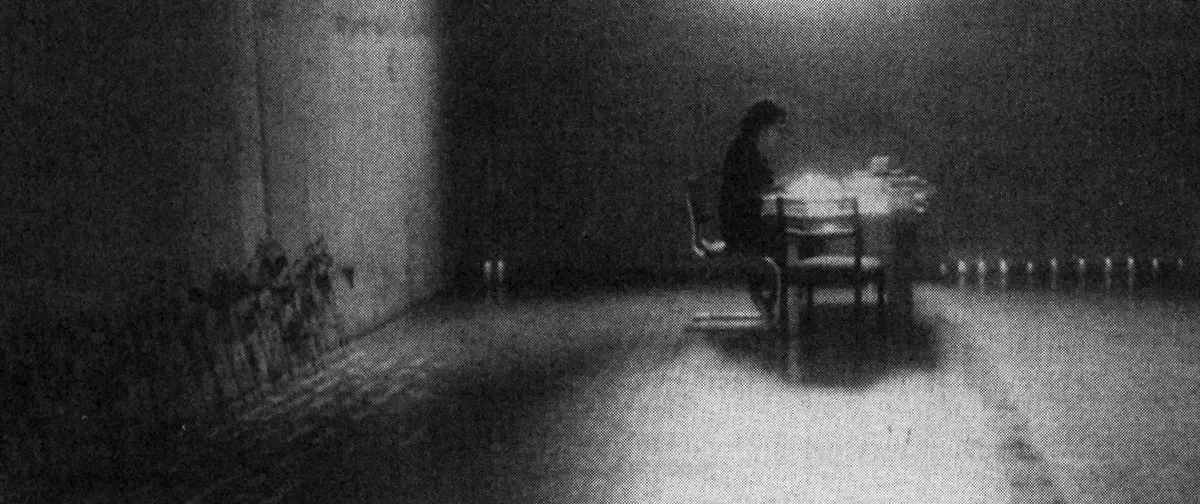
María Teresa Hincapié, in her work titled Towards the Sacred, brought to the Gallery the essence of her house in the country and her experience. The space was almost empty, with blades of grass appearing in the corners. The spectator could see an old man, a neighbor, who had been invited to live for a time in this space. Perhaps because there was no longer any room in society in which he could live out old age in dignity, and because it was thought that a gallery should be inhabited only by aesthetics-a clean rather than affected kind of aesthetics. The gallery was on the second floor and steps were installed to the neighboring park, thus enabling the occupant to take his dog in and out. A delicate tension was established between the cleanness of the space and the moments of this life which came into contact with the spectator if only for a moment.
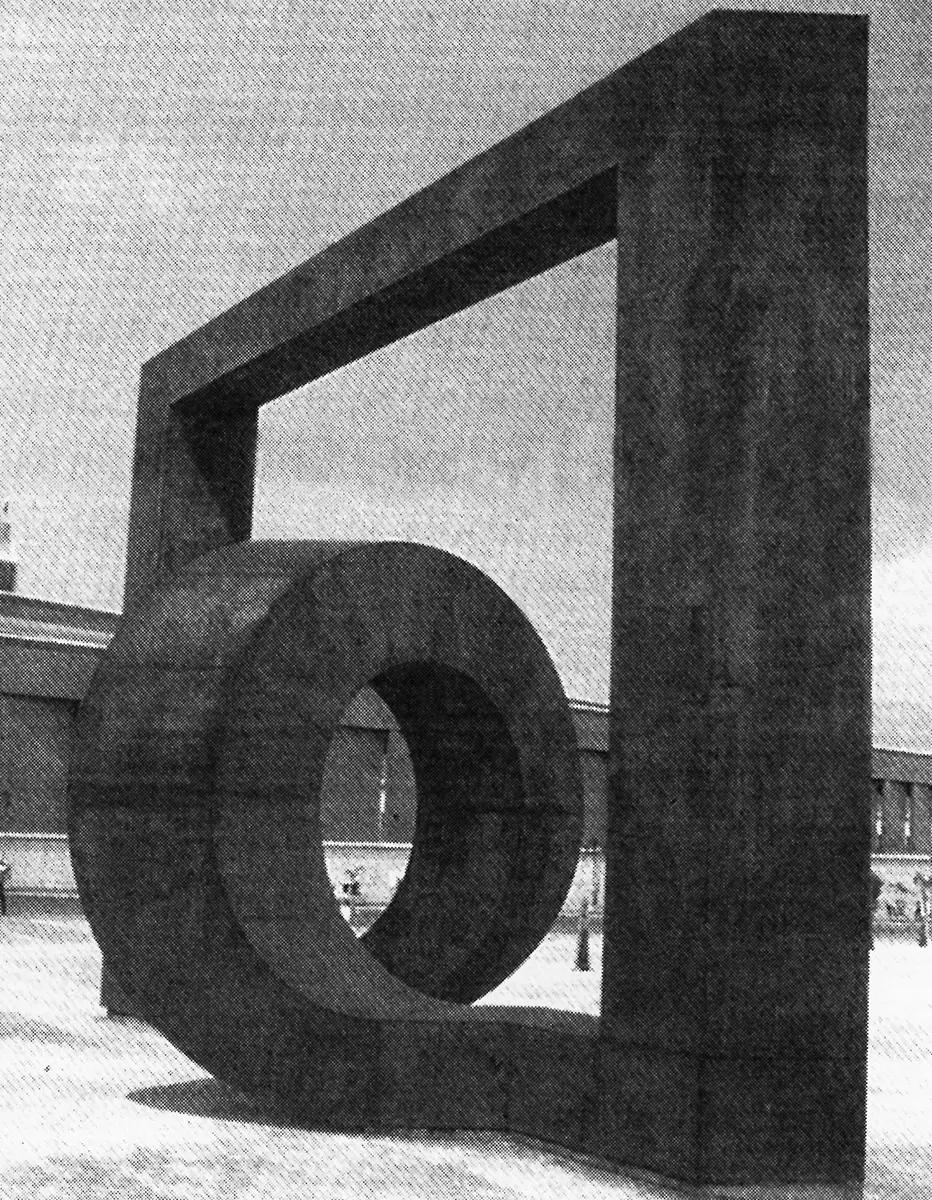
Ronny Vayda, in Saturn, constructed a metal ring that crossed space, and which was in no way symmetrical. Its curve, without losing its form, was adapted accordingly and covered everything. The reflection on geometry, which in Vayda's work has been mainly directed towards the cube and its possibilities, almost always imposing itself on space, here was transformed into the problems of the curve, through the conditions imposed by the space itself,' subtly testing the materials and above all, the manner of projection and construction.
The work of Álvaro Barrios was a requiem for dead artists and friends, of whom there remain only the works that are constantly renewed through our glance and which are transformed, through their absence, into an event. The work raised two major topics. In formal terms, it was a reaffirmation of kitsch as a mode of being or seeing. Pictures by Goya, Dali, Luis Caballero, Andy Warhol, and Carlos Rojas were placed in the center of two red canvases with the words 0 Caritas, a Cat Stevens song. There was a podium on which the phrase Ars longa, vita brevis (art is eternal, life is short), the title of the exhibition, was engraved. At the sides were white marble flames. Kitsch as an alternative mode of thought always questions stereotypes and, in this case, a hackneyed phrase used constantly in the mass media refers to “authentic tributes", which in fact prove melancholic, precisely because of the use of the same materials and the same empty ideas. In this work, the ritual proved above all authentic-and this is the second main theme of the work, which is a homage to friends from all periods, who have contributed with their conversation, approval, and criticism to the formation of artistic thought. Two of these five exhibitions transformed the space to reveal clearly the structure of thought.
Rodrigo Facundo projected onto the walls of the Gallery images of personal and collective history as evidence of the fragmented memory which hinders any historical continuity. The title of his exhibition, On the tip of the tongue, suggested the idea of something we apparently remember for an instant, but which we have in fact forgotten. The projection and the heterogeneous images of public and private elements coexisting in the same place was an exact example of a fragmentary structure that is unstable and lightweight, in which the parts are important as the voids and intervals of silence, which allow the emergence of stories, give rise to ambiguities and thus a change of meaning. But Facundo also subjected his visitors, through the most charming and playful mechanisms, to the spatial order which determined his memory. The spectator saw a procession, at different paces, of places, people and thoughts, retracing the path which made up his thoughts.
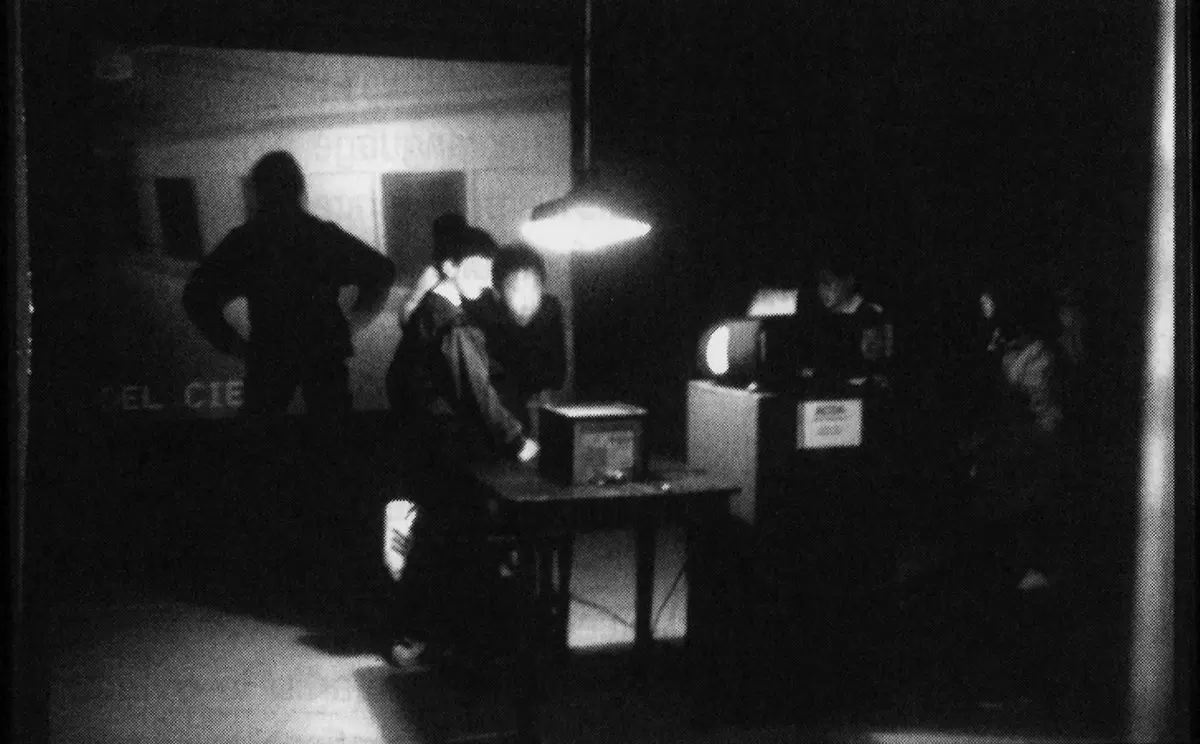
For Victor Laignelet, space is organized like the human brain. A right-hand side is a place of liberating images and the left, is a prison in which judgment is passed. The left side of the Gallery was thus the space of the watchman, and a closed circuit camera reflected on the wall the spectators on the right-hand side, who were able to move around and look at images suspended from the ceiling, the front side of which were the hard, masculine faces of delinquents, and the back side, the symbolic space par excellence. The painting evoked a world in which the feminine element, seen in terms of seduction, appeared as a means of extending consciousness. If a mode of seeing is a mode of being, then this work is both a summary of and an opening up towards a search by the artist to give form to a mental state in which apparently separate ideas enter into the realm of the senses as if a window were opened up to reveal the other side of the wall and within a single time and a single space; what one had been taught to see separately could now be seen in its entirety. A cage went to look for a bird, the title of the exhibition, was a trap to make the spectator enter the labyrinth of his or her own sense of perception where, in a remark by Kafka quoted by the artist, the hiding places are many, and salvation comes just one, but where the possibilities for salvation are as many as the hiding places.
NATALIA GUTIÉRREZ