
"Painting is a poetic language or it is nothing"
The figure of Manuel Rodríguez Lozano (1895-1971) has been little studied in the history of Mexican art. He has been placed conventionally within the Mexican school of painting—a term he coined in the I940s—when his attitude was much more polemical. There are a few references to his role in education as head of the drawing department at the Secretariat of Public Education, in I924, as director of the National School of Plastic Arts, the Antigua Academia de San Carlos, to his activity as a cultural promoter, and his links with the theatrical group Ulysses and the magazine Contemporáneos. Also discussed are his amorous relations with Carmen Mondragón (Nahui Ollin), Abraham Angel, and Antonieta Rivas Mercado, and the stylistic periods of his work.
This exhibition curated by Beatriz Zamorano and Ángel Suárez at the Museum of Modern Art seemed to provide more information, but not more interpretation. It continued to reflect the commonplaces of his historiography, without achieving a critical view of the artist's sense of conception and construction, his different, and at the same time social, modern, and universal sensibility. "A woman is painted as a woman, a man as a man, this was his universality ... The strength of his painting was its own limitation... due to its poetic content... If painting, like art, really has a spiritually stimulating value, give it to the people, and it will fulfill its social function." Despite its soberness, the exhibition did not propose any revision in museographical terms. The information provided was more concerned with personal anecdotes about his love life than an interpretation of how the latter affected his production.
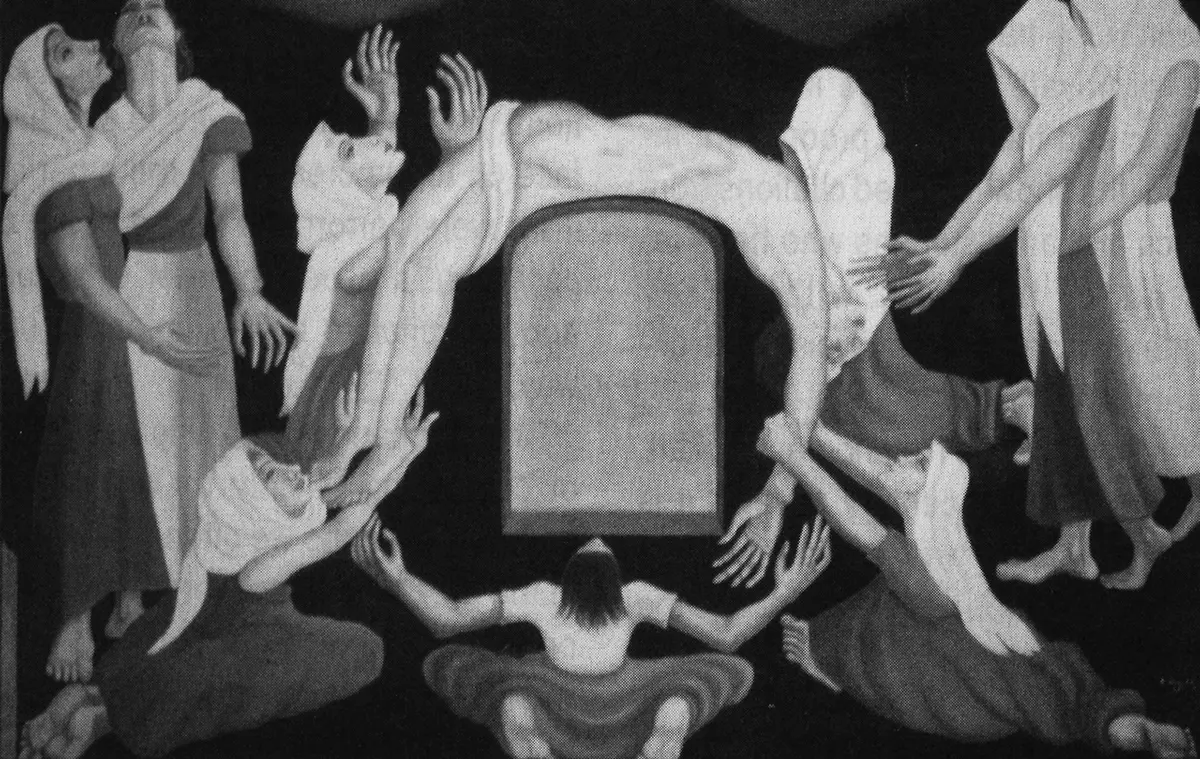
There are many references to European artists who served as stylistic models for the Mexican artist, or to his role as a trainer of other artists in Mexico. But these are made without an examination of the political, social, and cultural factors that led him to marginalize himself and propose an art based on spirituality. One of the achievements of the show was to gather together the series titled Santa Ana muerta (1932-1933). Here the drama of colors in the work, the intensity of contrasts, the economy of the compositions, and the decisive female presence help create a profound and vital questioning of death. The languid, elongated forms contrasted strongly with the colossal and monumental female figures from the same period (1930-1936).
As a writer and critic, Lozano was also the author of discourse that, like his painting, underwent an evolution of its own. For him, the authenticity of Mexican painting lay in the search for our own affirmation and the creation of a language that would have the flavor, the sense, the light, the heart and soul of Mexico. His criticism of the muralists, who he thought confused anecdote, picturesque elements, and politics in art- which for him were the same thing-led him to adopt a heroic stance in defense of authenticity. The painting should be the expression of transcendent values. The artist, Rodríguez Lozano believes, should create his own effective perspective.
In this respect, the presentation of different facets and relations characterizing his writing and pictorial production should have been part of the curatorial approach. This approach should also have explained the function of private patronage in Lozano's artistic and theoretical production. Instead, the show included citations from critics and art historians who have referred to his work without any contextualization or analysis of the different ways in which that work has been placed in the historiography of art.
In this "end-of-century review", it is a pity that there was no attempt to integrate the theorist, the painter, and the man, no attempt to analyze his work in the context of his time.
ANA ISABEL PÉREZ