
The circus is one of the most ancient forms of spectacle. From its imperial Roman past, plethoric with the cannibalism of the colonized, to such capitalist versions as the Barnum & Bailey troupe and the academically disciplined Moscow Circus, the circus has been a mirror of society.
The flea circus has its origin in the slums, on the periphery of the large three-ring North American circus. It was there, among cheap swindlers, and exhibitors of grotesque and monstrous creatures, that this little parasite of its spectacular big brother flourished. The attractive and grotesque quality of the flea circus resides in the fact that it is parallel to the real circus. The possibility that insects can develop specific skills and perform feats that would even be extraordinary for a human being led to a series of Darwinian questions about the supposed superiority of one species over another, the survival instinct, and other such matters. We might therefore conclude that Cardoso's work, consisting of the presentation of this para-spectacle within the circuit of another spectacle —that of contemporary art—would lead to an emphasis on such questions through these metaphors of the human condition; or, more ambitiously, a reflection on the nature itself of the representation, the act.
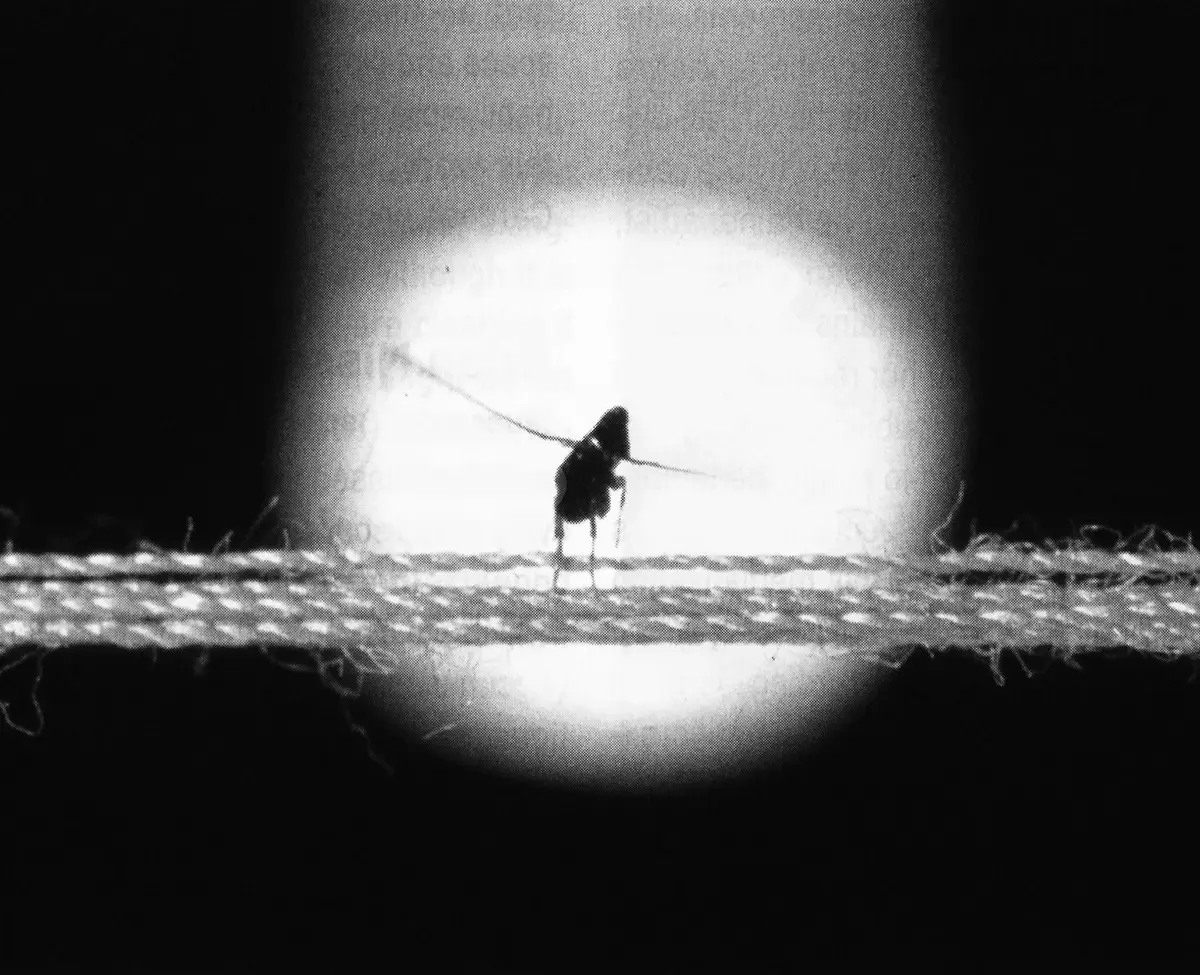
This exhibition at the New Museum consisted of a large curtain painted like a circus tent, the surface of which contained a monitor screen that acted as a sandpit. The screen showed a continuous video created by the artist, in collaboration with two other artists. The installation was accompanied and supplemented by a series of circus apparatus on a flea scale, a tiny trapeze, and a little cannon, arranged in glass cases. Alongside, there was another revealing, metallic, non-colored contraption, which was no longer a scale adaptation of pre-existing artifacts in the human circus but specifically designed for the training of the fleas. In the video, the spectator sees the animals, in magnified form, performing their feats, presented with hypothetical artistic names: the duel with swords, the balancing act on the tight rope, the firing of the bullet flea, the weightlifter, and other such acts. The editing is presented through the use of the publicity spot technique. Literally, a spot of colored light marks a circle on the surface, the virtual sand, and within it, for a few brief seconds, as in television advertisements, the acts are performed. The performative aspect of the work, and the circus, disappear with the emphasis of the camera on the creatures. The trainer artist, with her body and head wrapped in strange clothes, remains at a secondary level, as does her relationship with the fleas and the public. Curiously, despite the intention to mimic the temporal structure of the spectacle and circus music, the result of this mediatization through the presence of a video, which continues to be a recording, is most cruelly comparable to a scientific experiment. The documentation of the representation carried out in this way lays bare the inexorable effects of physical force as the source of apparently significant acts, the stubborn lack of will or intention on the part of the fleas: in short, the instrumental precaution inherent in any kind of training and survival process. These images are perhaps closer to a classification-oriented positivist nightmare of the nineteenth century than to an exaltation of the funambulist, a fantastic element proposed by a vision in the style of a Baudelairian flaneur.
The parasitic nature of the reality proposed by the circus, the parasitic nature of the flea circus, and the turning of the screw resulting from the creation of a kind of video installation recording the event, come together like a series of Chinese boxes. The final problem in this chain process is the fact that all this is proposed within the space and circuit of art. There are perhaps more questions than answers in this work, both for Maria Fernando Cardoso and for the spectators.
NICOLÁS GUAGNINI