
Mariano Sapia (b.1964) is an artist who, in the vast panorama of realism of the 1980s, managed from his earliest works to create his own image. Now 33 years old, he has acquired a well-deserved international reputation. He represented Argentina at the First Biennial of South Africa (1995) and one of his paintings, Harvest of Women, oil on canvas (1990,120 x 200 cm.) was recently acquired by the Metropolitan Museum in New York.
Sapia’s own image results from a special combination of aspects of magical realism and social criticism painting. His work can be placed within the path opened up by such masters as Berni and Figari. From the former, he retains an interest in recording marginality and the world of consumption, and from the latter, expressive use of color stain and nocturnal atmospheres, as well as the search for the extraordinary aspects of the prosaic, everyday world.
Sapia’s works have a strong local flavor. Backed up by their sense of pleasure in the act of painting and subjective reinterpretation (mainly through the use of color), they reflect the artist’s own experiences as an inhabitant of the Buenos Aires neighborhood of Villa Lugano. They describe the life of the lower classes far from the city center, the marginalized inhabitants of the precarious suburbs of Buenos Aires. But, contrary to what one might expect, there is no dramatism or pessimism in his pictures-an impression which is confirmed by the paintings from the last two years making up this recent show at the Borges Cultural Center.
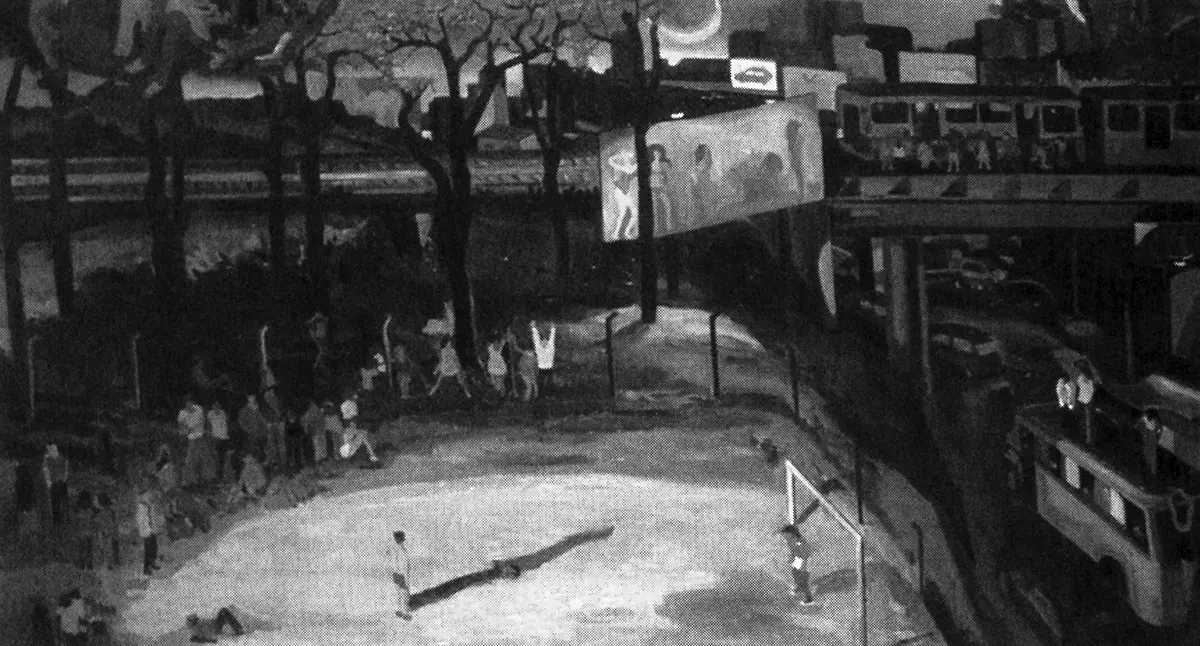
The figures, indifferent to the impact of publicity posters and the threat of helicopters moving around in the night sky, have gathered together to participate in the same action: a demonstration around a road block, a religious ritual, or a sports event. It is this spontaneous participation that results in a change of vision, generally negative (from the perspective of the center), of the marginal lives of those who live on the outskirts and who spend long periods of time under the bridges or traveling in deteriorated trucks.
Dismantling the stereotypes of critical realism, Sapia shows in his paintings that marginality may also be synonymous with fiestas and celebration. What is being celebrated in this case is not simply the external fact of people being side by side (which may also be the case of those in the city), but the genuine kind of intention uniting everyone, preventing them from engaging in unrelated conversations or their lives from fragmenting into individual experiences. What is being celebrated in fact is the spontaneous participation of everyone in the strength of common action.
In some cases, the actions are channeled through violence —Road Block is an example. In others, the action results in festivities of a sporting or religious kind. At times, the idea of the nation, symbolized by the Argentinean flag, becomes one of the pillars of the union. But it is mainly football that provides the main bond and attraction, capturing the attention of both young and old, men and women, those who ride horses, and those who rest along the roadside. No one is immune to the effects of a picado, the emotion of seeing a penalty converted, the admiration felt for a crack player, except for lovers who fleetingly move away for some furtive encounter.
Sapia once again offers proof of his skills as a painter. In a period of new trends in techniques and genres, he shows us that painting is not yet dead but still has many things to say.
ELENA OLIVERAS