
This was perhaps the first time that we could see how the concept-or the sentiment of wandering is expressed with greater depth in the work of Pancho Quilici. Wandering, the title of the exhibition was taken from one of the artist's own texts, according to the last references left by Roberto Guevara. The act of wandering through the paths of memory, and thus through the paths of landscape, is an interior experience, a meditative one that is clearly of transcendental importance to the artist. The result appears in images that challenge the spectator, providing a sensory yet intellectual experience that generates pleasure through the speculative dimension of our symbolic thought. This is produced through the conformation of the artist’s personal language, the result of many years of artistic practice. Although Quilici’s production continues to be characterized by its formal virtuosity, it is now transcended by other, new proposals that reveal a sense of lightness and a quality of the ethereal that were less evident before. Now, as the artist himself recently pointed out, he establishes a division between two planes that formerly interacted by being superimposed in an ambivalent and reversible manner: the plane of reason and the plane of the imagination. Curiously, in the former, the artist works with abstract forms: the circle and square, pure symbols that are given infinite symbolic possibilities by rotation, displacement, and combination. In this way, Quilici establishes a symbology of multiplication: symbols that generate other symbols, in the search for greater complexity. At the second level, that of the imagination, the image is, paradoxically, closer to reality: a natural landscape, resolved in an almost academic manner and which constitutes, through the context in which it appears, the fantastic image par excellence. The works concern displacement, wandering through imaginary settings, the vestiges of ancient contemplative experiences of landscapes, the fascination for, and the mark left on the artist by certain places, like Mochima (Sucre state), the Orinoco, Africa, the Middle East, Europe, and above all, the Sahara.
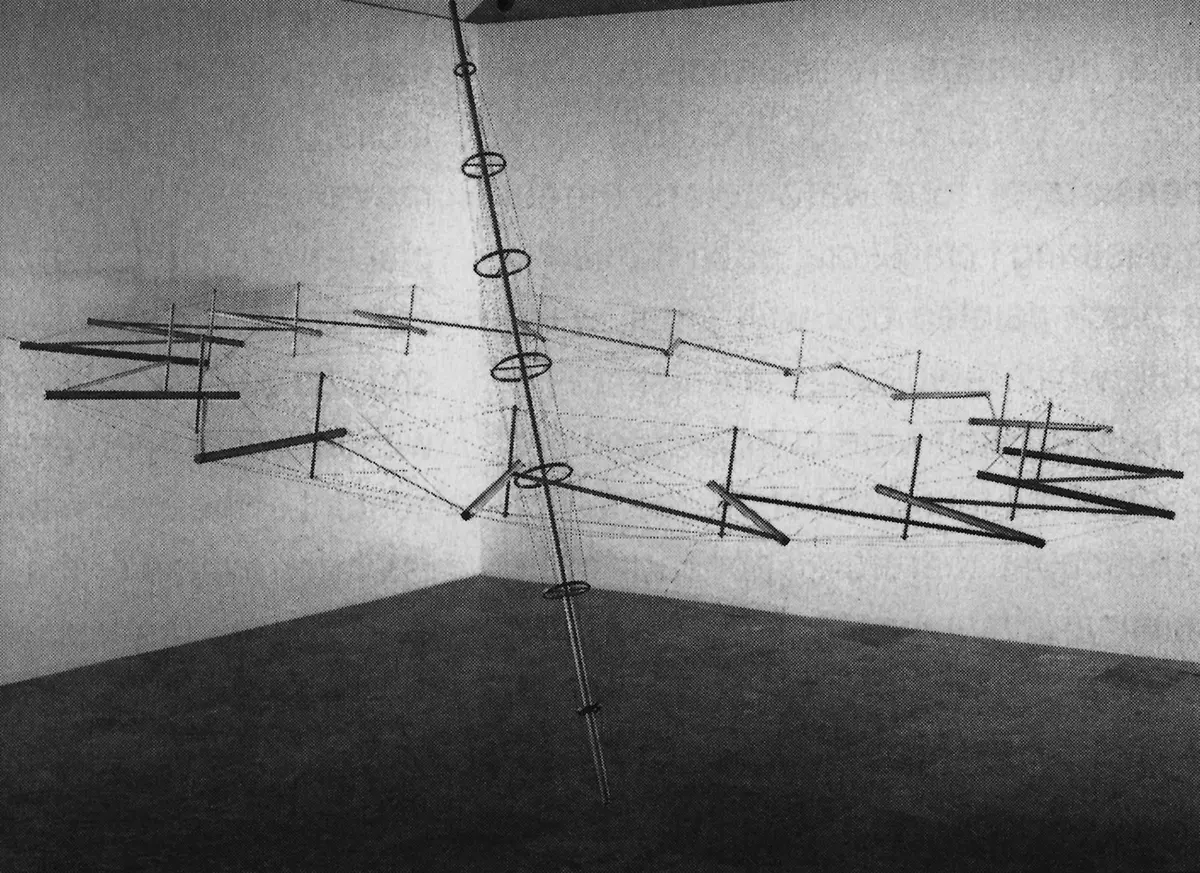
Quilici is particularly interested in the Sahara, which is, for him, like the vision of the planet's afterlife has disappeared. Although desert landscapes are not decisive factors in these works (certain atmospheres are, due to the use of ochre tones), a sense of solitude and vastness predominates. There is no human presence and what we see is what the artist sees-external worlds which at the same time are his inner images: his wanderings in search of a center (literally proposed in such monumental canvases as The Great Register). This center marked out by its greater luminosity in the circle that appears in the pictorial plane is resolved differently in the case of three-dimensional works: either through beveled glass (with allusive references to Quilici's usual constructive symbology), which is placed above and at a certain distance from the watercolors (The Ephemeral Eternals series), or through structures executed in aluminum tubes and a very aerial kind of wire with strongly cosmological connotations (In the bonds of loosening and Descending Areas).
In The Ephemeral Eternals, on the other hand, the artist establishes an interplay of contrasts between opacity and transparency. The bevel, the structure of which is a combination of the circle and the square, is projected as a shadow on the landscape (painted in watercolors) due to the external light which filters through the glass. The result is linear drawings based on circles, squares, spirals, etc. (depending on the combinatorial arrangement used), which are superimposed on the landscape. In the case of the structures, the light intervenes actively from the moment when the shadows appear on the floor, walls, or other surfaces of the works, once again revealing the constructive aspect of Quilici's art. In other words, far from discarding plastic elements previously used as pictorial resources, Quilici now reworks them in a more subtle manner, outside the pictorial plane, resorting to other more evanescent and intangible elements, such as glass, light, air, and even the spectator’s point of view.
In this way, new perceptual experiences are established with the spectator, “dot landscapes” (Sobrevinientes) which constitute a visual exercise in which the monumentality and complexity of the image are reformulated. Unlike his usual kind of line, this work consists of four watercolors barely measuring I cm x I cm, each framed in a black painted box with small white dots which emphasize the immensity of space. Each watercolor is placed on each of the four walls of the room. The landscape, therefore, appears in its minimal dimension and there results, as with the large format works, a concentration in the spectator's gaze toward specific focal points representing the moments of maximum introspection.
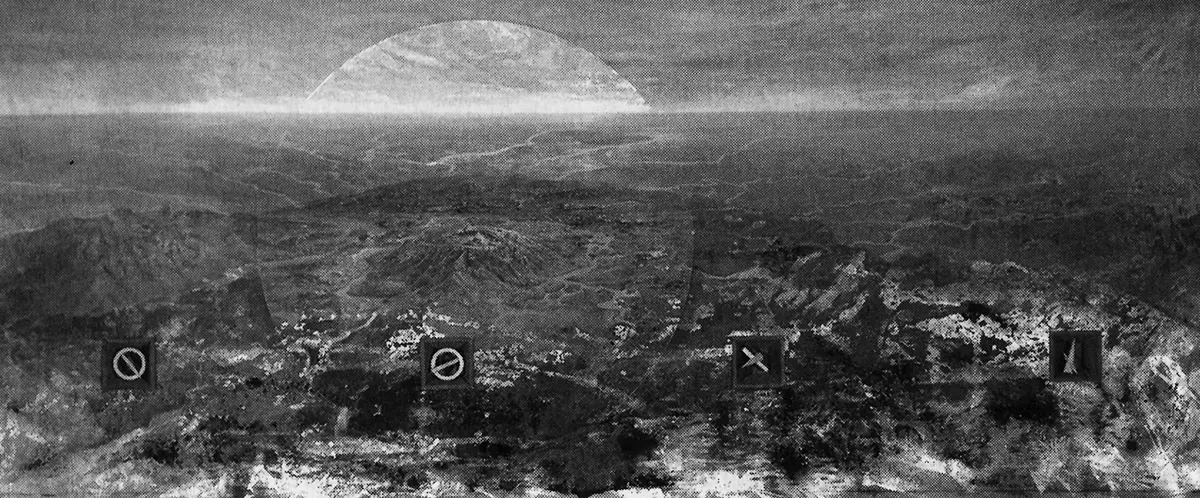
The intellectual realization and representation of organic elements, i.e. the physical quality of matter in itself, constitute another dichotomy in these recent works. The earth is depicted in all its organicness, with stains being fully expressed. Curiously, these appear in the foreground of the landscape, rather than in the background, where the images are treated with greater and more meticulous detail. Perhaps this is one of the few moments in which the artist allowed himself to reveal a suggestion of hazard and chance in the pictorial treatment since his thought is predominantly ordered and structured.
The three-dimensional structures, furthermore, would seem to replace to some extent the transparent architectures which were formerly fused into the landscape. For this reason, the two- dimensional and three-dimensional elements establish an important difference in these works. The aluminum tubes appear in rotation (suggesting a solar image) in a work such as Descending Areas. In others, they seem to gravitate, as with In the bonds of loosening, and in a sense, such effects can also be seen in such graphic works as the Narrowing doubts series, in the use of chiaroscuro and the sensation of mobility.
While the structures present a satellite, floating vision, the landscape paintings (except for the watercolors of The Ephemeral Eternals) are generally characterized by an overwhelming, giddy sense of rhythm. Vertigo is a constant feature in Quilici’s work, something for which he has a special predilection. As a result of this centrifugal movement, the center becomes displaced or rather determines certain focal points: water volcanoes, and very specific geographical accidents, which without doubt intervene in the symbolic content of the works. In The Great Register, for example, the circle of light is centered on the volcano. Several rivers flow into this center and each element is a “figurative” symbology (to use a term that distinguishes this aspect from the previously noted abstract concepts). In this way, reference is made to the passage of life towards death, towards wandering, and the search for a mystical center of knowledge, or recognition, of oneself. Roberto Guevara provided a very handsome definition for these works, which are not about landscapes, but rather about the displacement of events.
SUSANA BENKO