
We are halfway along the path between experimentation with new technologies applied to the visual arts and their adaptation to the expressive needs of the creators. In this frenzy of ideas and new ways of expressing them, we sometimes seem to become confused by all that is happening before our eyes, all that is being proposed to us, and the reading of which should always be, in one way or another, consistent with what the artist wants us to discover.
Thus many of the works which have been given pride of place in museums, well-known galleries, and specialized publications propose a kind of technology that gives an impression at times overwhelming of high tech-ness, of things evolving at a dizzying pace, always exceeding themselves without any problem and leaving us, despite all our efforts, lagging behind in the life of technological progress and its applications. It is then that we try to see and face up to the creation of the other as if we were performing a kind of act of contrition, a pause in order to reflect and recapitulate before going on our way.
This momentary halt, this possibility of controlling (if only for a few moments) vertigo we often experience in the presence of new projects, is not only healthy but a necessary experience. It is a reminder of the fact that all these things that surprise and astonish us now, and to which our initial reaction is one of admiration, followed by an attempt at interpretation, are nothing more than material that will soon become obsolete, judged no longer by our eyes nor by our personal stock of documents, but by our memory.
It is precisely here that one of the essential aspects of Paolo Gasparini’s proposal can be seen in his use of means of expression which have all but fallen into disuse. They have been displaced by more advanced technologies and very often intended to surprise, with the sense of surprise, in general, is more striking than the content of the proposal itself.
Gasparini recently presented in Mexico City an audiovisual work titled Mexico City-Los Angeles: Un viaje jodido: One hell of a fucking journey. Three circular boxes full of transparencies, three projectors, and an audiocassette, had to be coordinated with all the rest of a contemporary journey with old technology. But this accounted for a good part of its effect.
Gasparini presented his work in the presence of a restless, knowledgeable public in the Centro de la Imagen in Mexico City. The audiovisual work involved the use of three projectors which he had to operate himself: it was one of the most impressive and heartrending experiences seen in a long time. Along with the expressive force characteristic of an old kind of audiovisual work, the content of the photographs examined a reality that occurs at the same time as that of the reading of this article. It is not a question of recuperating the past or imagining desirable horizons for this world that Gasparini has depicted. The objective —and this is what he achieved— is to highlight certain contradictory and everyday games occurring in important large places like Los Angeles and Mexico City, without disregarding nerve centers like Tijuana and other frontier areas.
It would seem that time reworks the faces of old heroes, seeing them with new eyes. Do the name of Emiliano Zapata-his face, his figure, and his aura-mean the same as it did when he rode at the turn of the century, with his cry for land and freedom? No, and yet it is the same Zapata, the same inspiration, the same desire not to experience again what we have already experienced before. But the effort, we now know, was thwarted. Thanks to Gasparini, we see before our eyes those who emulated Zapata in front of the Zocalo in Mexico City. They are now perhaps slimmer or fatter but what does it matter? The blood is the same, they are the followers, sons, and grandsons of the bravura of those days, seeming to ignore anything that might be hatched against them in the glass offices of the holdings, trusts, and ministries. And they are too small to resist the sudden thrust of an official order for their brutal eviction but big and strong enough for their mere presence to provide us with an intensive lesson in history.
Other photographs by Gasparini recover the old words which our grandparents taught us but do so in the form of publicity propaganda and spectacular urban billboards which usurp the horizon, with the protection of the law, with the right to get in the way and, at the same time, forcing our eyes to look.
As a final chance, a final possible space for human encounter, the gaze of the homeless wandering the streets of Los Angeles and Mexico City, the gaze of those without passport or nationality, but with a history and their sharp criticism of the world which we have constructed. Here lies the response to our questions, one for which we do not find any possible answer. Within the text appearing in this audiovisual work, we find the well-known words that "the future is no longer like the past. Only in this way..."
For Paolo Gasparini this audiovisual production is a "... tribute to the human survival that the Mexican Indians, mestizos, and marginalized populations of all ranks and races have had to confront and suffer throughout the history of conquest and despoilment. Their faces stare out at us. They express their condition as the oppressed of the earth, they speak with the voice of an ancient and mutilated culture."
All this occurs as we listen to a piece of emblematic music. The Adios Nonino by Astor Piazzola, is perhaps the most moving moment in the presentation. Old Italian protest songs against fascism are also heard, as well as Judith Reyes, a Mexican trovadora whose voice and guitar lent their support during the most difficult moments of the unequal student struggle of 1968. This is the other discourse, that of the music which apparently had no relation, either geographical or radical, with what was being seen, but which enlisted our support because all the songs, in one way or another, in a specific country and precise year, denounced exploitation and celebrated the spirit of the human resistance, with its terrible and marvelous clinging to life. Whatever the adversaries or contradictions, sometimes even if the new style of life ran counter to history itself. Although it may be painful for us, this is the new space that is opening up before us and in which we must survive.
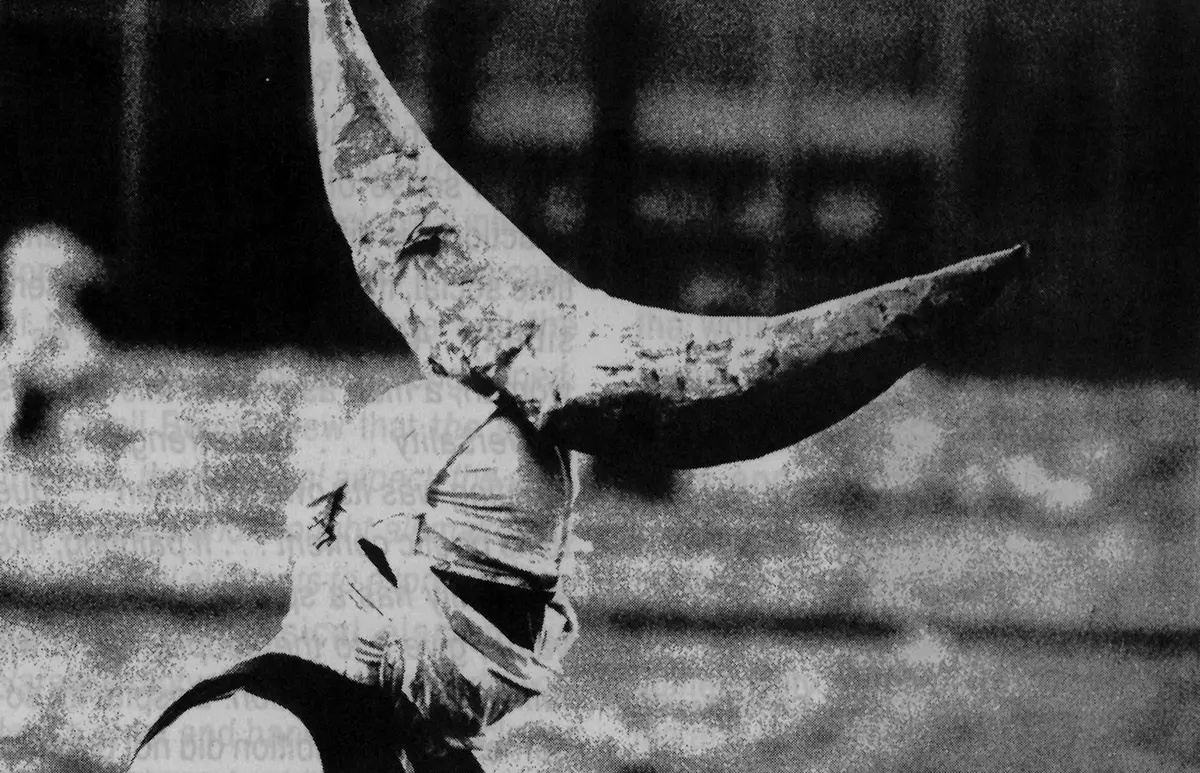
There is a man whose face is wrapped in rags, a waning moon tied to his head. Perhaps he is dancing, or acting. I like to think that he is escaping and that no one can catch him, that he will be the involuntary founder of a new society, that he will be remembered as the man who stole the moon, not in an act of wickedness or bad taste, but because he never wanted to lose the right to dream.
SANTIAGO ESPINOSA DE LOS MONTEROS