
One of the first lessons an art student learns is how to use shading and shadow to draw an object. By applying shadow, an artist learns to create the illusion of three dimensions on a flat surface. Brazilian artist, Regina Silveira turns this illusion on its head. Her work derives from the paradox of reducing an object to a tenuous reference point while magnifying its shadow into a dominant and substantial form.
For her installation Velox at the Blue Star Art Space in San Antonio, Silveira began with a found photograph of a motorcyclist. From this, she extended and translated the biker's silhouette through a perspective grid system. The reconfigured version became a cross between a distorted shadow and an immense ink blot.
Velox, specially created for Blue Star, is one of a series Silveira began in 1991. Another of her drawing and photo installations was included in the São Paolo Biennial in 1993 and, most recently in Re-Aligning Vision: Alternative Currents in South American Drawing, at the Museo del Barrio in New York and the Huntington Art Museum in Austin, Texas. Once the preliminary drawing was done, Silveira made an 18" x 24" enlargement of the photo, cut the image out, and positioned it at the base of a 14' high wall. The shadow was painted in black ink and emanates up and out from the photo. This massive 20' wide form extends like a tornado from the cyclist and is reminiscent of the swarm emerging above the sleeper in Goya’s Sleep of Reason.
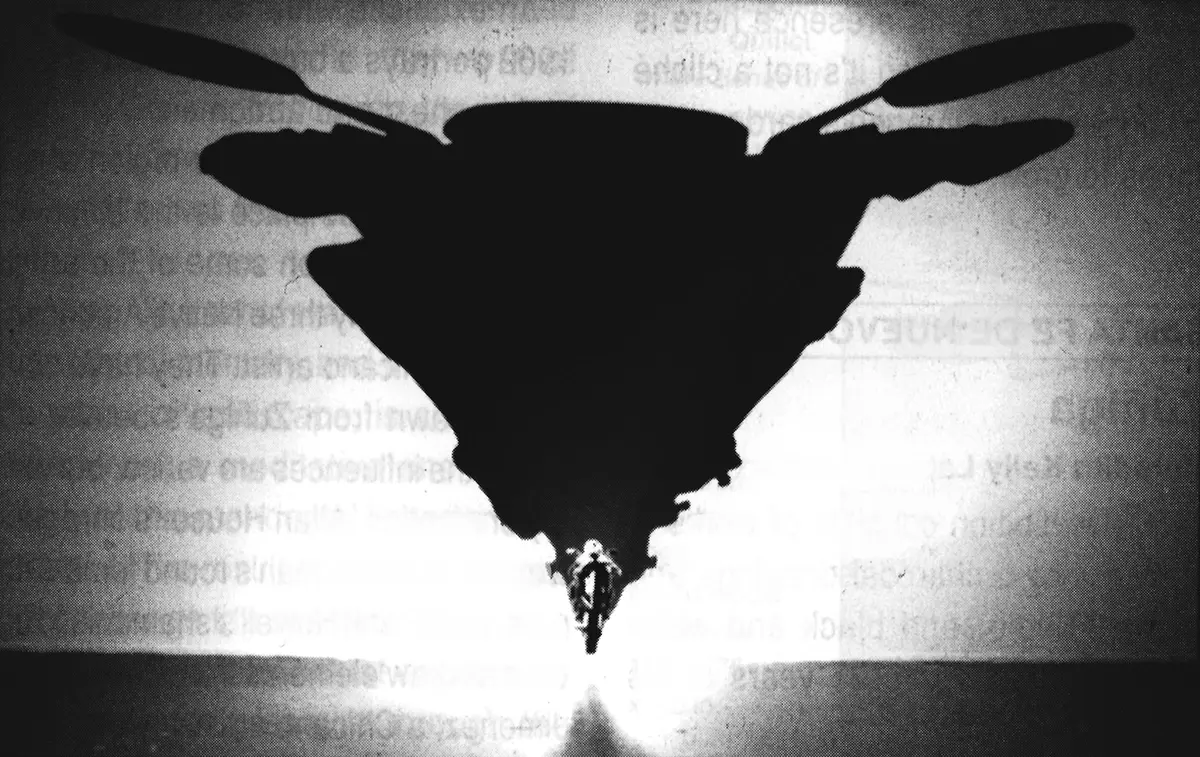
Silveira interprets a visual technique called anamorphosis. With the development of the Renaissance perspective, came the discovery that a distorted image could be made to appear normal when viewed from a particular angle or reflected into a mirrored cylinder. Leonardo da Vinci made amorphic drawings as early as 1470. Silveira, however, does not provide a means to a corrected view. As it is, the viewer is invited to make sense of this vertically aligned odd couple only through connections between the photo edge and the painting outline.
From a distance of 80', the viewer has an obstructed view of the work. The miniature motorcycle charges straight at you with its back tire hard against the polished concrete floor and the front one raised. This familiar "wheelie" position is the classic show-off pose of a daredevil biker gaining speed to make a death-defying leap.
Motorcycles take us back to films like the Wild One or Easy Rider and forward as the machines like the Harley Davidson continue to project fantasies of sex, excitement, danger, and romance to new generations of cyclists.
Realizing that the motorcycle also carries the message of macho power, Silveira summarily cuts it down to a quarter of its normal size. Though not necessarily a feminist statement, this miniaturization reduces the biker image to giggles rather than gasps. Size does matter.
On the other hand, Silveira magnifies the psychological impact and drama of the biker's shadow. The work reminds us of our instinctive fears and the terror invoked through enlarged shadows. Such threatening dark forms have been used in horror films since the silent era and were employed to great effect as giant spaceships darkened cities in the 1996 film Independence Day.
In Silveira’s work, fear intermingles with the innocuous and mundane ink blots used in Rorschach tests. In this type of mind game, patients are invited to voice their interpretations of an ink spot on paper that, when folded over and opened, becomes an abstract shape. What they see can be sometimes humorous and often disturbing but always revealing of the person’s state of mind. Silveira’s giant black form is descriptive of the mental enlargements we sometimes concoct out of small insignificant things. Velox communicates like a smoke signal and sends a message that Silveira wants her art to illuminate reality rather than fabricate illusion.
ROGER WELCH