
Araucaria, a tree of the conifer family that once flourished in the South American forests on the Atlantic coast and is now virtually extinct, was the title of this show by Rimer Cardillo that featured work from the last decade of his production.
The title reflects Cardillo's ecological concerns and is a metaphor for the periods and losses that make it difficult to reconstruct the past, inexorably blurring the present and threatening the future. It also locates in geographic terms the route that marks the beginning of his archaeological journey-one which is also, in good part, that of his art and life.
What at the beginning of the 1980s consisted of research into the fate of the indigenous peoples who formerly lived on the Uruguayan soil (his native land), often acting as an allegory of life under dictatorship (Uruguay, 1973- 1984), broadened in the following years to other spheres of Latin America, an area which is not limited only to its territorial or sociological definition but includes the pre and post-colonial cultural profiles of the physical place and conceptual dimension of his work.
The repertoire of objects and images which Cardillo handles ranges from fossilized animals constructed in terracotta to curtains printed in serigraphy, presenting a kind of antitaxonomy of archaeological discoveries in Uruguay and the adjacent Atlantic regions. I say anti-taxonomy because in Tapestries in the process of disappearance (1992), Cardillo, far from wishing to establish any classifications, tries to provide a summation in terms of quantity, differences, and similitudes, as well as the catastrophic nature of the losses involved. In these works, sequential registers printed on wallpaper show the trading activity of an indigenous woman with an age-old turtle; street dogs appear in various kinds of representation-including xylography on fabric-and the same turtle emerges from the paper and becomes three-dimensional in wire and a wooden reliquary is transformed into a near parody of some piece of electro domestic equipment. If there is one thing with which the artist is not sparing, it is his technical resources, which he also handles with a mastery rooted in long experience with his media. It is precisely this familiarity, and in particular with print-making, which gives Cardillo the authority to make the technique serve the interests of his ideas, to transgress it and make use of pastiche, although without any postmodern pretensions. It is in his case a fundamental strategy that guides his work, through the condensation of a host of problems and their variants and the various points of view from which critical analysis can be proposed.
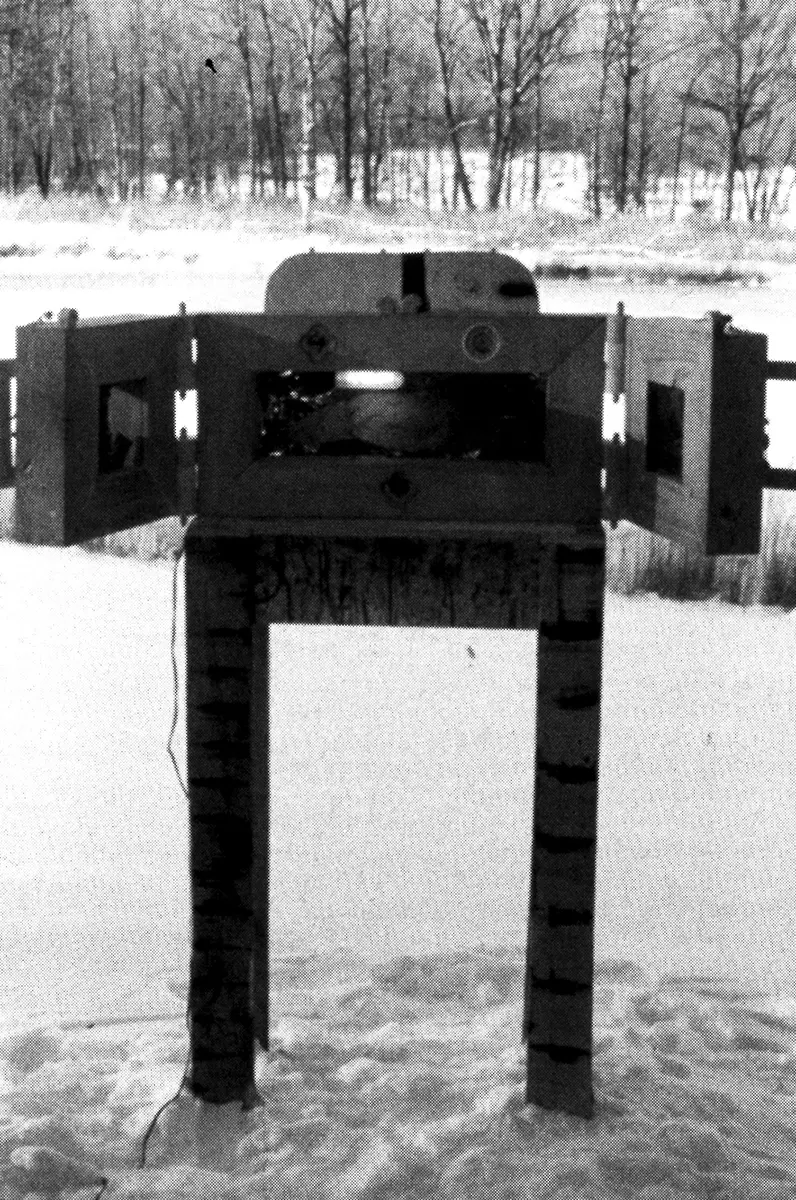
At times, the relationship between images, periods of time, and materials become paradoxical, as in the case of the wire turtle noted above or the Reliquary of the little mule (1995), in which the fossil of an armadillo appears protected/threatened in a wooden and aluminum construction which includes a microwave oven. These hybrid creations by Cardillo are commentaries —from the particularity of an armadillo— of the inexorable cultural contamination which has affected and continues to affect the destiny of our world.
Particularly significant is Hooves (1997), a work in which two deer hooves have been soldered together by a piece of wax-covered bronze. The symmetrical assembly of the hooves converts the resulting form into a kind of boomerang. The association gives the piece an effect of efficiency, transmitting the artist’s latent sense of fear and providing a warning which is implicit in the entire show: all the actions and omissions which make up the architecture of history will fall back on us and determine our fate-the old dictum that we will reap tomorrow what we sow today.
Fragment by fragment, Cardillo blends levels of information in cultural anthropology which seeks to recuperate marginal histories, forgotten rites, decimated animals, and times without cronos, emphasizing the notion of continuity, revealing a social construction of the present which is shown without mystification. On the contrary, the critique is latent and there are indications that involve us and confront us with our own indifference and with the widespread passivity that we share with the most direct protagonists of this world whose routine is now about to collapse.
In this sense, it is interesting to see how Cardillo mediates between this distant time that he is recording and the present which is unfolding. He does so by making use, on the one hand, of his own pilgrimage to the place of events and, on the other, of his condition as a contemporary artist handling a wide range of modern technical resources. The technology of computer-manipulated imagery, as well as the handicraft features of a figure captured in clay or print-making techniques for the transfer of an image, form a counterpoint, as does the artist’s attempt to incorporate himself into the socio-cultural landscape which he narrates and to give an autobiographical dimension to the work.
Tlazolteotl (1996/1998), a serigraph image on a mirror, is paradigmatic of this use of counterpoint, not only because of the more direct involvement of the observer but because the reflection functions, in this case, as a window linking two spaces-although the window does not open and the window is only an illusion. Tlazolteotl is an Aztec goddess of creation, illumination, and absolution. Cardillo handles his images over and over again, sometimes frontally, other times in profile. The image is printed on mirrors or very peremptory kinds of paper, within a small wooden frame, or serigraphed in large format, in the crystals of the Bronx Museum building. It is a metaphor and emblem of life, continuity, and of art itself. Tlazolteotl and Hooves are the two extremes of the spirit reflected in this exhibition.
The show was mounted in a manner that highlighted Cardillo’s process, by divesting itself of the more formal aspects of his work at the beginning of the 1980s and focusing increasingly on the conceptual profile of his current production. The pieces, although unique, share a reflective structure which, coupled with the careful curatorial approach and montage, interacted to generate an effect similar to that of an environment. A dialogue was created which made the spectator assume his responsibilities but in which the responses and solutions were difficult to visualize.
Finally, we might say that it is time, itself made up of a countless number of different superimposed times, which forms the backbone of Cardillo’s work, reflecting his attempts to recuperate a memory that is virtually lost and is continually being further eroded. The exhibition was an expression of something which Jorge Luis Borges said in his History of Eternity, "without an eternity without a delicate and secret mirror of what souls have experienced, universal history, and with it, our own personal history is time lost and wasted."
ANA TISCORNIA