
If there is one characteristic that marks recent Latin American art it is the eclecticism with which the more or less recent past is taken and mixed in. That attitude is accompanied by an experiential posture: the weight of one's own experience. If we assume that the past is the space for interpretation, memory acquires a special significance: it is that which allows one to pick and discard. It is one of the various elements that construct identity and can be seen from two perspectives: a more personal and subjective one, referring to our memories, and another one that is more closely linked to rationality, which is to say, that which provides us with information. Both memories are present in each of us; both influence our behavior and are difficult to separate despite the fact that the first moves in the private sphere and the second in the public.
So, given the subjectivism and the experiential attitude already mentioned, various artists see the past as a stage for a series of individual and collective memories with which they can relate themselves, most often in order to reinterpret them. To look at the past, to rediscover it, allows one to assume differences from others and thus, define characteristics of identity.
Rodrigo Facundo (b. 1958, Ibagué, Colombia) aims to produce a meditation that transcends his personal history; in proposing to analyze those signs that form part of the collective, centering his inquiry on a space that seeks to understand what is exterior to the self, avoiding remaining stuck in the narcissism of self-contemplation.
"I have always been interested in domestic life. Those images one finds in family photo collections, in department store catalogs. I take nothing from them but the taste, what I like about that image. I feel like a catalyst for all the images circulating in whatever place I find myself... I select those images consciously. That is how I find the signals."1
What relationship exists between the notion of knowing who we are and the form in which we handle memories? This is a question that appears again and again as the background for the formulation of his concepts. Reality becomes for him a space in which to reconstruct a world outfitted with archivistic resources, storing images that reclaim and recontextualize.
In the early nineties, his initial painting was making room for highly textured surfaces in which photographs were combined. Reflecting on a statement by Susan Sontag, "All photographs are memento mori. To taken photograph is to take part in the mortality, vulnerability, and immutability of another person or thing"2 Facundo takes the photographic image as a reflection of the past.
It is the possibility of showing a moment or the passage of time and they possess the double alternative of being present and memory for they permit the longing for or recomposition of another reality. They are the trace left by an instant that has passed.
In his series Instantes y huellas (Instants and Traces) from 1991, he combined two elements charged with meanings: photography and clay, producing objects that sought to have a direct impact on our senses. By concealing the photographic processes, he left the spectator to find them, lost among the features of the clay. And from them emerged characters from art history, anonymous figures, and natural disasters preserved by photographic memory from certain oblivion.3
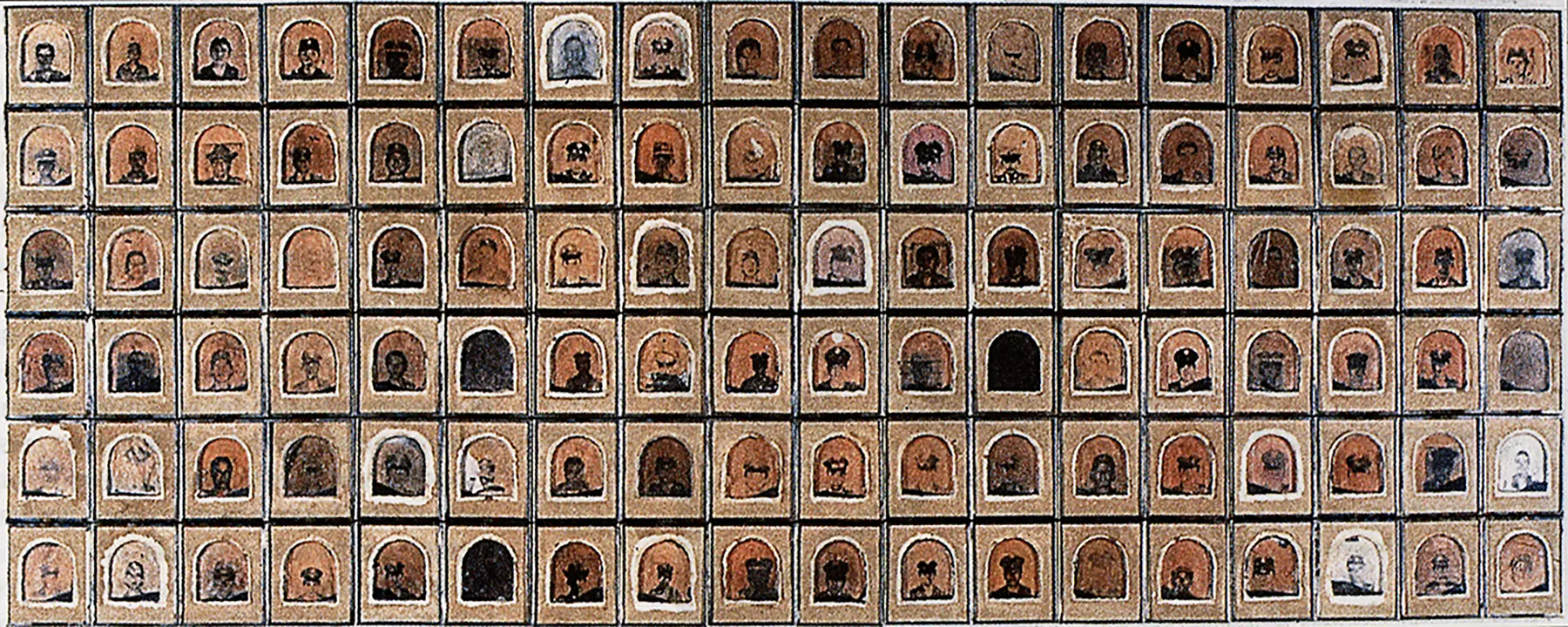
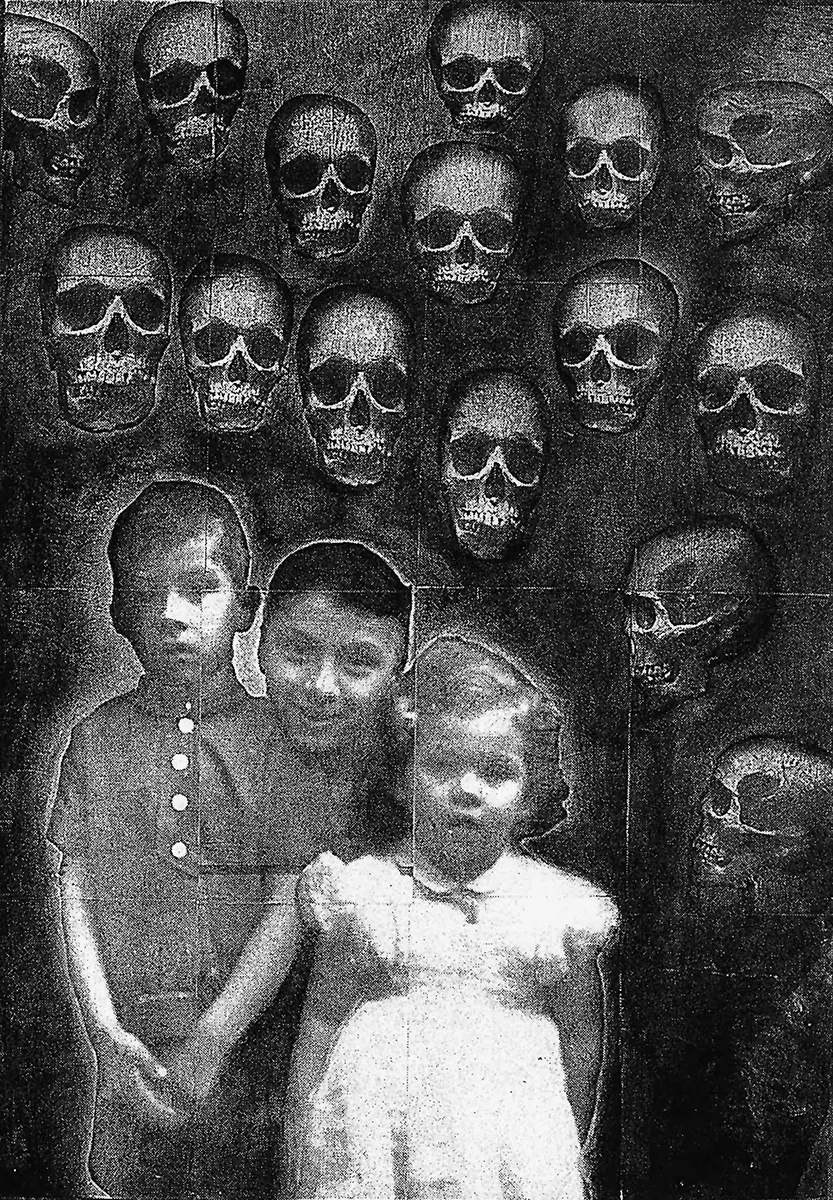
The sensation of a funereal place, of a place of loss and the experience of mourning, becomes concrete in works like Luz perpetua (Perpetual Light) and 1084 from 1992. The violence and the memory of those who have disappeared become a constant for those living the daily reality of Colombia. Facundo attempts to sublimate this daily reality, to look at it in a more poetic manner, to reorganize it, recomposing the memory fragments. Within small niches laid out in rows, as they appear in cemeteries, he placed photographs blurred by the film of paraffin with which he covered them. Past time, and memory, became present for our perception.
The material the support was made of cracks and all that is left—as in reality— is the emotive nature with which present time charges those ecstatic images of the past. And the meaning of the photography changes: it is no longer the image that is looked at indifferently in a newspaper that illustrates acts of violence. The frozen presence of the anonymous face seeks to incite the spectator to experience mourning as well, now collective mourning.
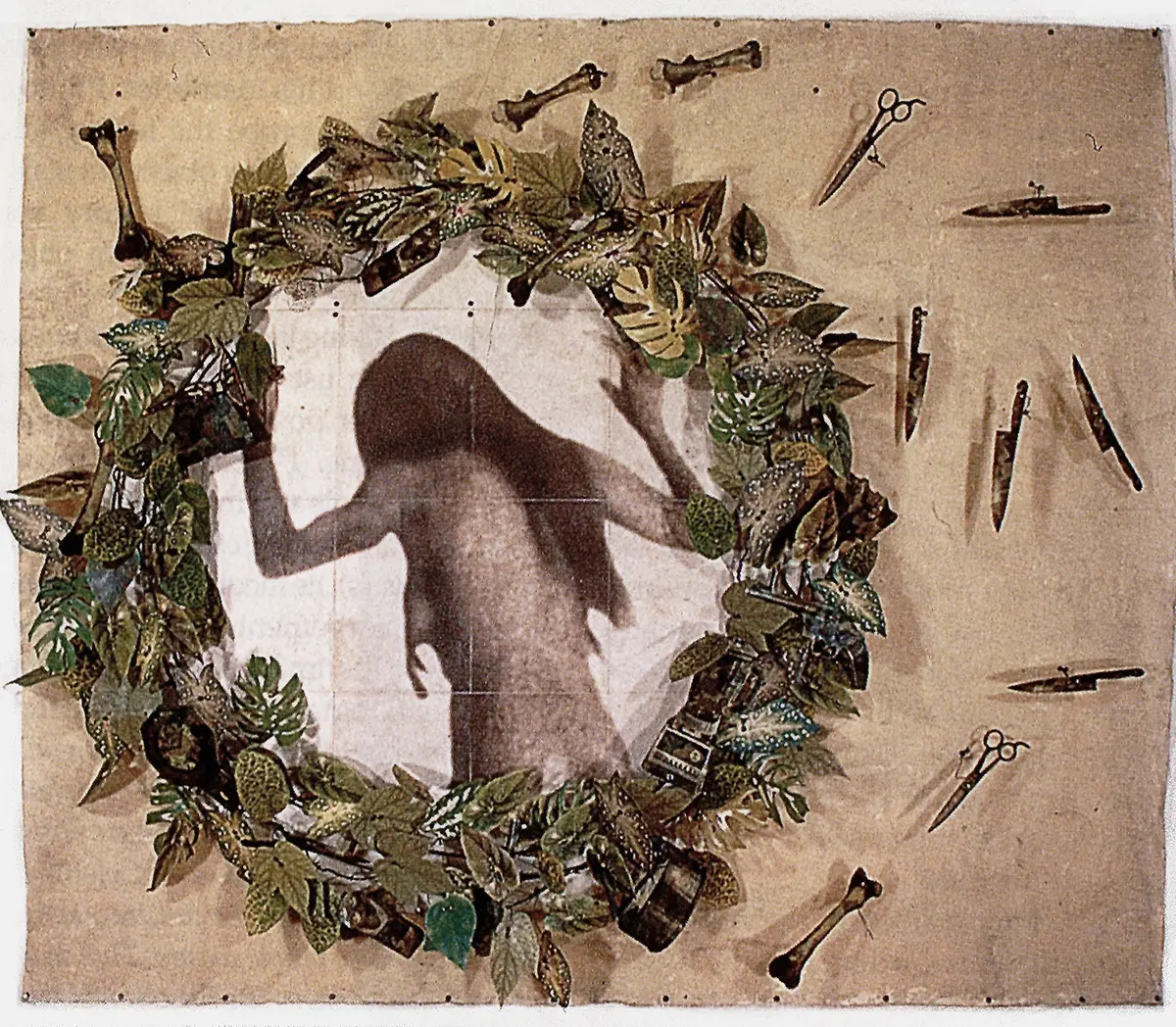
Perhaps remembering the reflections of Baudrillard regarding objects, Facundo begins in 1993 to combine everyday objects with anonymous figures. His Objetos melancólicos (Melancholy Objects) are cut-out figures, printed on paper or fabric, coated with wax, and set among household plants. Leaning against the wall they produce a sensation of fragility, of lightness, of possible disappearance. Objects like revolvers, bones, and picture frames, are camouflaged and allude as much to domestic violence as to external violence. Therearetheobjects that accompany man, like his trace and his memories. Photography helps him probe the feeling and function of the everyday object but it also allows him to reconstruct history and death ends up recognized in an object that invites reflection.
In 1995, utilizing large-format canvasses and making use of mixed media, he looks into other possible gazes onto the passage of time. Photography doesn't lose its central role and in works like El rey delosanimales (The King of the Animals) and Cocos (Coconuts), he incorporates big photographic enlargements that take as their initial referents images taken from the religious iconography of the colonial period. "I know that there are prejudices against the figurative in painting. But I know that in this place where I live a visual culture prevails that comes from the period of the Colony. It is a period that formalized the culture of naivete and produced the people we are. That is why sometimes my images use the colonial visual code that was basically for images of worship. I know that by combining different images in the pictorial space that what I am doing is switching temporal and social codes. In the end, all of my images are borrowed and sometimes I ask myself: what here is not borrowed?."5
And since memory is recovery, it is not forgetting, he goes on bringing those images into the present era. The fragments are set in a new context in which the mixture of reality, subconscious personal experiences, and collective memories is not missing. In November of 1997, Facundo mounts an exhibit in the space of the Santa Fe Gallery in Bogota, an installation titled En la punta de la Lengua (On The Tip of The Tongue). In the exhibit catalog, he explains the following parameters of his inquiry: "The distance that exists between our personal memories and the history of the country is more complex than the distance that exists between a 'now' from which we remember and a 'before' that is remembered. Personal memories and our understanding of history start to create a map whose composition is based on distinct, mutually exclusive languages, and in both cases, space manifests itself in a drastically opposed fashion. This dichotomy allowed me to come to the conclusion that our history takes place in two parallel realities: in the absence and inwardly. By 'absence' I mean the way we constitute ourselves as passive witnesses of a history that is constructed using external elements as an official story that becomes an imposed, foreign memory. In a parallel fashion individual memory is developed "inwardly," with a unique character and virtually impossible to transcribe ..."6
This extended quote allows the reader to come closer to the concept that lay at the base of the research for this project: the recognition of the coexistence of two parallel levels of memory. Such is his reflection on the particular situation in Colombia in which memory is fragmented and broken apart in a society with a proclivity to amnesia. And without wishing to arrive at singular answers regarding how to construct a national identity, he attempts in his work to show the encounters and separations existing between collective memory and the subjective and personal map of autobiographical memory. The proposed goal in these meetings from diverse dimensions is to begin to remember, questioning with its images an official story that runs the risk of becoming an imposed memory.
In his use of three keywords—places, people, and though—he chooses a series of images provided by his family album and by the documentation of historic events, in addition to the emblems, flags, and even cartoons that in one way or another provide a graphic summary of events.
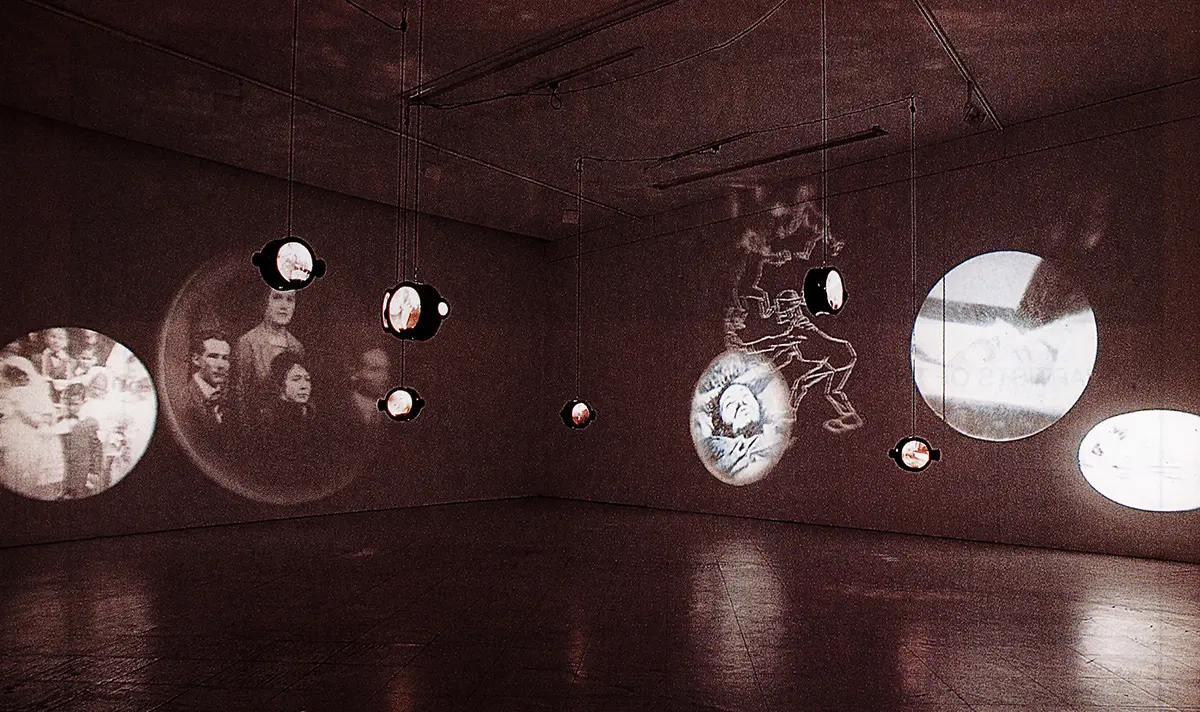
Because history so frequently attempts to immortalize itself through monuments that become spaces with the peculiar quality of eternalizing memory, Facundo takes up this notion and reworked images to create his own monuments. Without forsaking his interesting photographic documentation, he seeks resources in various techniques of visualization used in the nineteenth century, important antecedents in the development of cinema. His research on devices like the stereoscope and the zoetrope formed the foundation for his circular Arquitecturas del eco (Architectures of the Echo) and Recuerdo de las formas ambiguas (Memory of Ambiguous Forms).
Assuming that memory allows us to gather together very personal fragments of reality, Facundo very rapidly "shoots" images that, through the means of metaphor, are transformed and converted into symbols diametrically opposite to their originals. There is an intention to make manifest how certain values associated with certain symbols are subverted by the passage of time: abundance-poverty, freedom-oppression, and so on. It is as if he wished to place us once again before the past so we might be capable of reclaiming ourselves from amnesia and able to discover and understand the real history beyond the traditional accounts.
And in this gaze, aimed equally at collective history as, at the personal, there continues to be an aspect of a search for identity. That return to history is a return to the sources, to the public spirit as well as to the spiritual heritage of the nation. He doesn't seek to create an imaginary one so much as to reconstruct it through new perspectives.
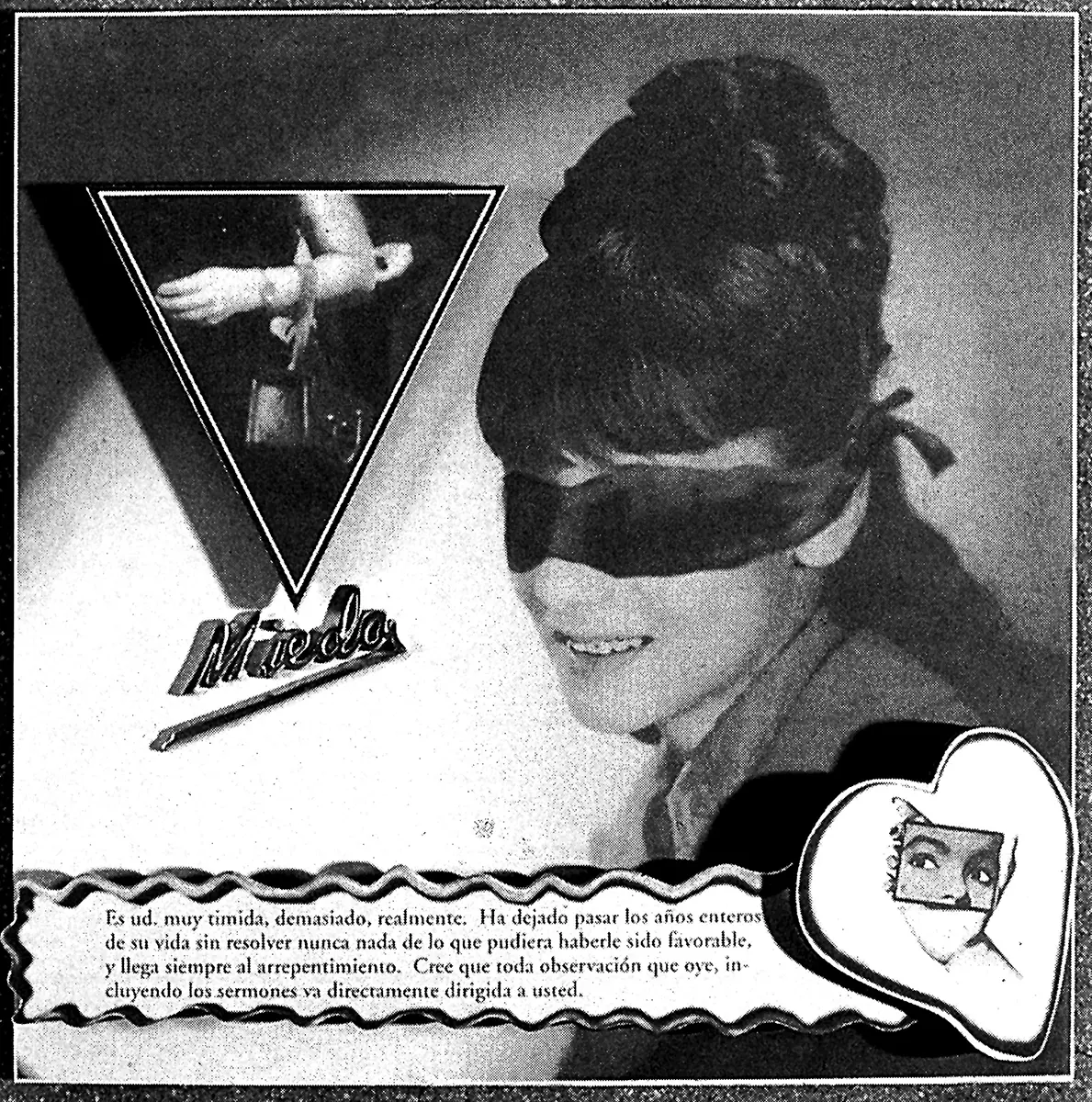
In 1998, his inquiries have led him to propose a series of Anónimos (Anonymous Figures), attaching histories to fictitious characters, as they approximate certain attitudes one can find in everyday life and which form part of the recognizable stereotypes. And there again appear memory and identity in the way that through his images he intends to show how a contrasting duality exists between the external ideals shown by publicity like models of happiness, of individual achievement, and the reality people actually live.
The sources for his images come from magazine and newspaper advertisements and his visual discourse has the opposite effect of publicity: instead of announcing utopias, they announce desperation. With digitally manipulated images, he bums offset plates which function not as the basis for a mass-produced piece but rather as the matrix of the piece. To it, he incorporates, in the style of an assemblage, cut-out objects.
Skepticism seems to be gaining ground in Facundo's work and the text by Baudrillard that accompanies his Anónima Desilusionado (Disillusioned) could be the frame of reference by which to conceptualize the images:
"You have the illusion you exist for something and to break the continuity of nothingness. But deep down you know that you don't add anything to the nothingness of the world for you form a part of it. Out of fear of not desiring anything you would prefer to desire nothingness. Existence is that which one doesn't have to give oneself over to. It has been given to us like a consolation prize and there is no need to believe in it."7
Facundo seeks not only to explain the past but also to understand the present, concerned with the accelerated ideological and political destabilization due to the crisis in social identities.
The past has been his connecting theme, exploring the use of materials and techniques extracted from the material culture, from everyday life, and from the collective imagination. And in the recovery of valid resources for the creation, there are no innocent representations of the past, as the thought of as much from a perspective of inquiry into identity as of a questioning of the accounts.
NOTES
IVONNE PINI
Professor at the National University of Colombia. Executive Editor for ArtNexus.