

During the month of March, the Colombo American Center presented an interesting exhibition curated by Germán Rubiano Caballero, titled Sculptures in Wood, featuring works by seven Colombian sculptors who, as the curator pointed out, "do not form a group" as all are from different generations, with their own different interests.
The curatorial criteria were based first of all on the quality of the works and the marked degree of participation of these artists in the artistic activity of the country, reflected in a constant work process that has led to the full development of each work. The curator noted that “they are all interested in carefully crafted work, as well as geometry, the sense of order and although their work is essentially abstract, in almost all cases there is a reference to various realities which range from pre-Columbian art to the presence of machines and instruments, as well as nature." The selection of the works, which were from different periods, reflected these characteristics and the versatility of the language of wood as a sculptural material whose possibilities extend from carving to modern assemblage.
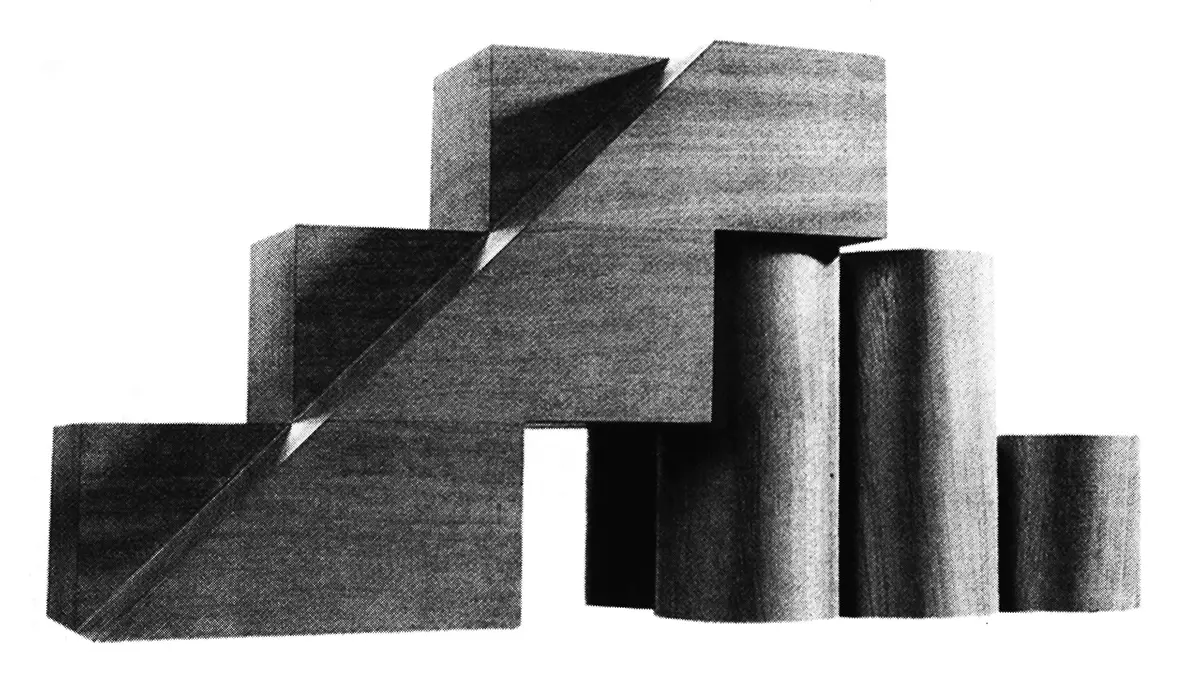
The most established artist in the show was Eduardo Ramírez Villamizar, who presented three works, all constructions in wood dating from 1963. These are part of a series in which Ramírez Villamizar abandoned chromatic language and two-dimensional works. They are impeccable reliefs in white painted wood, in which the artist creates what might be described as folds in geometrical patterns that create ascending and circular rhythms in which the artist announces the course of his sub sequent sculptural production, in which the work establishes a dialogue with surrounding space without forgoing a certain inde pendency as an object: that is to say, the work behaves within the parameters of modern sculpture.
As the curator points out, Villamizar as well as Germán Botero, and Alberto Uribe have maintained links with architecture, and the work of the three artists reflects “a control by the intellect and the confident handling of a wide range of problems involving space and construction." The last two artists sometimes use guaiacum, a hardwood, as in the piece titled Ferruco, by Botero (1993), along with bronze and aluminum, and in the untitled work from 1978 by Uribe that also uses calibrated iron rods. The pieces by Botero relate to the world of objects, and in particular, machines, while those of Uribe are conceived within a strictly geometrical order.
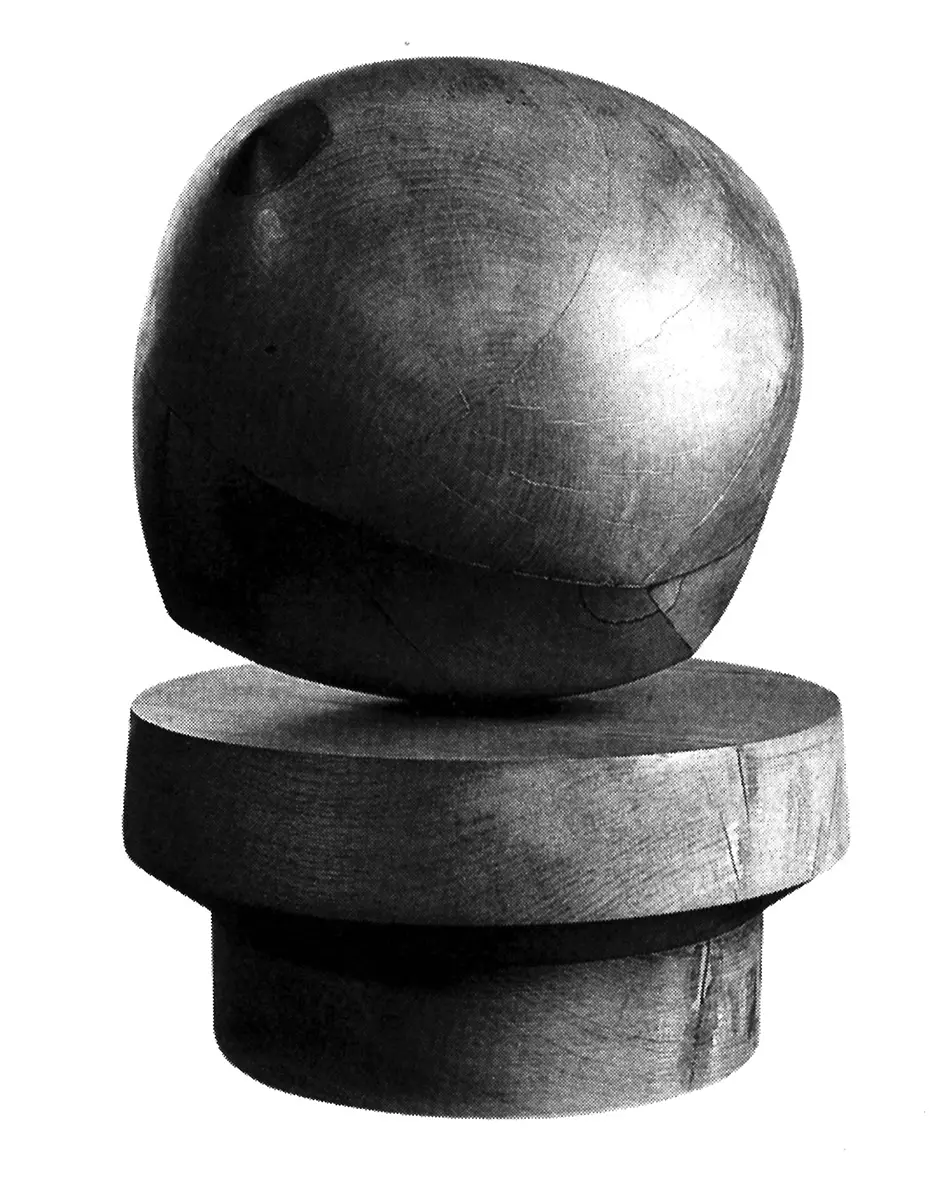
The other participants were from a generation of artists born in the early 1950s. One of them was Hosse Vanegas, “a skilled assembler of volumes which oscillate between organic and strictly geometrical references." Vanegas presented two pieces executed in bolondo wood from Africa, titled Serpent and Skull, both from the early 1990s. The other three participants were Consuelo Gómez, Teresa Sánchez, and Mónica Negret. Each exhibited three works from the 1980s and 1990s. These artists began their production at a time when three-dimensional works were acquiring a greater awareness vis-à-vis the space. The early works by Sánchez and Negret propose ruptures in sculpture and painting; Negret's incorporate color reminiscent of a painting. Consuelo Gómez has produced some very rich and varied work which has always been characterized by her excellent handling of materials-wood, glass, and metal, as well as by her particular vision of form, objects, and the relationship established between each of these and with space. In one work, a polished base served as the support for a rather irregular semisphere which achieved an unusual degree of equilibrium. In another work, a solid and very pure form ended with a small glass opening.
Teresa Sánchez is a very interesting artist whose approach has remained constant since the 1980s. in both her early pieces (which as noted above were of a more pictorial kind) and in her more recent work in three-dimensional production, she has used wood as support and essential material. Her recent objects reflect a very particular kind of sensitivity toward the essence of pure form. It is an essence that often refers to the natural world, whose forms are transmuted into “minimalist" objects, in the sense that they interact with space and are conceived through an intellectual purification of the elements that result in the considerable economy. At the same time, they are very distant from minimalist practice in that the artist handles her material, generally various kinds of wood, in terms of its intrinsic qualities of weight, color, and texture. Whether in carvings or assemblages, she always leaves her indelible mark as their creator. This time she presented three very characteristic, delicate, elongated pieces. In one, the wood establishes a dialogue with the emery dust; in another with heavy material, iron; and in the third case, the work was constructed with two kinds of wood, ivory, and walnut.
It is interesting to note that this exhibition focused on sculpture in wood, managed to gather together artists who, as noted above, belong to different generations and whose investigations are related to the concepts of modern sculpture, as in the case of Ramírez Villamizar, as well as the more contemporary conceptions which call into question the very concept of sculpture. The curator, who was well aware of the fundamental differences, successfully presented a very wide panorama within a framework of purified harmony, the result of a montage which, like the floor works, was very well illuminated. The show clearly confirmed that “carefully crafted work... geometry and the sense of order" are indispensable tools for the exploitation of wood as a tactile material that is able to express itself in different ways both in modern artistic practice as well as in contemporary forms of art.
MARTA RODRÍGUEZ