
This exhibition consists of works in bronze, onyx, charcoal drawings, and some 30 color and black and white lithographs spanning 35 years of his significant career.
Though born in San Jose, Costa Rica, Zúñiga has always been considered a Mexican artist. This is due to the fact that he has spent most of his life there and to his connection with the other Mexican masters, namely Diego Rivera, Orozco, Siqueiros, Cuevas, and the Frenchman Jean Chariot.
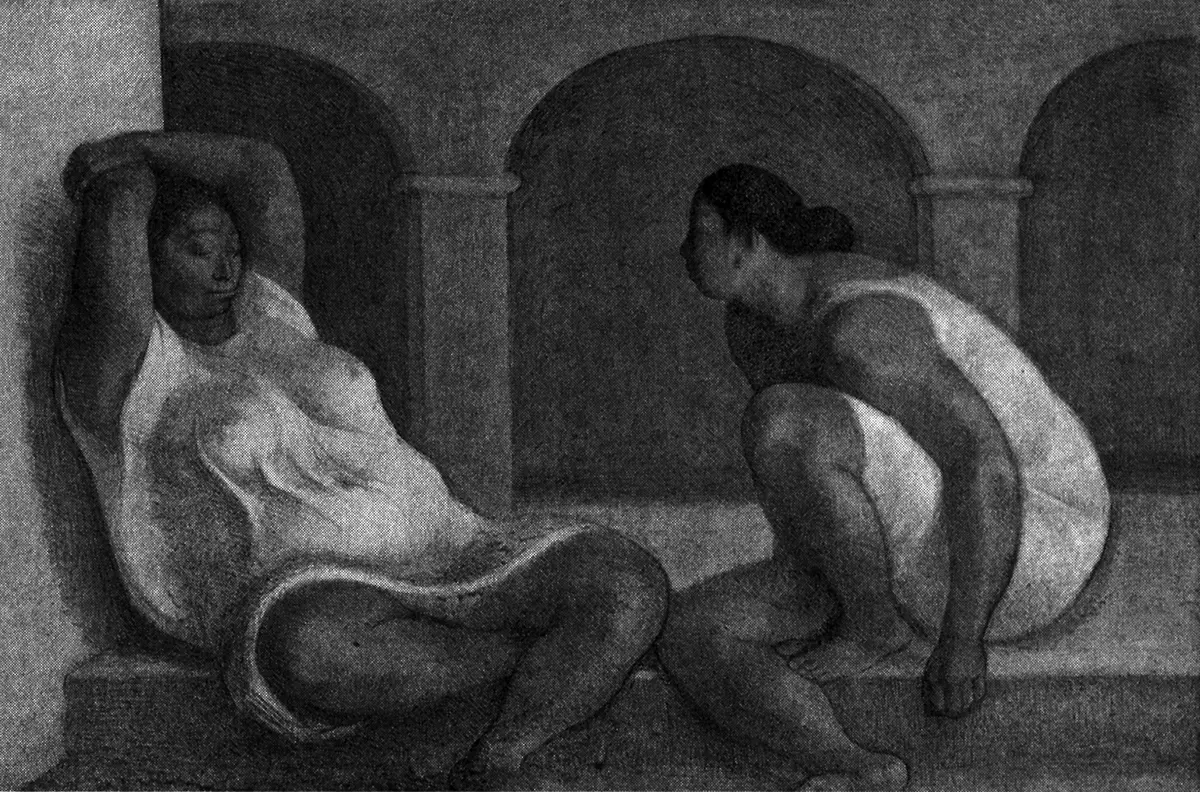
There are many notable works in the exhibition: El Coloquio, a lithograph, shows two women having a conversation in a portal. The feeling portrayed is deep and complex, though the moment seems commonplace. One of Zúñiga's greatest distinguishing marks is the attitude of portraying deep emotion in simple moments, along with masterful draftsmanship.
A series titled Mexican Masters Suite relates directly to the sculptures in the exhibition, and the sculptures themselves seem to bring the two-dimensional figures into the space.
An exquisite white onyx figure from 1962 portrays a buxom woman resting on her chest and abdomen.
Of special interest to the region where this exhibit takes place is the influence of Zúñiga’s work on some of the artists here, particularly three Native Americans and one Chicano artist. They have obviously drawn from Zúñiga's oeuvre. Of these, the influences are varied but worthy of mention. Allan Houser’s shrouded women, R.C. Gorman’s round female figures, and Frank Howell’s shamanistic figures all draw elements from Zúñiga. Luis Jimenez, a Chicano artist who is known mostly for his monumental cast fiberglass works, also demonstrates a significant connection to Zúniga. Both artists create drawings with elegant lines that provide the basis for their sculptures.
The show's opening and related events caused great commotion here as there is special interest in this Spanish-speaking community for recognizing itself into the rest of the Latin American world that they have been isolated from for such a long time. Two lectures were presented at the Museum of Fine Arts in conjunction with the exhibition. David Retting of the Allan Houser Foundation spoke about the mutual appreciation that Zúñiga and Houser shared for Henry Moore. Edward Sullivan, Chairman of the Art Department at New York University, gave a conference on Zúñiga’s work and its significance to Mexican and Latin American art. He drew interesting associations with early Chac Mool figures and the work of this artist and spoke eloquently about the spirituality and sensual nature of the work. This spirituality and sensuality are still evident in Zúñiga's most recent sculptural works, even though these were made after the artist lost his sight.
STUART ASHMAN