
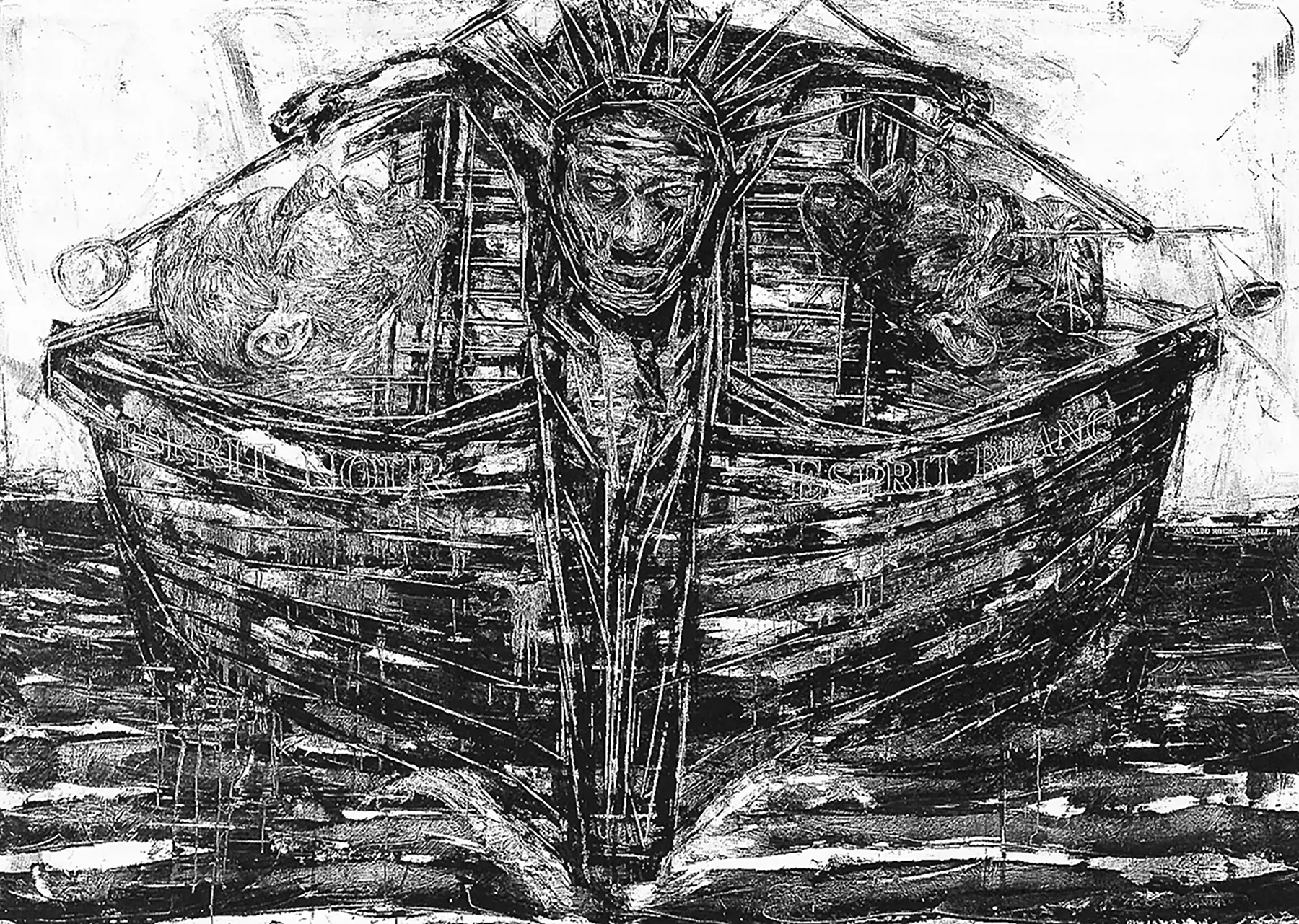
Federica Palomero: My first question is about painting. In this way, it spans the questions to come, given that your entire work is inseparable from painting. It is a question that perhaps you would not have been asked in the early eighties when you began your work in art as it corresponds to a moment of great stimulus for painting. During the nineties, it seemed that at an international level other languages have been preferred by artists and critics (not all of them). Where do you situate yourself nowadays in relation to painting as a technique and as a language and in relation to painting as your way of being in art?
Arnaldo Roche-Rabell: A question like that leads me to another which I ask myself: What is the reason for my work? What drives it? To whom is it addressed? All these years I have been so busy trying to validate my personal experience as an artist that I haven't had time to ask myself how the development of currents in art has influenced my work. The key question I always ask myself is: Where do I want to get to with my work? One might paint for a variety of reasons; one of them, which is quite valid, is to comment on art, in a philosophical or political fashion. For others, it is to paint for God.
During all those years, I have asked myself where have I found that certainty that what I paint is something worthy and meaningful to such an extent that it manifests itself in physical terms. I don't paint for God. I see art as an instrument that has been given to me, in which I see myself, commune, and take pleasure. Daily life becomes the foundation of my work; I want to be a "historian" of one single story. I have this need to translate everything into images and am fascinated by how we see and interpret things. All events, with multiple interpretations and varied angles and perspectives, become images.
To use and explore them is part of my objective, if a certain contemporary school makes possible the enlargement of the perception of the world then any of the achievements in technique or language it has developed are relevant.
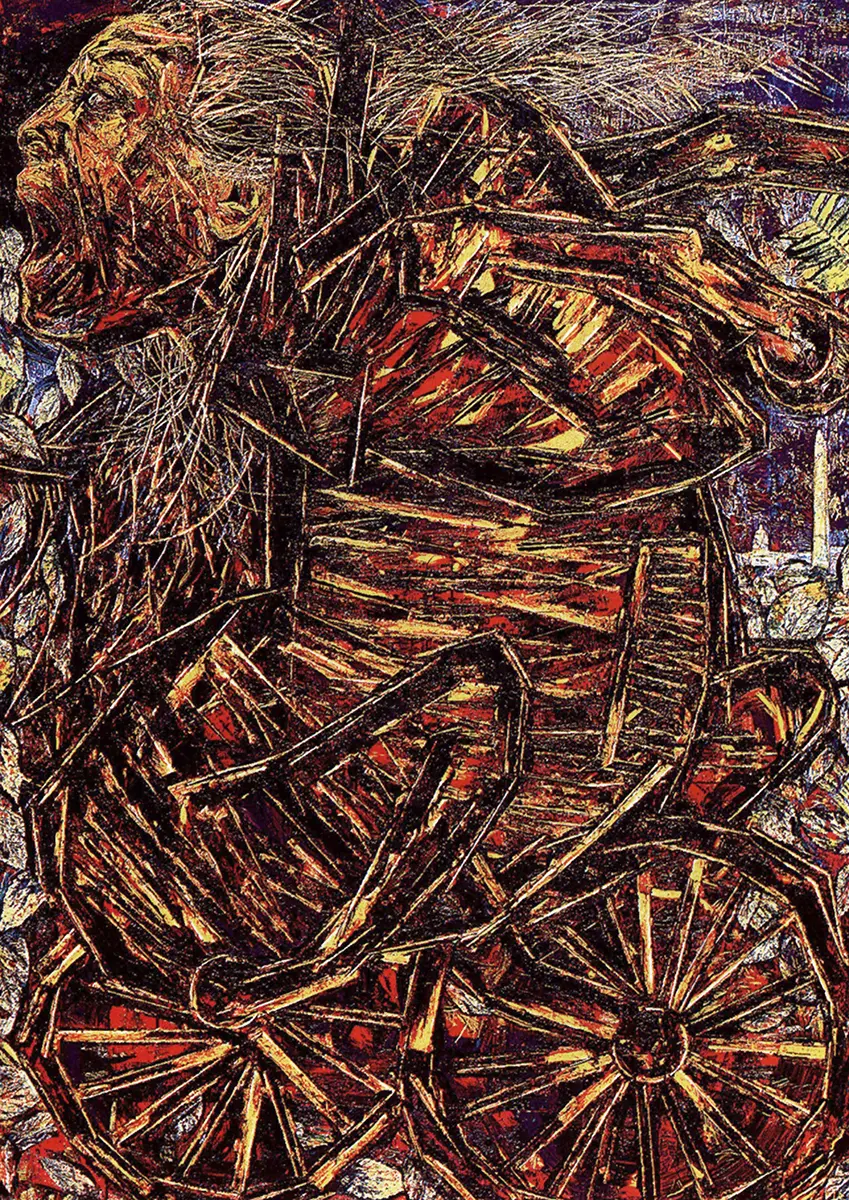
F.P. In the words you just used, a sense of painting as ritual appears in a certain way. But in addition, one must take into account your particular technique of frottage or tracing, that resembles, in its immediacy, violence, and uncertainty regarding the final product, a performance—a very private performance—since you are physically involved and involving the model. Is painting a ritual?
AR.R. My painting becomes a living ritual. My interest is in exploring possibilities, investigating, and commenting on life. As far as my starting from daily life, performance, due to its immediacy, seems to be the best means by which to get close to the people and the events that turn into the vehicles for my creativity. To succeed in touching people in a physical and emotional spot is the most eloquent way of living life. Initially, meetings with people or events may be casual, but the process of producing the work is slow and requires introspection, reflection, and even respect for the subject or the situation represented. In this time in which performance is established between the artist and his model, forces are being generated that produce the final event in which, in concrete form, the rational and irrational are transformed into images. I would like to persuade more than to demonstrate; I understand there is a process in life that I would like to imitate in my art. We move through life believing things, and associating ideas and concepts; these generate ideas that make us prophets, kings, or losers. That aspect of life fascinates me —I am conscious of creating fiction. I'm not looking for the truth of things. The ambiguity is part of a partial "language," a reflection of our reality. We live in a world of partial ideas, where we partially save ourselves, partially love, and partially share. And to give you an example: one is partially Latin American.
Even when I struggle with archetypes and images that presume to have a physical presence and absolute content, the real value which I attribute to them is that they reaffirm or question the notion of these things. There is no doubt that if living is a performance, it is an integral part of my ritual.
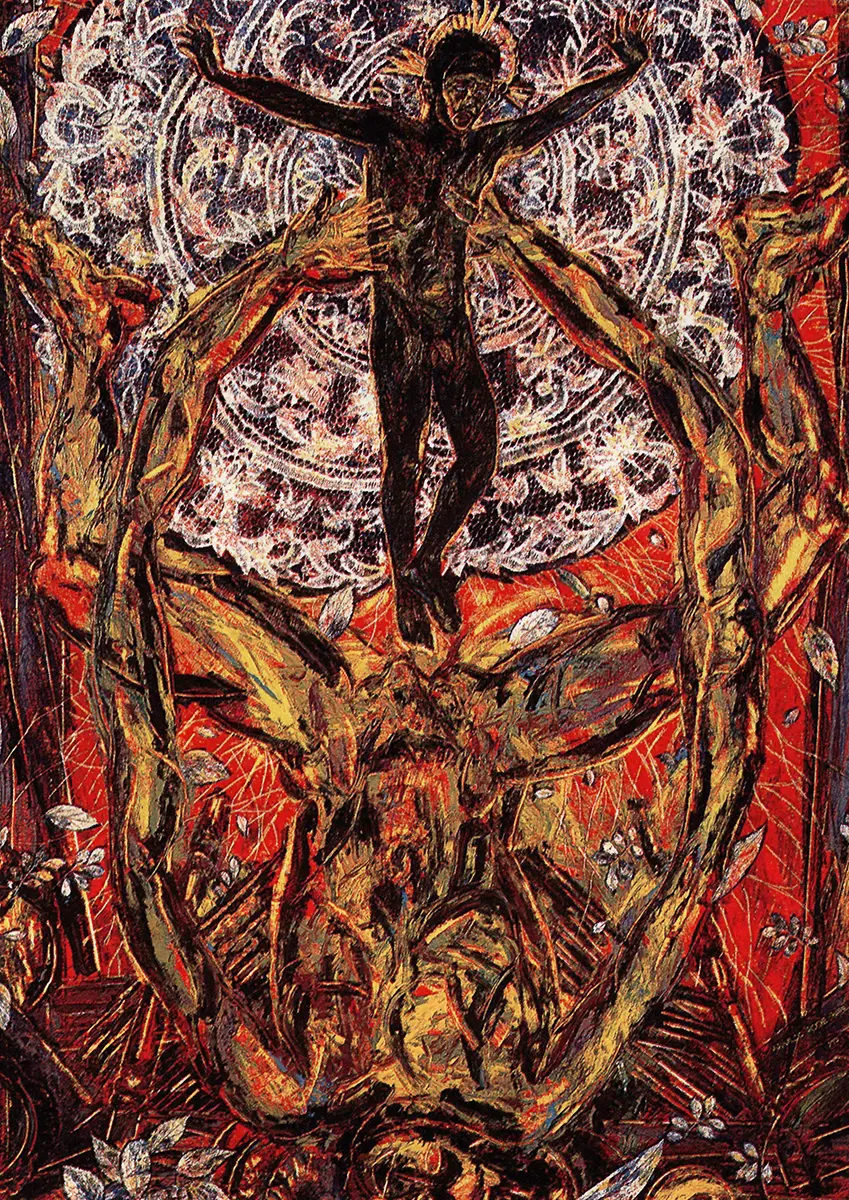
F.P. From what you just said, and from your work itself, there is a very particular, very tense sense of temporality. The immediacy of the performance and the time required for in-depth research coexist, seeing as how your iconography can become very complex. How do you manage to sustain that level of expressiveness, freshness, and of living life very experientially, integrating your thematic and conceptual inquiries?
A.R.R. So that you might understand how I achieve that strength in the immediacy of the moment, I must mention how intense and rich my life is. The only reason I have sustained over the course of so many years the same conviction and creative effervescence is that I have an elevated sense of the power of art, of what it can mean in the emotional development of an individual. It depends a great deal on what I call "the dramatic moment," in which one achieves that maximum physical and emotional closeness. It is worth mentioning that I have an obsession for life and for denying death, that my actions have a degree of rawness to activate the inanimate and to contain that which has life. Sometimes It feels like a plunderer on a sea of sensations and associations. Among the elements that generate this catharsis, that process of creating the image, sometimes over the course of weeks, one could mention dreams and revelations over which I have little control. From the interaction with models are born what could be considered heroic forms, but which in reality are normal-sized. The use of frottage as a methodology leads to the creation of those images in the extreme. I have the responsibility to extract light from the darkness. In the very act of painting, I scratch and that is how I bring my characters to the surface. Another factor that determines that inexhaustible energy is my certainty that the guarantee of transformation and change that life gives us is with me like a blessing. The process of developing an image can take a day or three months. The changes that take place are physically radical. Nothing is planned beforehand and the simple act of living and surviving on the canvas is what creates a stylistic continuity over the many years. In these processes it is necessary that not only I but the model as well and in other cases the concepts being explored, survive; otherwise, the work is destroyed.
This hypersensibility that induces me to show my things in my own fashion, to create mirrors, images in which the world of ideas generates passions that transform everything, creates a vision that could be called the psychobiology of the encounter. As I understand it, the piece turns into a testimonial and the spectator into a witness. During the last few years, I have been concerned with the role the rest of the world plays when looking at my work. I hope I have left sufficient space for the observer to interact in such an intimate process.
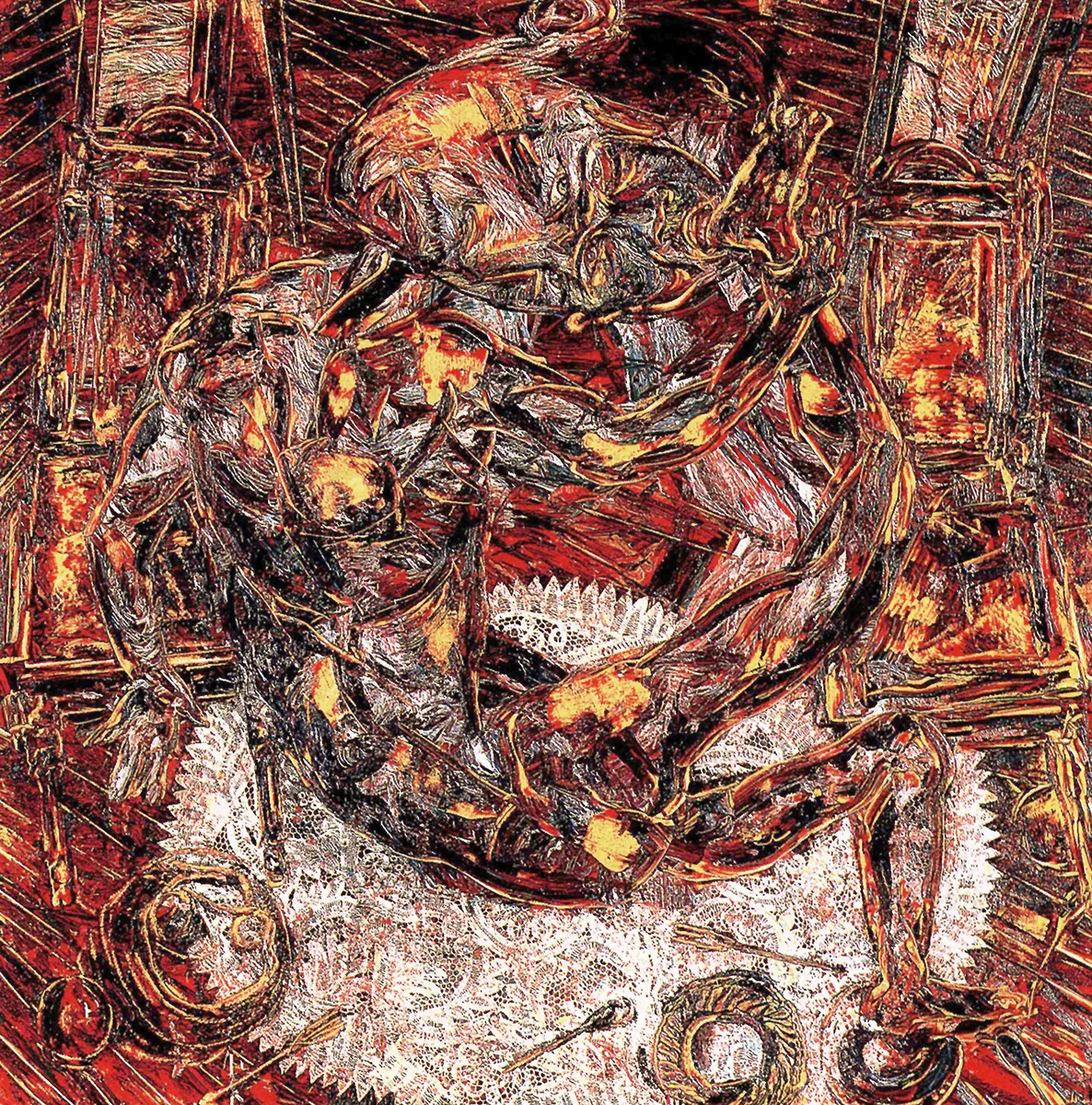
F.P. You speak of dreams, revelations, and the interaction with the "models." There is another aspect that interests me: your dealings with art history. Save a few exceptions, like the works of Jose Campeche and Osiris Delgado, there don't exist pictorial quotations or precise references, but there are evocative atmospheres and reminiscences that suggest a kinship with great works of the past, above all religious ones. How do these images emerge and how do you process them?
A.R.R. There's no doubt that the word religiosity describes the terms in which my work is realized. Historically, I am not the first nor the only one who has worked this way. I am the kind of artist who is not satisfied with this pretentious and often false world, and who decides to celebrate his own existence because to some extent it satisfies me and fills my gaze with my hands. As I said ten years ago, "beauty" is not in the eyes of the beholder but rather in the hands of the one who possesses it. In all of this, religion, history, and on various occasions politics are my allies. There is almost religious aggression to the themes I develop. For my part, I know that I don't attack the reality of things but rather, the image that we have created of them. I couldn't be more aware of the concept of change from life to death, that when I play with figuration, the "rubbing," it becomes an experiment to get the material to show itself. I have practically turned into a spirit myself that bursts into the world to manifest itself. Everything began out of necessity: I had to study my own nature and the nature of things to create these large mirrors that function in both senses.
I would like to give you some information which I consider important regarding energy. Direct contact with bodies —be it organic or be it material—generates this energy of immediacy that keeps the concept of my figuration alive. Titles are often sayings or phrases from daily speech; those suggestive phrases generate the work. I place importance on what is common, that knowledge that the ordinary being possesses, recovering in a certain measure that notion of what belongs to the people, popular religion. Being so religious, I have always wondered about the concept of representing the eternal, of making images of God without feeling that my desire would be to meet God or to represent Him. I know where He resides. I create images not of what is unrepresentable but of what is present. The importance of the image and that notion of the substantiality of the medium being used is fundamental to my work, is religion. If anything characterizes my work over the course of so many years it is the self-imposed notion of pushing and exploring oils as far as they will go. Preserving it as a virgin is fundamental; for that reason, I avoid collage or the multiplicity of media—not so when I think of all the techniques I have tried out on the surface of the canvas. All that time I knew myself to be like Saint Thomas who needed "to see to believe." I was a little bolder, I stuck my hand into the wound. I had to find myself through my self-portraits and to see myself in others through the technique of frottage.
As for what my relationship is with the history of art, I understand that the formal study of art and its movements are not the only things that can become influence the conceptual development of an artist's images. Places, institutions, and oftentimes personalities or friends become a means to promote changes in the way one sees oneself.
Chicago is one of my big influences, it is a city with its own character and a long tradition of excellence in the arts. This city has great institutions, artists, and collectors, and a fascination for naive and eccentric art flourishes there. These things I've mentioned are part of my history, of the fact that I became aware of my history in that city.
People like my professor and mentor, the art historian Bob Loescher made me realize my Hispanicity in a city rich in its ethnic elements. The tutelage of my professors, the artists Ray Yoshida and Richard Keane helped me to give myself the time to develop my ideas. At that time it was not easy for me to accept that I was going to break into the world of the living and even less so that I would be writing a part of the history of the presence of Latin American art in the United States. What better frame could an artist ask for to find himself than the city of Chicago. I was able to hold the mirror up to myself and recognize my own nature; it no longer was so hard to find myself, but simply to let myself be influenced by the spirituality of other artists. To see El Greco's material spirituality or the obsession with the visual and physical world in the work of Albright became a religious event. I'm not lying to you when I tell you that I die with van Gogh when I see his obsession with revealing that landscape of interior light. The absurd and theatrical character of the work of artists of the stature of Roger Brown and Ed Paske and his group of imaginists in Chicago were welcomed in the production of my work. There was no way of speaking of life and our humanity except with the monumental scale of Golub although, for obvious reasons, elaborated in a different way.
When faced with history, the importance of the image and that notion of substantiality with the medium being used is fundamental to my work, is religion. I have turned oils into decomposed objects and into reconstructed nature. With oil painting, I become an imitator of the wind as well as an alchemist in order to create mirrors of the soul.
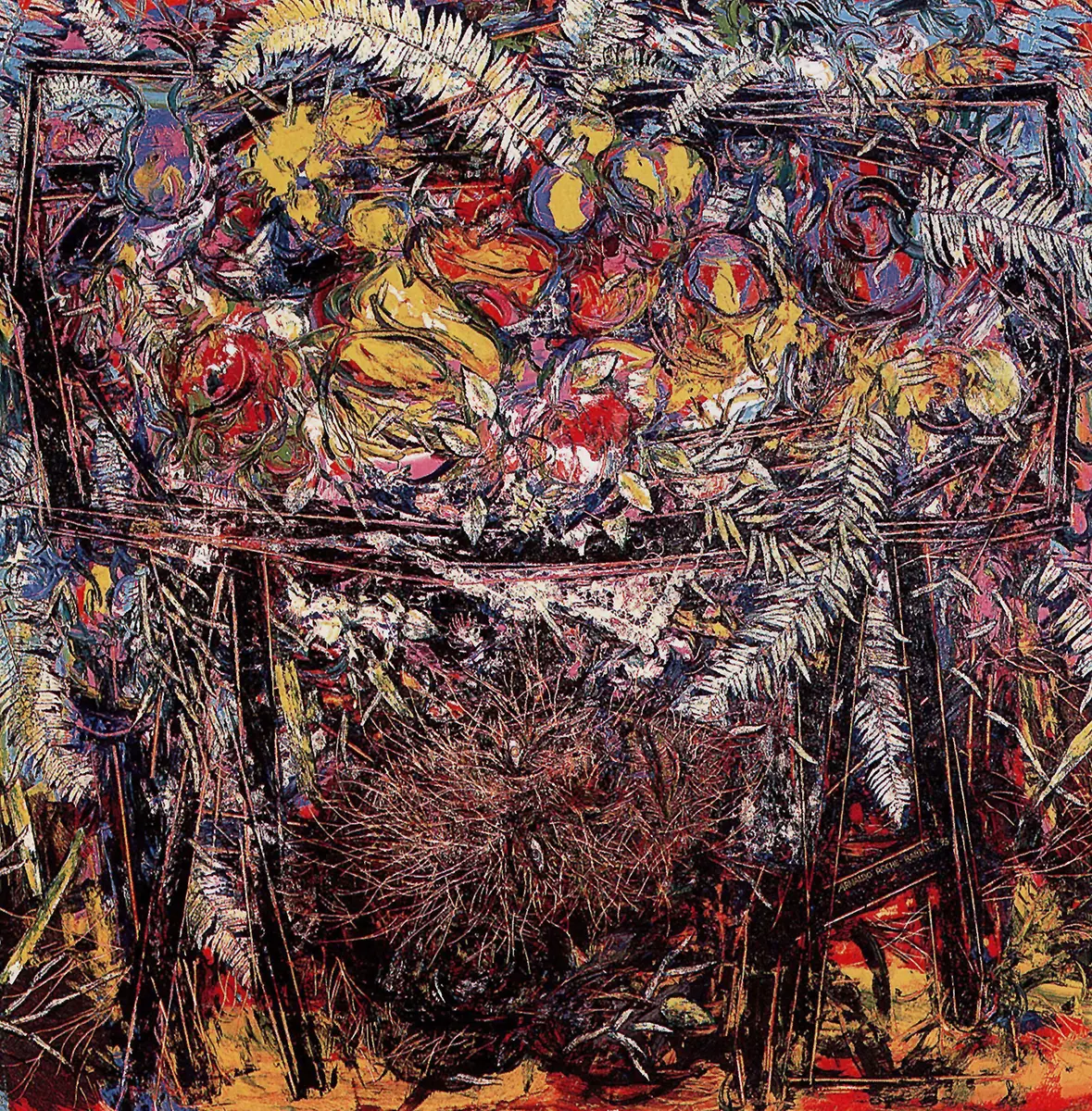
F.P. Now I would like you to talk to me about specifically religious aspects of your work, in the broadest sense. And for you to associate the religious feeling with two other concepts that appear frequently in comments about your painting: those of surrealism and expressionism—taken, of course, not in their literal meanings as artistic movements of which you are an heir, but rather as general tendencies, ways of feeling and relating oneself to the world.
A.R.R. I have to confess that my knowledge of religions outside of Christianity is rat her limited. I believe that my d rea ms and revelations are plain to see in my work within the framework of the basic beliefs of the Protestant Church.
This has to do with my personal history. I went to the Catholic Church when I was a child. In that stage, up to when I was fourteen, I came to have contact with certain "spiritualist" rituals but then, in my adolescence it was a charismatic experience that provided direction for my vision of God and religion. After that event, I embraced the Methodist Church and its beliefs. While recognizing the emotional and therapeutic value my work was charged with, the Protestant notion that "no rite or mass can make present the sacrifice of Jesus Christ" was always present. One thing that defines charismatics is a simple and enthusiastic attitude to get close to the Creator, along with an anti-hierarchical posture in which there is no need for mediating saints or human hierarchies to achieve communion with God and His Spirit. That is the case with me.
F.P. How do you relate this experience to your work?
A.R.R: The event that established the difference in the way I valued my talent and my life was Chicago. That was where I confirmed my vision that a new man would arise and I was able to understand the importance and use of my "talent." I understood that painting is not producing an image and then standing in front of God with the image in my hands, it is turning around and showing it to the people.
I feel myself to be a justified sinner who, through his faith, validates the means he utilizes for secular ends, the creation of mirrors that work on both sides. The model beneath the canvas is like a man bathed in oil paints (baptismal waters) and I, like a voice in the desert, pull him to the surface of this canvas and he is born like a new man. I don't believe there is any better way of secularizing and justifying my actions than with these phrases, concepts, and sayings falling within the realm of popular culture. The spoken word becomes a medium that generates images.
The way I see it, my art has to do with a secularized religion. I don't pretend that I will be saved or redeemed before God because of my art. Although I am grateful to Him, my work is not an offering to God nor do I wish for it to be hung in a sanctuary or temple. I am making these clarifications because I don't consider myself to be a naive artist.
F.P. Do you consider that your works are religious more due to their life force than their themes?
A.R.R. The forces of my consciousness and the fire that produces them simply show that I think and exist. I also recognize that I am just one among many voices that are testifying that life is marvelous. If the creation of icons through my technique was of greatest importance then they would become something as important as the matrix from which they emerged. I don't think that is the case with me.
I don't venerate the images it produces and they could never usurp the importance of the human being and the respect it has for it and its perception of things. To attempt to establish a relation between religion and my religious feeling could be diverted somewhat from my true motivations. Moreover, it would become difficult for me to specula teabout the effect that my works have on those who approach them. It is enough for me to recognize that I have never wanted to study and process my religious feeling.
My right to live life and comment on it does not end with my works. They become a diary and a testimony to the fact that I took the liberty to express myself, thus perpetuating the respect and passion I have for others. I wish they would look without making them feel that I want to convince them that they don't know how to look. I want, with these "pretentious surfaces," to urge them to touch like Saint Thomas, to get close to the event, to this miracle in constant revelation. That they identify with my energies, because I am shouting at them what I have seen, heard, and touched. That I am alive and that the act of painting still has the power to reveal our nature. I would like to arrive and belong; this is evident in my obsession with light, color, and texture. The light emanates from the canvas, it is scraped, scratched, printed and sweats is filled, embraced, and rubbed. You sweat, paint on the floor, stretch out, and attack again. Until the canvas can bear no more.
F.P. Let's talk about the real and the surreal in other terms, no longer religious.
A.R.R. To elevate African masks like pieces of furniture or utensils from daily life to the plane of "art" is to transform them into tools of creativity. I recognize that they are resources, many of them, just as concepts of a religious, social, psychological, or political nature are in the face of the gestural, raw force my work generates.
As I understand it, part of the fundamentals of surrealism is the creation of techniques and metaphors that play with and alter the notion that the spectator has of things. This implies making us doubt the form or function of objects and the creation of images from an unconscious state to a conscious one as, in my case, converting what can't be seen into pictorial reality.
F.P. And among those "objects" are you and your self-representation ...
A.R.R. At one time what motivated me to elaborate the self-portraits was a search for the forms and ways to enlarge my perception of myself and of life. These are images that reconcile themselves with the world; consciously and subconsciously they are like the manifestation of a sixth sense, a final reality.
F.P. Let's go back now to the two notions of surrealism and expressionism.
A.R.R. I understand that to the extent that I link the development of my work to the use of mechanisms and techniques that help me create what I am aiming for surrealism is a fundamental word for defining my work.
On the other hand, if I look back, to the extent that I understand that the foundation of my existence is driven by root forces, I find myself obliged to make rituals, to seek forms that evoke my need to make myself present, to exist, to be cause and effect. In that sense, expressionism would be another word with which to define my work.
F.P. How have you sustained, over the course of nearly twenty years, that intensity in your work?
A.R.R. The key lies in that a single genre' isn't sufficient for defining this creative process. Everything begins with a "creative need," and that dilemma that every artist faces of conception versus execution. After identifying the need, whatever it is, I exhaust the energy generated and enter a process of gestation in which time becomes a determining factor for me to ask myself what the cause is of that need and its possible effects or results.
That is where the surrealist factor comes into play: one has to rationalize the subconscious and seek reconciliation when technique and the medium of oil paints become the base for inquiry when I am seeking not to illustrate but to implement an expressionistic event It's like going in circles: one begins with one need and ends with another. After identifying the compulsive forces, one analyzes them in order to then culminate with the brutal act of subjugation in which the material world undergoes visual changes manifested in oils. All these changes take place in semi-conscious states. Changes upon changes. Every layer of oil becomes one more level of interpretation on which new elements are added. This process might be completed in a few days or several months.
Although I set aside collage in the traditional sense, my works become pictorial montages in which each element—human, animal, or material— is represented with a certain degree of autonomy. It happens that way due to the variety of forms and techniques used to get them to leave in the oils the particular characteristics that describe them. In that sense, I don't think that there is a more noble, eloquent, and terrible example than that of looking at the representation I made of my mother. As she is a simple and elegant woman, she engages in an act of humility and sincerity by placing herself beneath the canvas to be transformed into an art object. She never asked anything of me in return but ten years ago, the only alternative I had was to give her my head. When the event was completed, her physical presence was there to be seen on the canvas and my head was floating—nearly disarticulated—over her shoulders. So I exalted her; that is how I celebrate life, by creating this third reality that is of the two: surreal expression in which the desire to illuminate the soul is all that exists. A question of faith? I want you to believe me.
F.P. I believe you; more than by what you say, by what you paint.
FEDERICA PALOMERO
Painting and sculpture manager of the Museo de Bellas Artes. Art Historian. Caracas, Venezuela.