
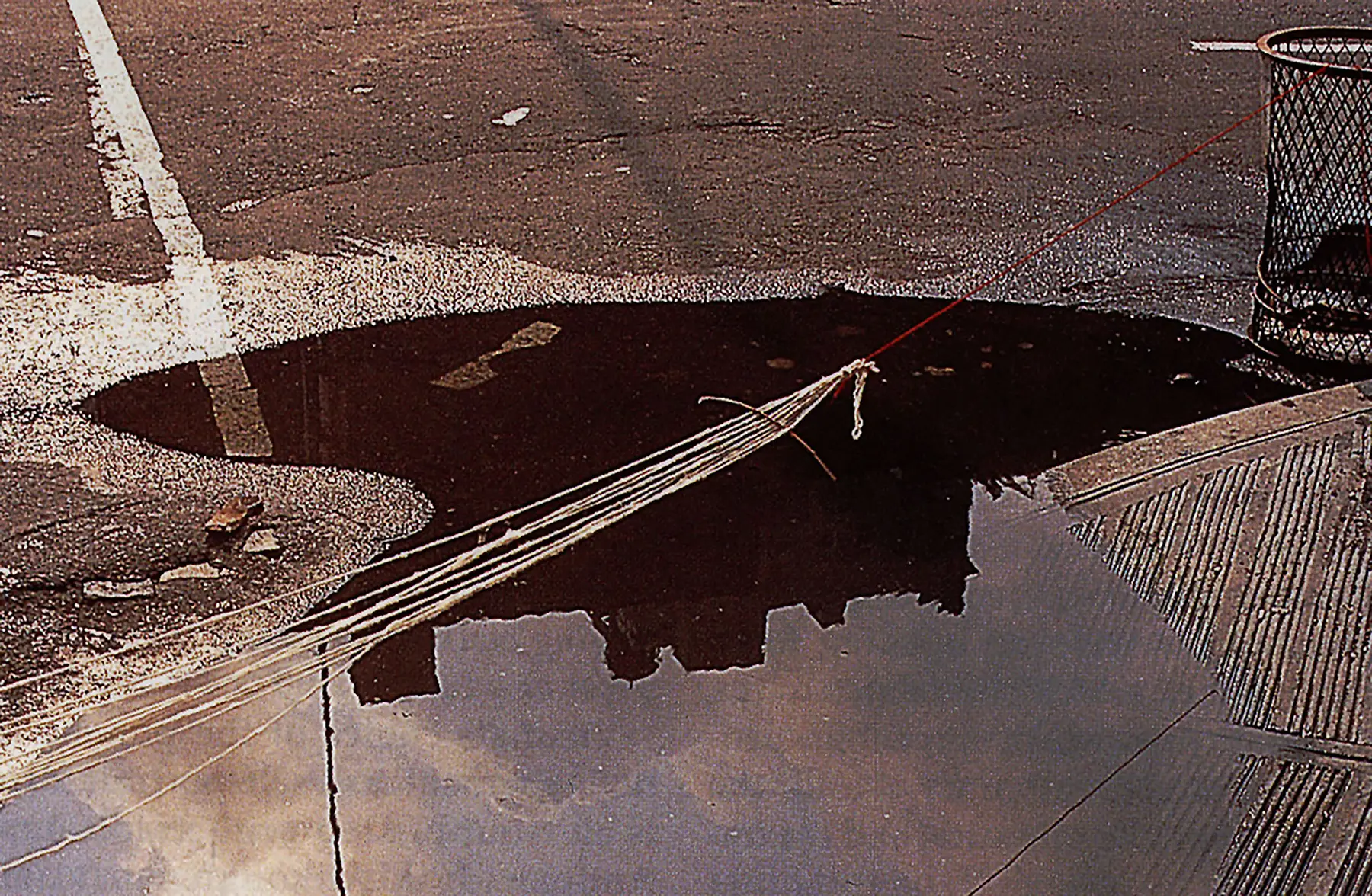
Over the past thirty years, Chilean artist Cecilia Vicuña has been constructing a body of work that incorporates poetry, performance, sculpture, and film. One critical element in all of these expressions is fiber: from fleece and fuzz to snarled yarns and tangled industrial netting, from garments and cloth to tattered rags unraveling back into thread and hair. Her texts include "The Metaphysics of Textiles," "The Unraveling of Words and Weaving of Water," and "Palabra e hilo/Word and Thread." Among her constructions are impossibly tiny garments, huge "weavings you can walk into," and spiraling vortices of fleece.
Initially recognized as a poet, Vicuña's installations have lately been reaching a wide international audience. Recent solo exhibitions include: Precarious (1990, Exit Art Gallery, New York, NY); El Ande Futuro (1992, University Art Museum, Matrix Gallery, Berkeley, CA); Cequt Fragments (1994, Center for Contemporary Arts, San Fe, NM); Hilumbres Allqa (1994, Kanaal Art Foundation, Kortrijk, Belgium); and Precarious (1996, Inverleith House, Edinburgh, Scotland). Important group shows include The Decade Show (1990, The New Museum of Contemporary Art, New York, NY); America, The Bride of the Sun (1992, Royak Museum of Antwerp, Belgium); and especially, INside the visible, an international exhibition of work by 36 20th-century women artists curated by M. Catherine de Zegher. INside the visible (the title is taken from one of Vicuña's poems), opened in 1996 at the Institute of Contemporary Arts in Boston, MA, with subsequent venues at The National Museum of Women, Washington, D.C., The Whitechapel Art Gallery, London, and the Art Gallery of Western Australia in Perth.1
In 1997, Vicuña was invited to participate in the Biennial at the Whitney Museum of American Art. There, amidst much strident and clamorous work, Vicuña created a piece of startling quiet. A Net of Holes, woven of soft black yarn and as hard to see as a spider's web, hung in the space under a concrete ceiling grid. Vicuña described the piece as "a statement of invisibility," and illuminated its significance with two quotes on the wall: the first, an indigenous voice after the Spanish conquest of Tenochtitlan, the Aztec capital [from Sahagun, 1528]: "Our only legacy was a net of holes/but not even shields can/hold such emptiness," and the second, from a poem by Lezama Lima: "El vacio es calmoso, lo podemos atraer con un hilo."
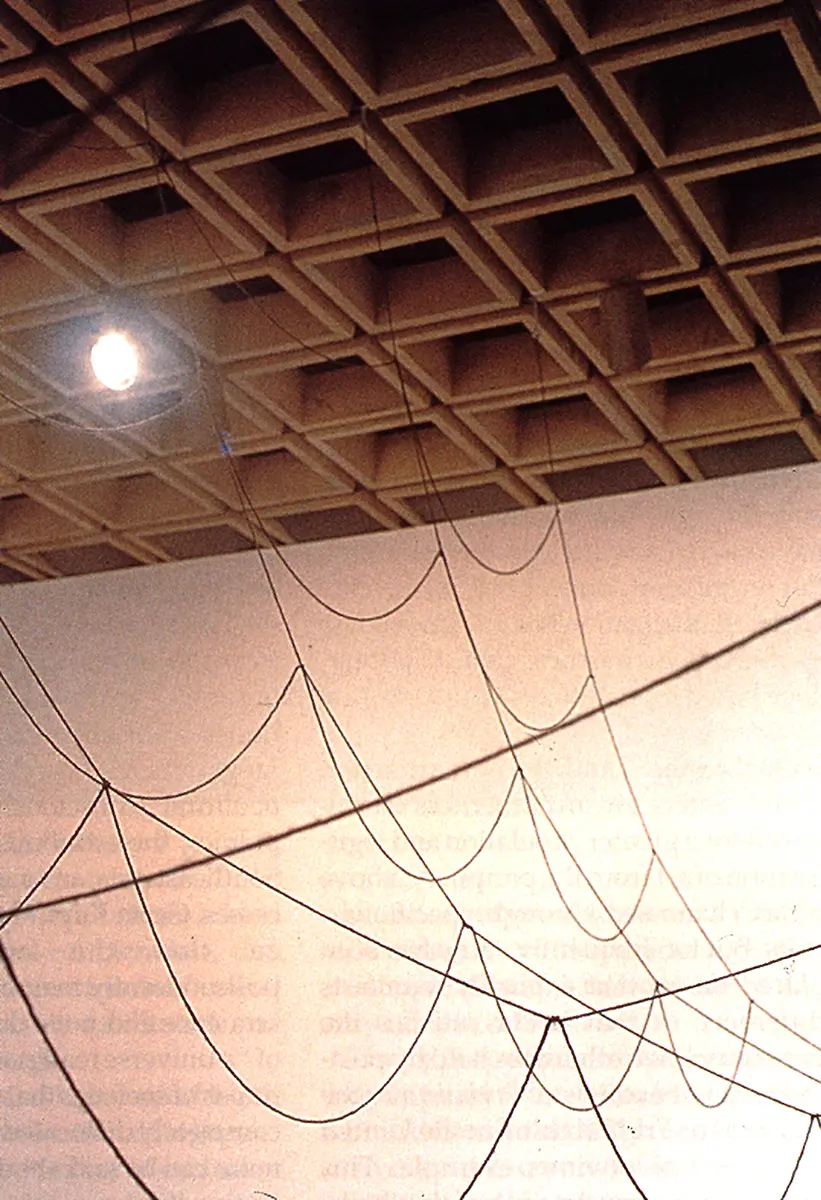
As in all her installations, A Net of Holes was partly inspired by its setting: I wanted, explains Vicuña, to undo the heaviness of the overhead architectural grid with a limp that dissolved it. The piece also extends meditations that have propelled Vicuña for decades: ideas about holes, voids, invisibility, and "invisible" persons, as well, as ideas about "the being and non-being of weaving... the point at which weaving may be stretched, enlarged, or dissolved into imperceptibility."
In these explorations, her work relates to the woven forms of artists Anni Albers and Lenore Tawney, especially Tawney's early work, which also influenced the painter Agnes Martin. Vicuña points out that Alberts and Tawney were among the first modern artists to pay attention to the soft lacework of ancient Peru. Vicuña sees herself as continuing this exploration by "enlarging the holes to such a scale that a person can pass through them."
As a textile specialist, my own interest in Vicuña's work lies in its pre-Columbian sympathies. I worked for many years with the Brooklyn Museum's fine collection of Andean textiles, and first met Vicuña when she came to the museum to film The Paracas Textile, a 2,000-year-old masterpiece from the south coast of Peru. Vicuña's project has never been to imitate these ancient textile forms but her work in thread, textiles, and fiber echoes traditional Andean awe for these materials. It reflects a world where fiber work was neither a minor craft nor women's work (as it has been in the European tradition), but instead, a medium of intense spiritual importance and critical prestige.2 Textiles were appreciated in the ancient Andes not only for their rich materiality but also for their immaterial and metaphysical aspects. Vicuña's garments, quipus ceq'es lines, woven prayers, and fiber structures take up and illuminate this resonant voice.
Garments: Threads of Time
Many of Vicuña's installations contain garments: objects which, according to indigenous Andean belief, can both retain the spirit and confound time.
Like language, distinctive clothing identifies indigenous Andeans. They refer to outsiders, who wear no traditional clothing, as "naked" or "peeled."3 Pre-Columbian burials contain vast amounts of cloth and clothing, including both utilitarian and ritual textiles. Miniature and gigantic garments appear as grave offerings, along with human clothes.
Costume links past, present, and future generations, for clothing, is presented to the dead, and patterns are passed to the living. Family lines are traced back through human ancestors to supernatural ones, whose designs on woven clothing chart family trees with mythic roots. During the Inca period (1438-1534 A.D.), mummies were periodically taken from their tombs to be dressed in new clothing, paraded on litter, fed, and consulted through mediums. Similar practices are preserved today to some extent in the ritual bundles of herding peoples in highland Bolivia and Peru. These bundles preserve heirloom garments and are brought out for ceremonial rituals in which ancestors are evoked as if spirits adhered to their threads.
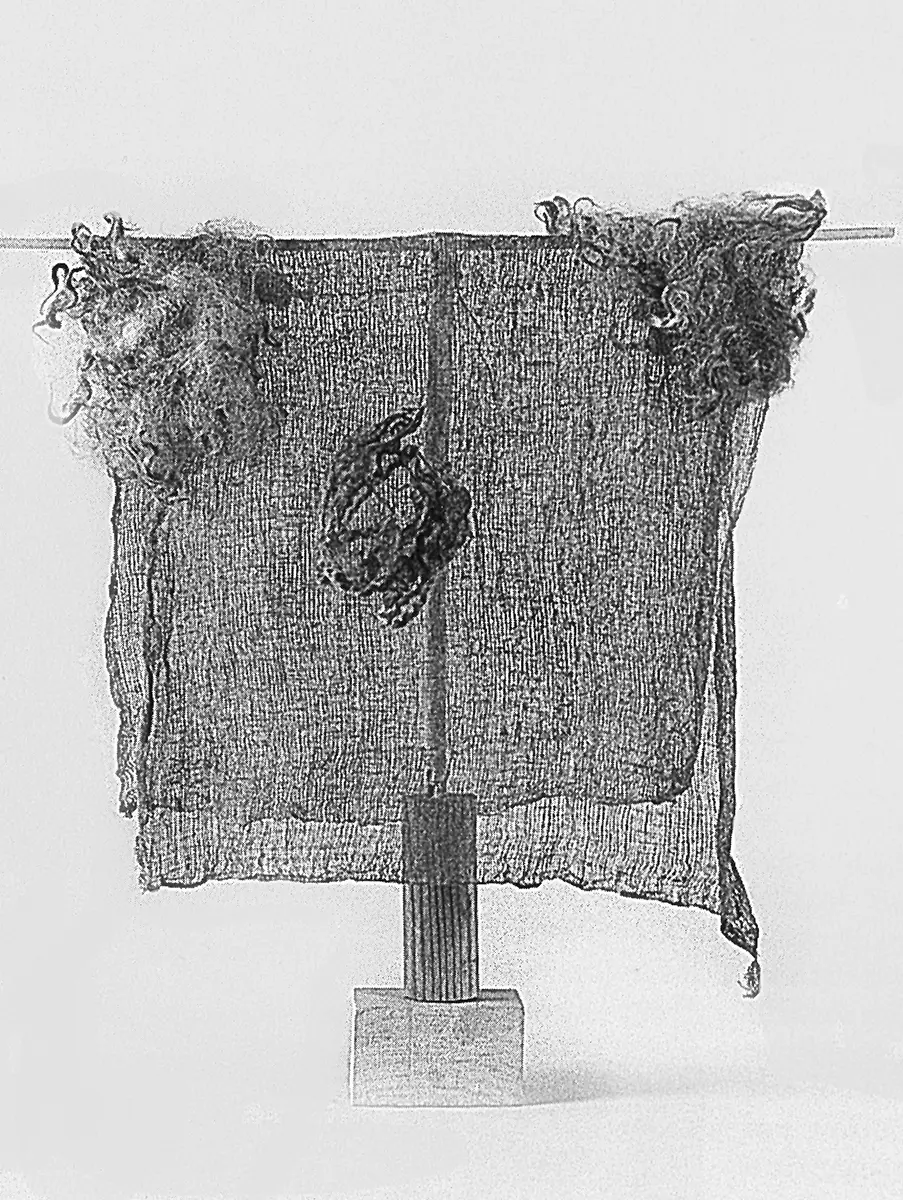
Among Vicuña's garment pieces are a set of twelve miniature ponchos. Roughly matching in size, Vicuña calls the set ponchos hilachudos (tattered ponchos) and says that it was conceived as a sort of serial self-portrait. The modern poncho seems to be a mestizo garment developed by Auracanian horsemen in northern Chile and Argentina in colonial times,4 but ponchos were also used by the people who buried their dead on the Paracas peninsula on the south coast of Peru 2,000 years ago.
Among the archaeological textiles in the Brooklyn Museum are a set of twelve miniature ponchos (which had been unknown to Vicuña), quite similar in size to Vicuña's ponchos hilachudos.5
All the Brooklyn ponchitos are identical in size and coordinated in color and decoration; they were clearly produced as a votive set. Too small to have been worn by any human, they might have been destinated for a figurine, except for the fact that their neck slits are only decorative. Garments in the ancient Andes were always shaped on the loom and never cut afterward. Neck openings were created while the cloth was being woven. So these ponchitos could never have accommodated a head. Like the Paracas ponchitos, Vicuña's ponchos hilachudos have no opening for a head: a lack which she relates to the phantom presence of "invisible" people in the contemporary world: the indigenous, the minority, and the immigrant.
Vicuña's garments (usually ponchos and skirts) have to do with trying to catch hold of identity. Bot the poncho and the skirt are mestizo forms. Their worn and gauzy fabrics recall pre-Columbian burial shrouds, but their airy eloquence is universal. They speak of the melancholy of the empty garment, which once housed both a human form and spirit and the impossibility of recalling the past. In The Coming of Age, Simone de Beauvoir quoted Emmanuel Berl, struggling with memory: "My past escapes me. I tug at one end, I tug at the other, and all that stays in my hand is a rotten scrap of fraying cloth. Everything turns into a ghost or a lie."6
Vicuña's choice of the poncho (a male garment) as a self-portrait form is not out-of-step with traditional Andean ideas. Although men's and women's garments have been clearly differentiated since ancient times, transvestism occurs in some solemn rituals. Genders can shift in the face of the sacred.
Quipus and Ceq’es: Threads in Space
Threads in pre-Columbian garments linked past and future times. Visible and invisible thread structures united Andean space as well.
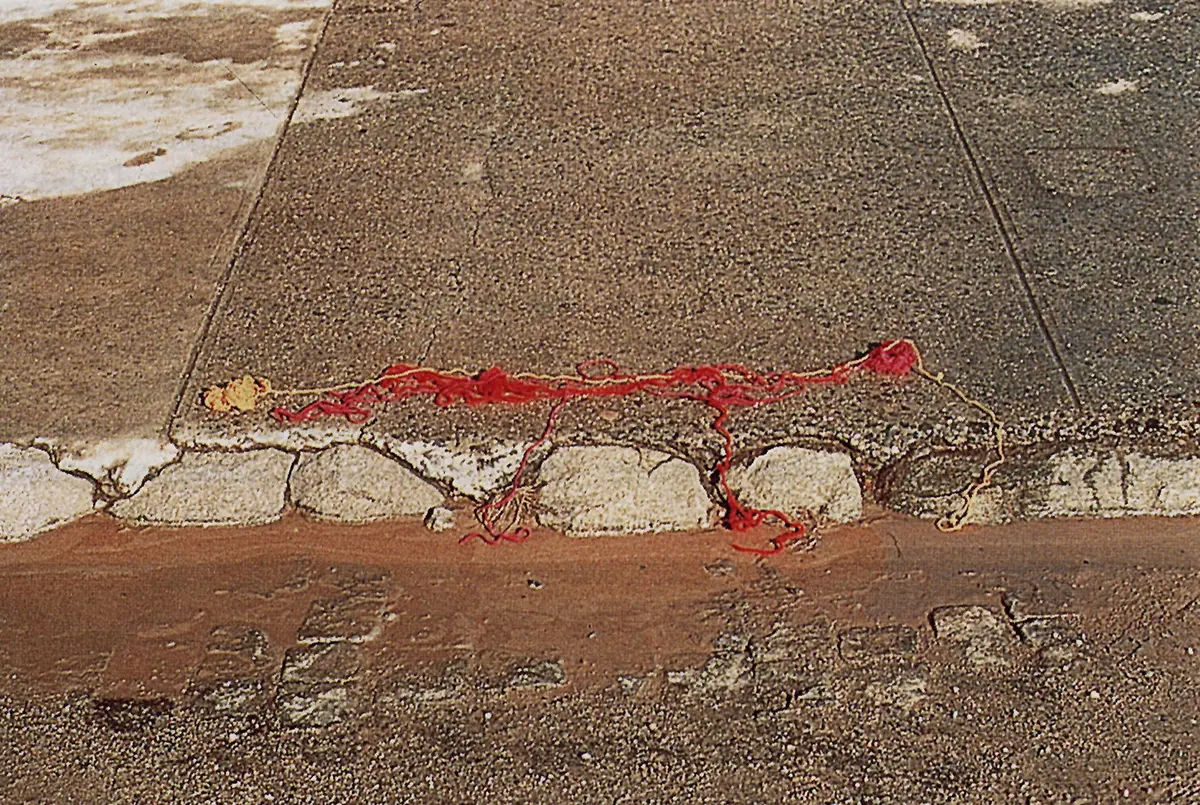
Scribes of the huge Inca empire (1438- 1534 AD) recorded information on quipus—knotted string devices. Only trained specialists knew how to read the statistics coded into the quipus strands by thread color, number, size, ply, twist direction, and knots. Spanish colonial administrators squelched the use of the quipu and the power of the quipu-masters. Now the complex knotted memories of their strands lie tangled and silent in museum drawers. One of Vicuña's first thread installations was an "empty quipu" or the "quipu that remembers nothing"—a strand of yarn stretched across a room. An imaginary "super quipu" tied the Incan empire together: 41 lines called ceq'e radiated outwards from the Incan capital Cuzco. Each connected a series of huacas, or sacred sites, and joined these and the empire together in a mythic map. The huacas stood along the ceq'e lines like knots on the strand of a quipu, and were the focus of ritual and sacrifice. Some huacas were rocks or springs; others were mummies; others were places from which a particular view could be sighted.7
Periodic processions along the ceq'e lines inscribed them in time and space, just as today indigenous Andean pilgrimages to sacred sites follow prescribed routes along the earth. Often single-file, and accompanied by music and singing, the lines of song and melody coincide with the thread-like path on the landscape. Vicuña has created many installations of ceq'e fragments, often walking and singing them into existence, as well as marking their presence with yarns strung close to the ground.
"The famous Nazca lines in the south of Peru may have traced a similar mythic system. The eminent art historian George Kubler once wrote: [the lines are clearly monumental. . . They are an architecture of two-dimensional space, consecrated to human actions rather than shelter, and recording a correspondence between the earth and the universe... They are an architecture of diagram and relation, with the substance reduced to a minimum."8
Woven Prayers Immaterial Material
Ancient Peruvian weavers were consummate artists, yet many of their creations had nothing to do with creating a commodity for human consumption; many seem to have functioned more as woven prayers. In Inca times, cloth offerings were often burned in ritual fires or offered to the elements. Perhaps more than sacrifice—the destruction of a valued object to prove the intensity of desire—this transubstantiation was meant to send the cloth from the physical realm to the spiritual.
Pre-Columbian grave offerings often include crude, unfinished pieces still on the loom, suggesting that they were made for the mediative process of creation itself. Like Navajo sand paintings of Tibetan sand mandalas, the simple incremental steps in the weaving have a mantric quality. Today in the highlands of Peru, young female pilgrims to the Ooyllur Rit’i (Star Snow) festival create similar quick miniature looms as part of a ritual of devotion.9
These quick crude "woven prayers" of bits of stick and string recall many Vicuña's "debris weavings." Rude and precarious, these webs mark space, forming insubstantial fabrics, and immaterial materials.
The spiral and the cross
In her poetry, Vicuña singles out and isolates words from a web of narrative and exposition. She then pulls the words apart and examines each syllable for its ancient associations. Likewise, in her installations and constructions, she emphasizes and pulls apart the basic structures of cloth at the micro-level, especially the spiral of spin direction and the crossing of warp and weft. In a poem dedicated to Anni Albers, the textile designer Jack Lenor Larsen called these "those ancient orders, almost as elemental as fire."10
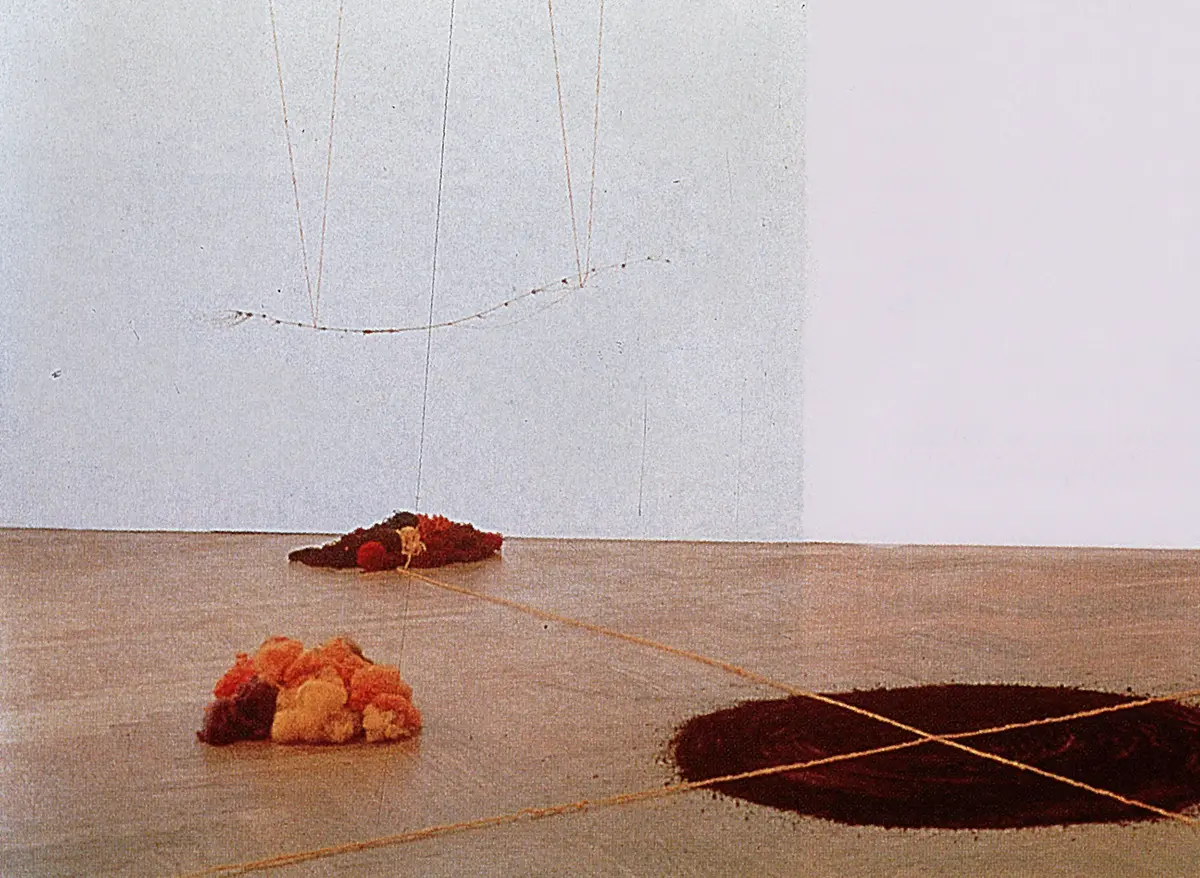
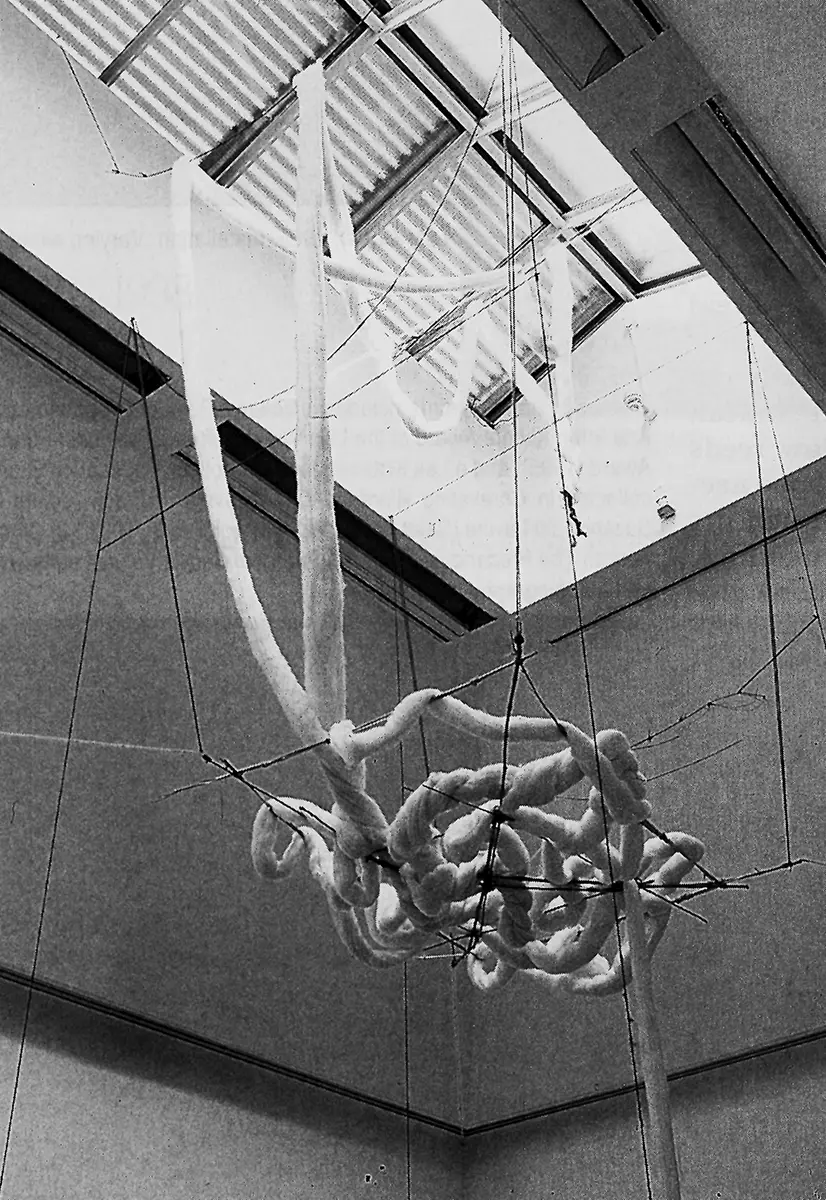
In the 1994 installation Hilumbres Allga, at the Kanaal Art Foundation in Kortrijk, Belgium, Vicuña created Escrito en Lana (Document in Wool), in which natural fleece and pigment piled on the floor were quartered by two lines of threads stretched above them, recalling the intersection of warp and weft.
Vicuña inscribes spirals: drawn in the Pacific sand in Con Con, 1996, and in fleece in various suspended coils, Spiral Weaving, 1992. In 1996, she was inspired by the garbage strewn on the beach, thinking that it looked like signs in some inscrutable language. She drew a spiral, thinking of the spiral of the ear, and the way we "listen" with our senses. It wasn't until many years later that she understood the spiral's primary importance to textiles (as a representation of the energy twisted into a spun thread), or saw that among the huge line drawings on the plains near Nazca, the ancient Peruvians had drawn spirals. One stands next to a huge grid of intersecting lines as if the spiral refers to thread and the grid to cloth.
Contemporary Quechua speakers ascribe magical properties to coiled energy, especially in the backward-spun thread. Pilgrims on their way to the Oollyur Rit'i festival step off the path to twist tall grass behind their back with their left hands. They say that they leave their sins behind in the backward-twisted stalks.11
Dry bones and pure rags
Extreme dryness was associated with spiritual purity in the ancient Andes. Anthropologist Frank Salomon has described how the dried munnies of the ancestors, known as the "beautiful grandparents" were thought of as purified humans. Humanity evolved during life: people started out as fleshy, chubby babies, and gradually became thinner and drier. In old age, bones protruded, and skin became leathery. After death, corpses gradually were reduced to the "hard" (that is, "pure") parts: hide and hollow bone.12
These "pure" materials of bone and skin have a resonance in the Andean loom: a collection of hollow reeds and dry sticks, often with bone needles used to pick out a design. Its threads combine to form coverings, a second skin. Hide and bone also make drums and flutes—still, the favored musical instruments to accompany ceremonial processions which trace ritual lines in the landscape.
Vicuña, again and again, uses dry, serene forms: pieces of bone and reed and empty shells where the air has replaced what was once filled with water or flesh and blood. Pre-Columbian weavers, again and again, produced exquisite gauzes—so limp and light and open that Isabel Iriarte calls them "membranes": they contain as much air as thread.13 They remind me not only of Vicuña's fiber thoughts but also of her first one-woman show at the National Museum of Fine Arts in Santiago, Chile (1971) where she filled the gallery with dry leaves.
In his poem The Rag and Bone Shop of the Heart, William Butler Yeats wrote that art is born out of the scraps and dirt of daily existence, rung from them like a ladder to the sky.14 For Vicuña, the process seems entirely the contrary. Her art is purified, reduced, and refined back to the rags and bone.
NOTES
1. Vicuña’s recent awards include the Bellagio Residency sponsored by the Rockefeller Foundation (1991), the Arts International Award of the Lilia Wallace-Reader’s Digest Fund (1992), the Fund for Poetry of New York Award (1995), and a Lee Krasner-Jackson Pollock Foundation Grant (1995). Many of her writings have been collected in Unraveling Words and The Weaving of Water, edited and translated by Eliot Weinberger and Suzanne Jill Levine (Saint Paul, MN: Graywolf Press, 1992.) In October 1997, Wesleyan University Press will publish The Precarious: The Arts Poetry of Cecilia Vicuña, edited by M. Catherine de Zegher, with the poem QUIPoem, an autobiography in debris.
William Butler Yeats, 1933, from "The Circus Animals' Desertion" reprinted in The Rag and Bone Shop of the Heart: Poems for Men, eds. Robert Bly, James Hillman, and Michael Meads (New York: 1992).
LOIS MARTIN
Painter, writer, and art critic.