
Daniel Zelaya recently presented at the Andreani Foundation his first exhibition in Buenos Aires in eight years, an event that generated considerable expectations.
This Buenos Aires artist has lived for several years in the province of Entre Rios and was in the early 1970s a member of the Grabas Group, along with Camporeale, Cugat, and Obelar, who distinguished themselves during those years with their innovative work in the graphic arts.
The show, under the suggestive title of Illusions and Finals, consisted of around twenty large format paintings in oil and a few in acrylic and casein. Each of the works confirmed the maturity achieved by this artist in his handling of pictorial language.
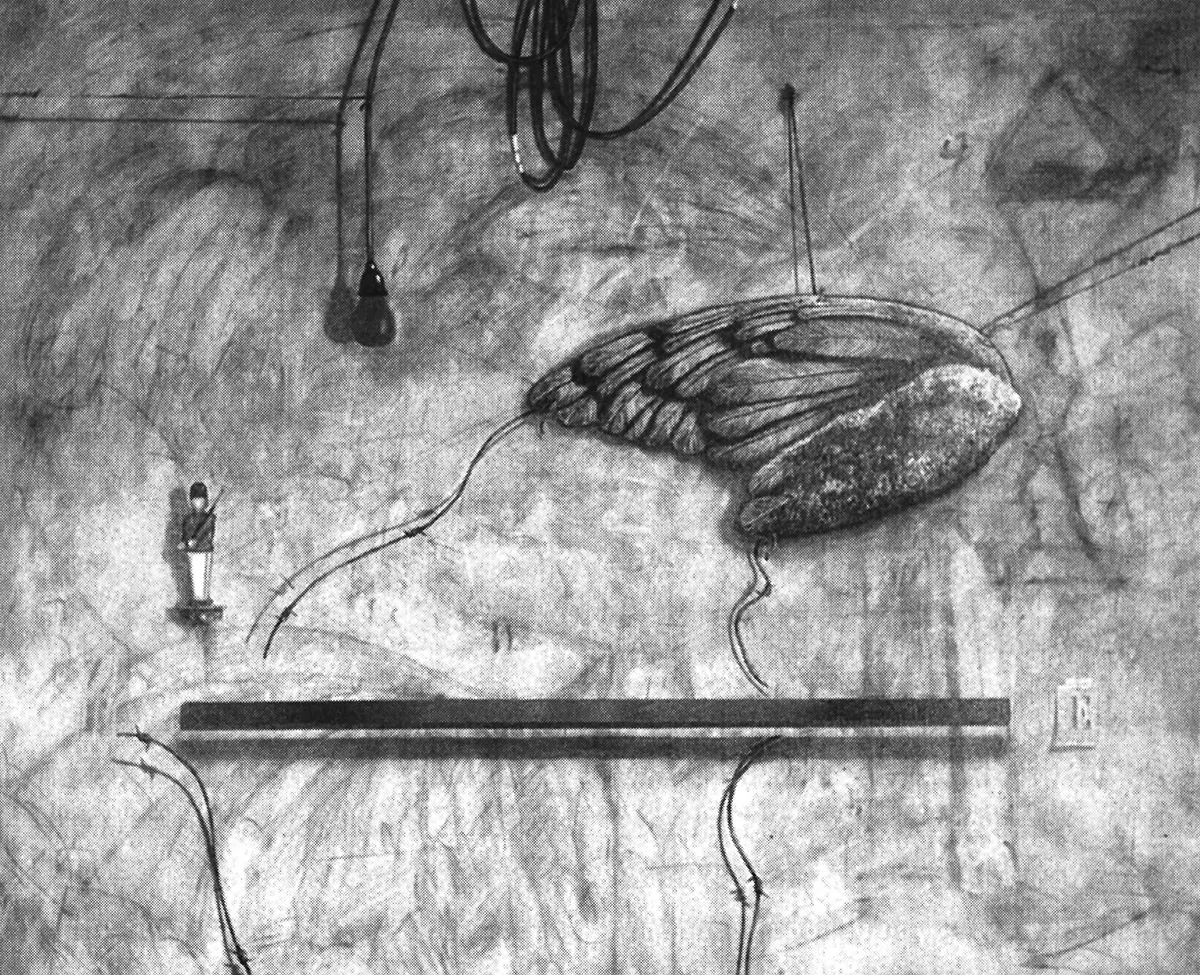
Although there were some changes in the iconographical elements of these new compositions, the vision proposed by Zelaya maintained his characteristic subtle irony in the exploration of themes related to our reality, both individual and collective, which in turn take on a universal dimension.
The recurrent theme in his work is a man and his circumstances, which is developed in three series: End of the Flight, End of the Game, and End of the Tango, as well as other works. The figures in these works are characters and objects referring to the world of toys: dolls with human and animal figures, cones, prisms, and garlands combine dynamically to create a sense of absolute freedom in a metaphoric world of fantasy, which extends deep into the symbolic elements of our social history.
This scenographic reality is presented with a sophisticated sense of color, to create atmospheres that are both credible and poetic. The drama is tempered and communicates a certain pleasure and joy in the act of doing.
Conditional Freedom, an oil painting from 1995, is based on a conceptual proposal in which the protagonist is a dove. This is perhaps the work that retains the most elements from his previous production. Other noteworthy pieces include End of the frog’s leap, with its compositional rigor, and End of the Game II where the organic representation appears in the figure of the dog, which thus increases the ambiguity between what is constructed and what is natural, between theatricality and reality. In this way, Zelaya engages our participation in the problems of our times.
ALBERTO COLLAZO