
This recent exhibition by Enrique Ježik, titled Landscape, was presented in the habitable sculpture by the Uruguayan artist Gonzalo Fonseca, titled The Wind Tower, a conic structure whose upper part has been sectioned off to reveal an opening to the sky. This tower is one of the many urban sculptures that are part of the so-called Ruta de la Amistad, a project undertaken on the occasion of the Olympic Games in Mexico City in 1968. The recovery of the site, which until now has been abandoned and lost in the skyline of the city, was the starting point for the Art in situ project of Pedro Reyes, the Mexican artist, architect, and curator. The project was conceived in 1996 to promote the creation by Mexican and foreign artists of site-specific works, in a clear attempt to recuperate and develop an important part of the country’s cultural heritage, and to contribute to the promotion of and access to a facet of contemporary art which has been poorly or little documented.
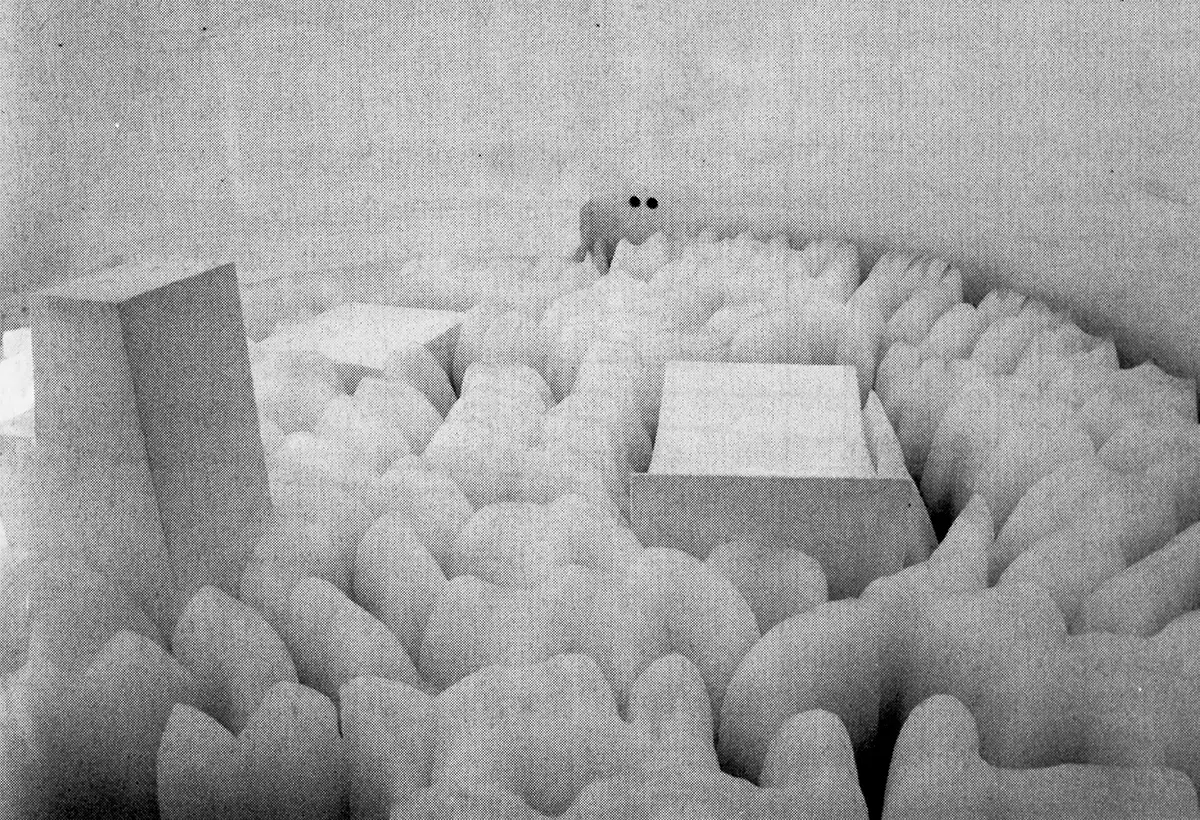
On this occasion, Ježik proposed a kind of transfigurable topography and recorded its various stages of transformation. The artist filled the interior of the Tower with 45,000 kilograms of ice, providing an artificial site with a natural element which, as it melted, changed in form with each passing day, once again recovering its organic morphology. The concept of the work was based on a fluid and anamorphic material which, in this case, was frozen and transformed into a geometrical configuration-industrial ice cubes-be- fore returning to its original condition. An important part of the project was left to chance and the indeterminate nature of the transformation process; at the same time, it also incorporated and made use of such elements as light, temperature, and sound, thus acquiring new forms and a different kind of materiality. Ježik used the physical properties of an element such as water-its visual, tactile, and sonorous qualities, and its different transformation possibilities as the aesthetic components of a process-oriented work.
The artist engaged in a game in which matter becomes form in a process of constant gestation, full of random and continuous mutation. As the days went by, the ice became increasingly brilliant and transparent, with the corners and jagged edges being gradually worn down, breaking and fusing with the adjacent blocks. Notions and concepts such as those of time and space, weight and lightness, fulness and void, solidity and liquidity, the archaic and the chaotic, contrasting with the order and articulation of the volumes the gradual melting revealed the presence of geometric concrete elements which are part of the Tower's structure-became tangible and seemed to be transformed into an original kind of matter. Paradoxically, the work only achieved its full completion with its own disappearance, with the integration of elements outside the site which managed to separate itself from the control of the artist, with the intervened site gradually becoming passable once again.
Parallel to the autonomous deconstruction/ construction process of the work, Ježik each day recorded the melting of the work with a video camera which recorded one picture per hour from three different angles. This material will be produced on a CD- ROM which is designed to illustrate the disappearance of the landscape on a countdown basis. The ability to make visible within a few minutes the slow transformation of the ice, until its total disintegration, would seem to be an attempt to revert the ungraspable effects of the elements which surround us, and to exercise some kind of possible or illusory control over natural phenomena which inevitably escape our reach.
MAGALÍ ARRIOLA