
The Ecuadorian-New York artist Hugo Bastidas paints the maladjustments of contemporary society. He does so by capitalizing on his own experience of the contrasts between Latin America and the United States, comparing the visual melodies of both spheres. The result can be heard in the infinite number of disarticulated sounds, and in the parodies of an anthropology of the future based on the irony of current social and political relations.
Like many other artists, Bastidas is aware of the history of art and works within the pictorial tradition, enabling him to join things together to show that history repeats itself. This history is made up of authoritarian figures, classes that have been dominated, cultures that have been thrashed, and an infinite number of discourses calling for social changes to protect those who are helpless. The works in this new exhibition, in coffee-grey tones, are swamped with color—this time white. They constitute the artist’s conception of what he considers the most important aspect of his painting—his relationship with the spectator. Some areas are more defined than others, with certain decisive points appearing in the light of the sun, resolved pictorially through white brush strokes. Curiously enough, this process highlights something which Bastidas seems to be hiding by painting and repainting with the color white—another of the ironies and contradictions of the reality which the artist analyzes through fragments of various lives.
He begins by drawing on paper. Sometimes he uses a word or an image; he then incorporates elements that develop the structure of the work. Thus words, arrows, and pencil notes appear. Sometimes he rubs them out, although almost always they remain intact or partially present, particularly in the works done prior to the final painting, which is in oil on canvas. It is as if the artist himself needs to confirm that he is on the right track, that "this is the universal question." His work, therefore, involves a process of initiation, development, and revision, comparable to that of a scientist or researcher—though his paintings are in no way cold or rigid, but warm and full of agility. In the same way, although he uses photography, he does so only occasionally, discarding it and fragmenting it so as to avoid any sense of rigidity in his painting. Various versions thus emerge before the oil work on canvas, in a process in which the artist enlarges the linework towards the brush stroke, or vice versa, decomposing the classic brush stroke into countless smaller strokes that take the painting back to its origins (drawing). At the same time, the process creates a velvety kind of texture. It is this to-and-from movement between drawing and painting which gives a post-conceptual note to Bastidas' work.
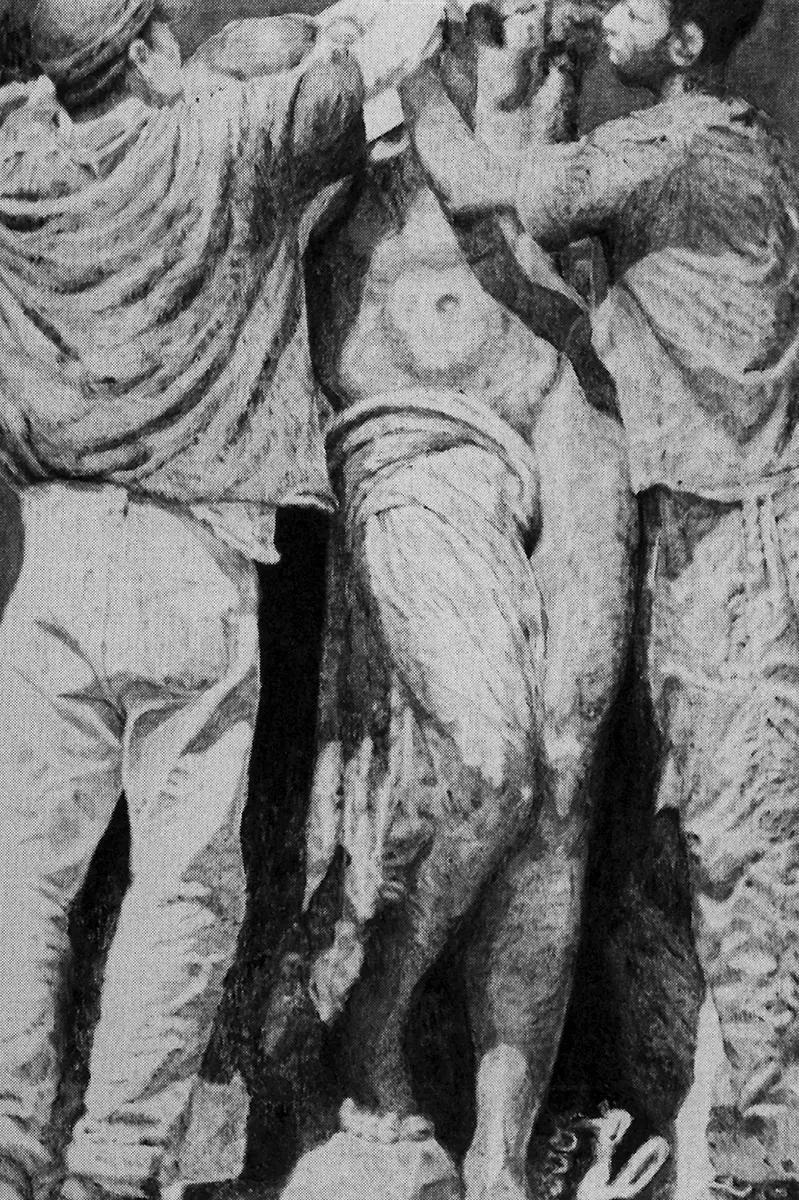
Working Boys exemplifies the metaphor of confusion with which the artist works. Two young boys appear alongside a sculptural figure, although it is not clear whether they are cleaning it or actually sculpting. It might be an erotic scene or a contrast between living figures and the fiction of the human body created by the sculpture. The work is a visual creation achieved through metaphor, an ironic expression of the devastation of globalization. By delimiting the images to sections, it frames our glance and seems to enlarge the figures. These resources enable the artist to emphasize that each of his pictures is a different version of the absurd and unjust dimensions of present-day society, whether in primitive cultures or in the most developed ones. The antagonism of artistic disciplines is tantamount to the antagonism of cultures. Bastidas' work reveals the antagonisms at the heart of our society through the harmony of linework and brush stroke.
GRACIELA KARTOFEL