
The German artist Jörg Bachhoffer recently presented his work for the third time in Bogota, a place he has frequented as a teacher and lecturer in the schools of plastic arts of the National University and the University of the Andes. The show was presented in Room No. I of the Museo de Arte of the University during the months of February and March confirmed the intention of an artistic search that fluctuates between two apparently contradictory objectives: on the one hand, the presence of a minimalist rigor that demystifies the sphere of art, and on the other, concerns of a spiritual kind that reveal an interest in associating art with sacred elements.
The first time that Bachhoffer presented his work in Bogota was in mid-1988, with a show titled The Reality behind Reality, which included a series of works done in Germany, where he lives, and in Peru, where he was on a six-month visit. The second exhibition was at the Espacio Alterno Gallery in 1991, when Bachhoffer showed a series of very austere and precise drawings and collages titled Subcutaneous. At this stage of his work, the image created with very little linework encouraged the spectator to embark on a series of very complex reflections related to the experience of a dual reality in which two-dimensional and three-dimensional elements, the physically real and the mentally suggested, skin and surface, appeared with imprecise edges.
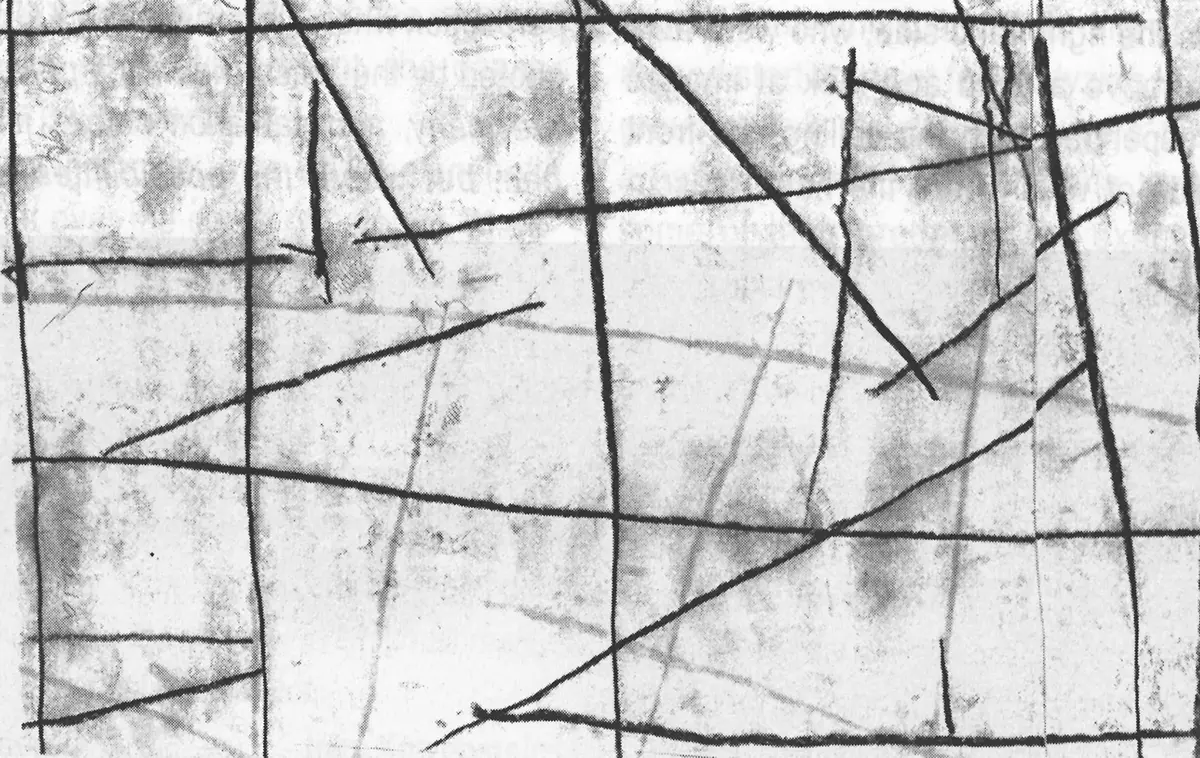
Essays on Dedalus included some works from the beginning of the decade, as well as more recent pieces, which emphasized the artist’s constant concern with space as an instance and dimension related both to man's experience as someone living in the world, and the artistic experience related to the spiritual dimension. The title chosen by Bachhoffer is intended to refer to man's uncertainty about space. In Greek mythology, Dedalus was the father of Icarus, able to fly with a set of wings he constructed but who did not heed his father's warning about flying too high, because the sun could burn his wings, or too low, because he might fall into the sea. Icarus was unable to control his flight and the sun melted his waxen wings, causing his death. This myth gives shape to Bachhoffer's experiences that serve as the starting point for his reflections on space viewed in terms of something dangerous, where all the elements are rather chaotically brought together in a process of constant floating. In the midst of this chaos, there are moments of precision, fleeting instants in which there is a convergence between the elements, instants in which there is order, fractions of time in which things come briefly together, and fleeting moments when things come to a standstill and which must be projected through an image.
These are the moments of order that Bachhoffer captures in his work, through a language that clearly reveals his preference for such media as drawing, collage, and photography, with a total absence of color. There is rigor in the spatial distribution of the elements and an explicit desire to use a minimum number of elements, charcoal strokes, and oil stains which when placed strategically on the white paper enable the artist to give form to his spatial perceptions which, viewed in two-dimensional terms, take account of the physical limits and qualities of the paper, with its eminently flat, long and broad qualities. However, this surface, when intervened with oil, recoils to give way to a new dimension depth, while the charcoal, for example, when placed on the surface, evokes another closer dimension. In this way, by intervening on a two-dimensional surface with a minimum of resources, the artist subtly evokes the third dimension. Speaking of the treatment of space in these works, the Irish critic Teddy Sheehan Reenkilla has said that "the superficiality of the charcoal is confronted with the reality of the living oil, a reality dilated in space and time, which is impregnated and moves, suggesting the presence of 'the reality behind reality.'"
The exhibition montage was conceived with the precision and austerity which characterize Bachhoffer’s work. It began with a space limited by a panel land the work, where two small format works were placed which introduced the visitor to the artist's themes and resources. A cube drawn with oil and charcoal established contact with this environment, with lines floating subtly on a rather imprecise surface indicating the presence of a new resource consisting of tracing paper which, placed on top of another surface that might be a drawing or a photograph, acts as a support for the charcoal line work. Thus, in a continuation of his two-dimensional work, the artist creates two dimensions that allow continued reflection on this state of constant flotation which is of particular interest to him.
Once the visitor crossed this threshold, he encountered two works done with photography, showing in enormous close up the palms of the hands; the closeness of the camera makes them appear to be extensive surfaces indented with lines that extend ad infinitum, surrounded by deep black space. The organic nature of this surface contrasts with the way in which the edges of the photograph are cut, which creates very precise geometrical forms, making them seem like longitudinal surfaces floating and moving around the white of the paper. This wall ended with two drawings done a few years ago, showing the anatomy of two faces, with traces of oil and where some of the edges are marked with fine and precise charcoal lines.
The other three walls of the room combined recent works on tracing paper —with occasional urban traces— and others which continued to use oil and charcoal. From any point in the exhibition space, the visitor, irrespective of whether or not they were close to or far from any given work, was affected by the dimension of space in the show as a whole-a space that brought together all the rigor of minimalism, filtered through a mind which believes that art is the sacred instant of contemporary man.
MARTA RODRÍGUEZ