
The Borges Cultural Center recently presented an exhibition of around 150 works by the Uruguayan artist José Gurvich (1927-1974). Born in Lithuania, Gurvich came to live in Montevideo in 1932. At the age of 15, he entered the School of Fine Arts, which was directed at that time by José Cuneo. Gurvich was an eager young man who was also interested in the study of music. The most important event that affected this versatile artist was his relationship with Joaquín Torres-García, whose workshop he joined at the end of the Second World War.
The exhibition of works, including paintings, ceramics, and wooden objects on view at the Borges Cultural Center offered a fine review of his artistic career from the 1950s to his last works in the 1970s.
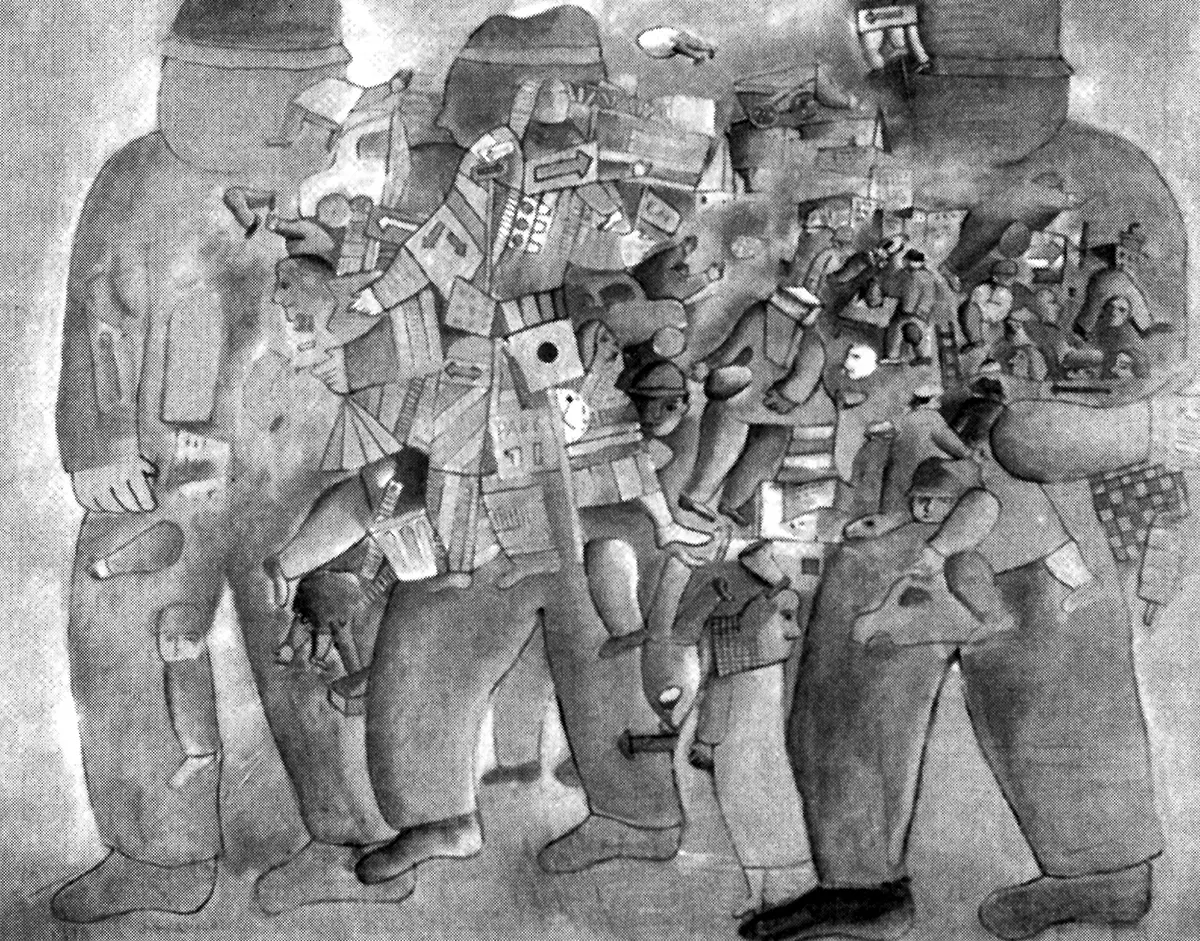
It is interesting to note his constructivist period, and the way his own style, which had deep roots in the Jewish popular culture of Europe, gradually emerged. In this respect, there are links with Chagall, reflected in his very free and imaginative undertakings. One is also reminded of the works of the Brazilian painter Lasar Segall.
From his constructivist period mention can be made of Construction in black and white, and oil work on cardboard, from 1960. Cosmic Couple, an oil work from 1966, is based on the idea of an emergence of a fantastic world. His experiences in the Israeli kibbutz, as well as in New York, helped him shape his artistic personality. A good example is a work titled Kibuyz, in tempera on paper from 1970, and N, oil on canvas from 1973.
The atmosphere of his works resulting from the subtle treatment of chromatic texture is also evident in his ceramic pieces and wooden objects. A veritable feast for those who revel in the plastic arts, this exhibition provided a fine example of the fusion of cultures characteristic of our continent.
ALBERTO COLLAZO