
The magical images of Julio Larraz are as enigmatic as they are technically beautiful. A master of color and light, Larraz describes the world of everyday reality with the touch of a choreographer designing every move within the rhythm of a musical composition. Born in Cuba, he arrived in the United States as a teenager with no formal training, but a gift for drawing that sustained his career as a caricaturist in New York, and is still evident in the precision of his painted images. Essentially self-taught, his inspiration came from art books and his prodigious study of art history, especially the Dutch and Spanish masters and American Realists.
Julio Larraz has enjoyed considerable success throughout the Americas, especially in New York where he lived for many years until settling in Miami in the early 90s. Interestingly, this is his first major exhibition in the South Florida area. The exhibition consists of over 40 works of art, including paintings, drawings, and sculptures produced over a period of more than 20 years. It clearly demonstrates the range of aesthetic concerns that the artist has explored over the years and his total dedication to the representation of the objective world.
An astute observer of everything around him, from the seeds in a piece of fruit to the ephemeral nature of clouds and sky, Julio Larraz is in constant contact with the essence of the most ordinary, and extraordinary, of objects. He is fascinated by the concrete aspects of his world and its shapes and forms and is determined to monumentalize and augment his subjects in order to investigate them both physically and psychologically. These subjects include still lifes, landscapes, interiors, and figures, all of which are included in this exhibition.
It is perhaps in his still life arrangements that the true impact of Larraz’s particular compositional approach is most evident. Painted in strong vibrant colors and infused with the penetrating light of the tropics, objects assume new importance and take on an arresting sense of presence. In Study for Jupiter, a watercolor dated 1994, the focal point is a detail of the curved top of a green squash. In White Dwarf, 1997, it is a head of garlic that casts a shadow that is more human than a vegetable. His concern is not with the object itself, but with its plastic qualities. Although the strange cropping and compositional arrangements are sometimes disturbing, he is not interested in metaphorical interpretations, but rather in the heightened reality, ordinary objects can assume when viewed close-up.
Julio Larraz suggests that one should consider the view of an insect encountering the relative giants of vegetables, fruit, flora, and fauna that are usually nondescript to us. An insect would see a mountain range of peaks and shadows in the crate of gorgeous red persimmons as illustrated in Cónclave, 1995. The fruits take on a monumental appearance that is as deceptive as it is real. There is a strange correlation between the red fruit and the sandy landscape in North of Roswell, 1991, painted during an extended stay in New Mexico. Its birds-eye view is one that appears often in his work, especially in images of sky and clouds taken from airplanes. Everything that he explores is investigated for its color, shape, and textural properties. They are then recreated with amazing veracity and arranged like pieces in a giant game of chess. He chooses every move with the careful maneuvers and the acumen of a master player.
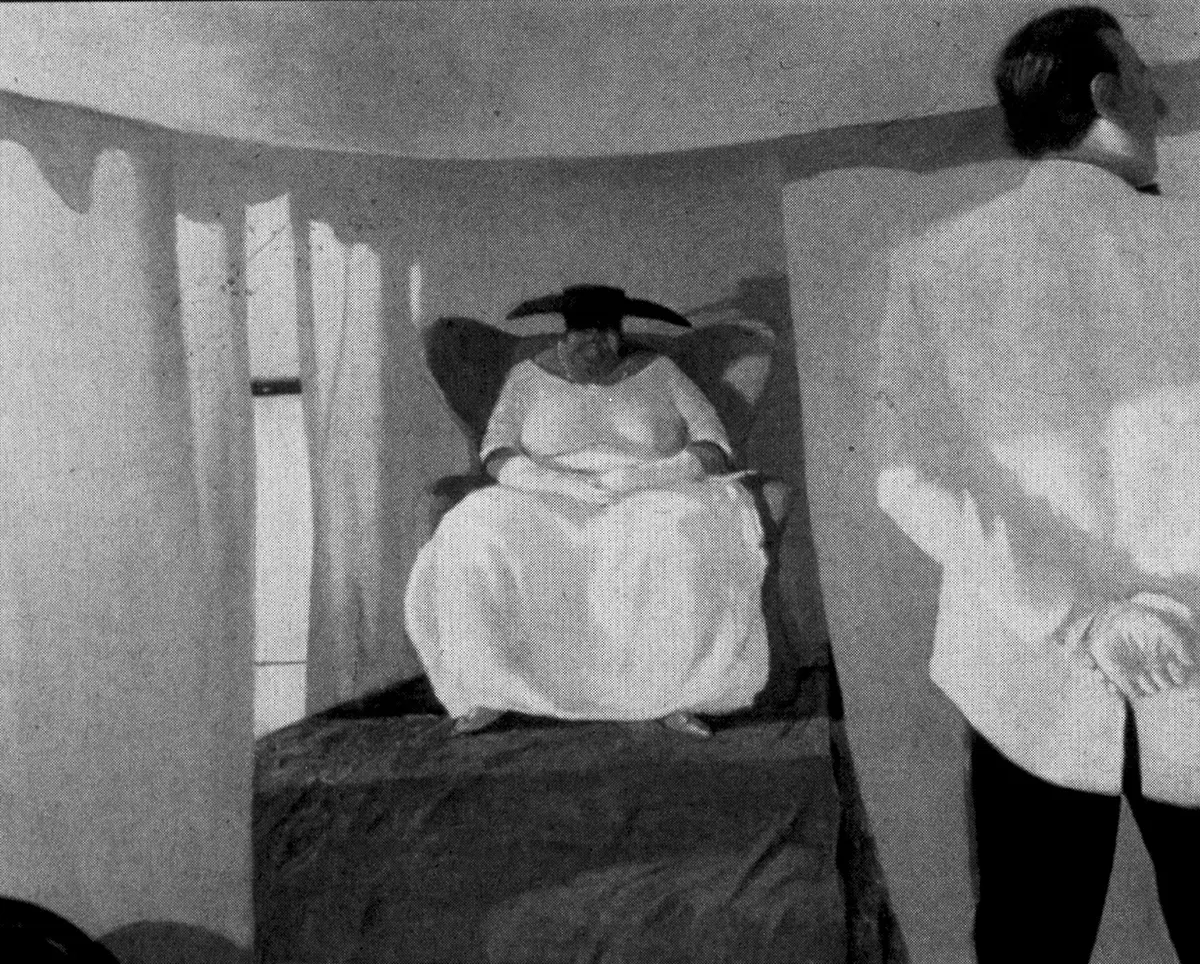
When this same ability to maneuver and choreograph is applied to interior scenes, the result is especially enigmatic. He has long incorporated stone windows looking at rolling hills or empty seas in his paintings. They can be tranquil, as in Hondo Valley, 1993, or can take on the aspects of the humorous and bizarre in Apples and the Moon, 1992, where a monkey perches atop a colander of apples to look out at the cliffs at the edge of a moonlit sea. Shadows are key to the moods of all of his works. In The Chart, 1987, the figure occupies an interior/exterior space. Larraz does not often include figures in his works, but when he does the effects are particularly dramatic. The psychological ambiguities that are present in all of his objective arrangements take on new meaning with the treatment of the figure. The woman in The Chart is his aunt, seen from above and wearing a medieval type of headdress that gives her the appearance of an astrologer or navigator studying what appears to be a map, or perhaps an astrological chart. Shadows add a mysterious effect that is further exaggerated by the technique that combines exactitude with a peculiar lack of detail in her face. The result is disorientating and disarming. Such painterly techniques and lighting effects have the same disquieting effect in Itinerant Oracle, 1997, one of the exhibition’s most powerful works. Attended by a white-gloved mayordomo, the large figure of a soothsayer awaits her next visitor on an elevated platform and the viewer is immediately enticed to peer through the entrance and become implicated in the scene.
The beautiful paintings of Julio Larraz lure us into a magical reality that is as fantastic as it is lucid and believable. Like the tiny insects confronting his monumental giants of colorful shapes and forms, we are forced to see the world anew and share in the strange vantage point of the artist.