
Marcelo Pombo (I959) is one of the outstanding figures of the current generation. His work is seen as part of neo pop, from which he uses as his main strategies the appropriation and aesthetic recuperation of kitsch. Brought up in a middle-class family, he has said: "kitsch was the landscape of my everyday life. It is a style which I sometimes refine, and which other times I deflate".
The illustration of the curious cohabitation between what is considered "good taste” (purified and sometimes minimalist style) and the bad taste of kitsch, with all its possible excesses, seems to have been one of the main objectives of this exhibition by Pombo at the Ricardo Rojas Cultural Center (part of the University of Buenos Aires). The visitor in search of certainty or confirmation was no doubt disappointed. As is to be expected with an artist of the 1990s, there is nothing stranger, in the world which the imagines, than certainty. Nothing is what we think it should be. There is in fact no should be at all. For this reason, neither the connotations of the objects depicted nor the montage and illumination of the works corresponded to what is considered normal practice. Some twenty small black-and-white drawings and a large format painting, executed on a common material (telgopor), comprised the selection. As in his earlier series, Pombo once again worked with the interplay between opposites. This time, the contrast between rich/poor, transcendental/ephemeral, conceptual artisanal took shape in the exhibition of photocopies of original drawings. Contrary to what one might have expected, the copy was as perfect as or even more perfect than the original, and in some case,s it was difficult to distinguish between the two. The efficiency of the copy, echoing the artist's perfectionist intentions, lies in the conversion of certain accidents in the line work into filled-in areas, thus emphasizing the clean black and white contrast. But it was not simply a question of inverting the technically inferior status of the copy in respect of the original, but of demolishing certain privileges of the unique, sacred aura of the latter.
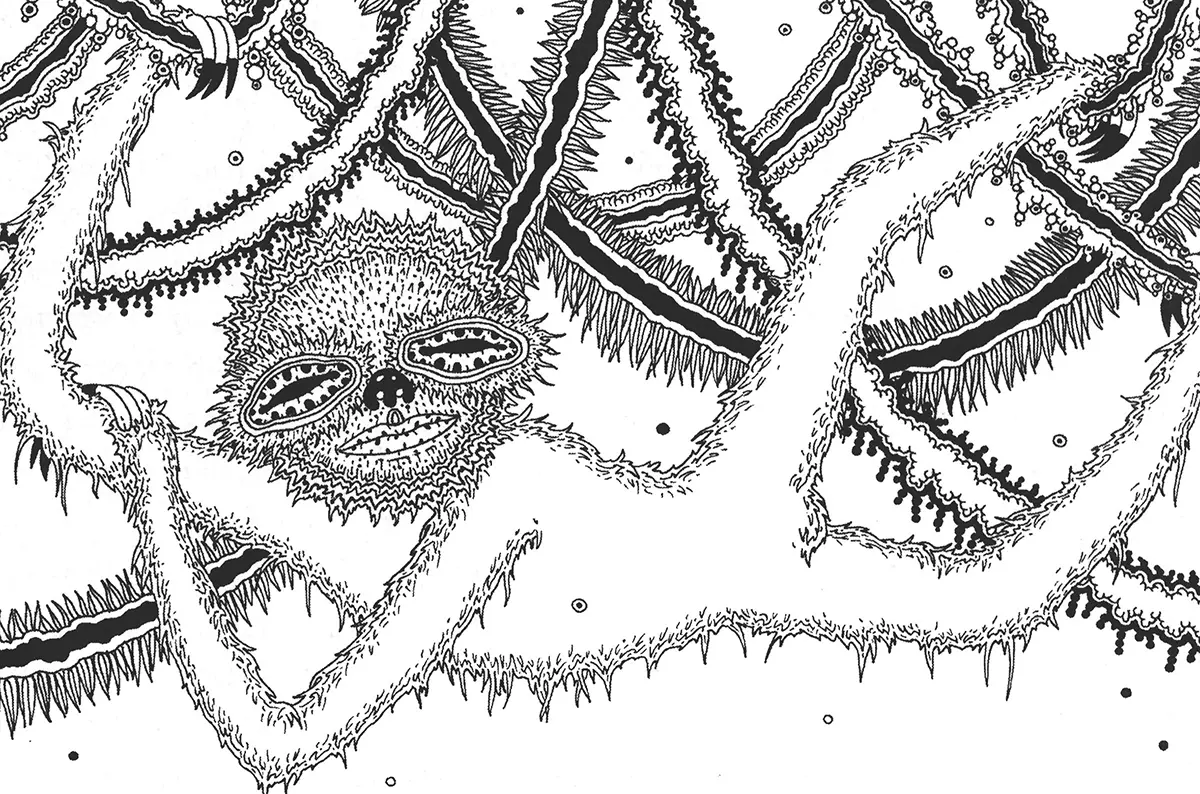
The artist’s strategy is to accept reproduction as part of his work. Furthermore, he advises buyers to keep the original in a safe place and to show only the photocopy, to ensure the preservation of an ephemeral material (paper). At a time in which technological progress devours and renders perishable everything that it produces, Pombo seems to be determined to redress the balance by emphasizing the eternity of art.
The displacement of what is traditionally considered as precious is also reflected in the direct work on the frames. As marginal elements vis-à-vis the drawing or painting, the frames, in this case, prove to be the only original elements since they are not reproducible. The artist has made them with the considerable skill of an artisan, in accordance with a careful geometric design that emphasizes the presence, on a telgopor surface, of small spheres of the same material placed at regular intervals.
In an echo of his earlier work, there is a combination of elements which may be decorative or artistic, academic or avant-garde, silly or intelligent (to use the artist’s own words). These oppositions refer back to the work of art itself and form the backdrop against which the artist’s personal obsessions are revealed. The intimate elements thus become the main reference, as can be seen in the depiction of erotic and sexual fantasies representative of gay difference, and in the concern about the omnipresent gaze of the Other which pursues us with its many eyes. In these cases, the images acquire a surrealist connotation, distant from the neo-pop aesthetic that characterized Pombo’s work in earlier periods.
The idea of fiesta proves to be less a synonym of joy and union than asphyxia and the pleasures of solitude. There is also the trap-setting connotation implied by the garlands-intestines, taking the celebratory vision in a visceral descent towards wounds and sickness.
In various ways, Pombo disrupts a perfectly ordered world and then proceeds to reconstruct and re-interpret it. His target consists of classifications and models, many of which refer to man and his relationship with his surroundings. In this sense, his work also seems to point toward the need for an urgent reconstruction of ethics.
ELENA OLIVERAS