
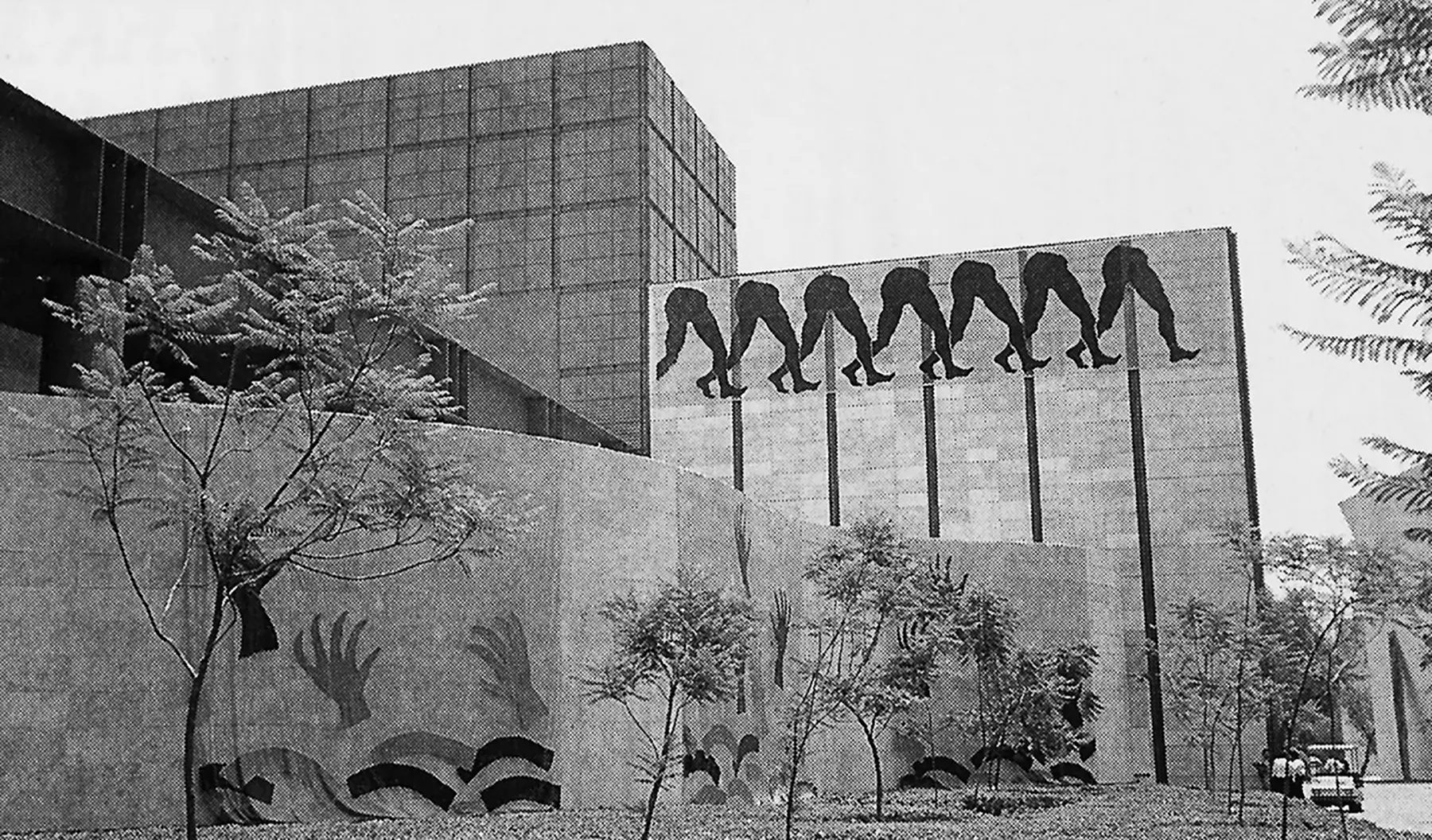
The selection presented at this edition of the Two-Dimensional Biennial of the National Salon of Plastic Arts reflected the current crisis in definitions with which attempts are made to explain a good deal of contemporary production. The show was held on the premises of the National Center for the Arts (which houses schools of music, dance, theater, and plastic arts, as well as various research centers), to enable students to come into contact with the most recent production of a select group of artists resident in the country. The exhibition was not restricted to just the Gallery but included site-specific works in all the areas and buildings of the Center. The results were as ambiguous as the concept of the two dimensions. This year, various works were selected that differed from tradition and tended towards the recuperation of a variety of conceptual aspects that have for various decades characterized the so-called avant-garde.
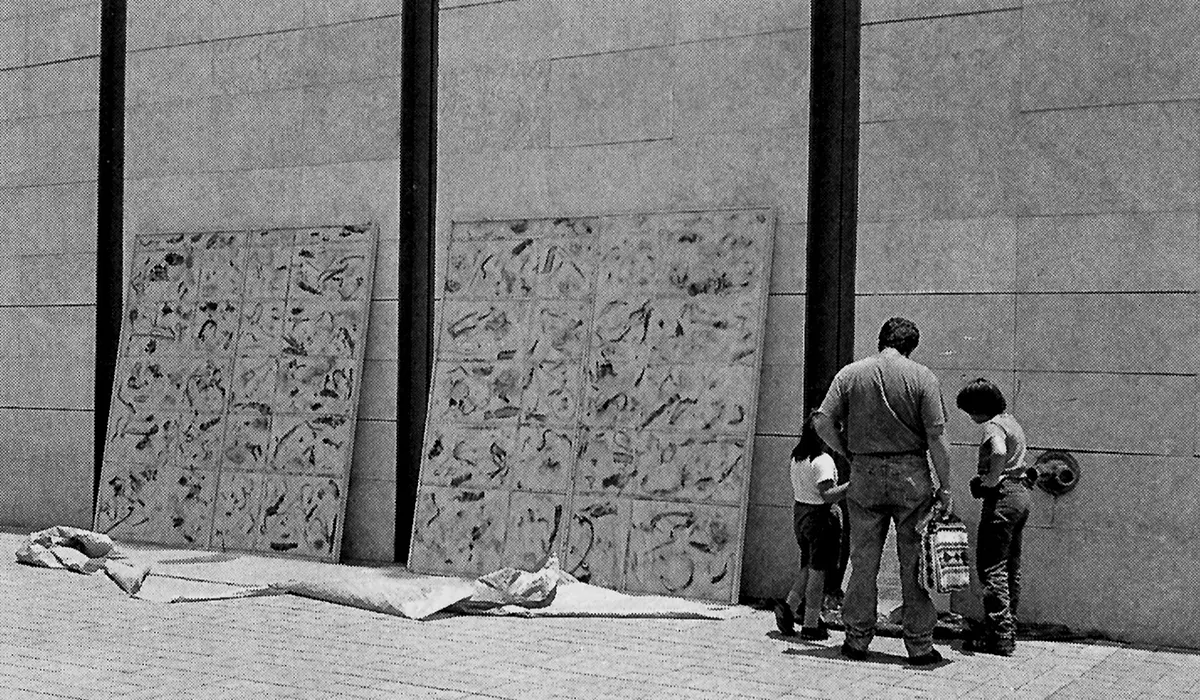
One of the striking works of this kind was The Intervened Transit by Cesar Hayashi, consisting of approximately II square meters of mosaic from the artist’s workshop. While it functioned on the floor, the mosaic "documented" life inside the studio—the passage of the artist and visitors, the traces of time, stains and paint drippings, wine, and other things. Marks, once removed from the floor, recalled certain plastic solutions of abstract expressionism. And with the mosaic as a canvas, the artist emphasized certain textures, inserting and correcting some of the compositional elements-hence the intervention, before presenting the piece as a large picture in various public places in the form of bus stops and ceilings, for a period of six months. What was on view at the CNA Gallery was a floor fragment placed as a floor, not as a picture, and a series of texts and photographs documenting the process.
Within this kind of reinterpretation of North American abstraction, mention can also be made of the triptych by Carlos Márquez, titled The Song of the Bristles with Feathers. This consisted of three wooden boxes in which Márquez arranged a series of brushes and feathers which are seen from a distance formed an abstract composition. The resulting edges made use of both the texture and the chromatic qualities of the materials to provide a well-achieved synthesis of the principle of the ready-made together with monochrome abstraction and informalism.
Paloma Torres proposed a similar synthesis in her White Landscape, a work in painted ceramics in which the material and objective qualities of the work predominated over any constraint of two-dimensionality. Even a work such as Cloning, by Lupina Flores and Juan Caballero —a series of little square mirrors making up a concave surface— emphasized the possibility of overcoming the mere presentation of everyday objects through the reinforcement of some conceptual aspect, in this case, initiated through the title (and indeed, the work managed to “clone" those around it in the Gallery).
Other pieces also presented as two-dimensional were in fact more complex works with objective characteristics. This was the case with the series making up the Logbook of the performance as a personal ritual, by Enrique Ferreol. The work was based on a course given by the conceptualist Monica Meyer that the artist attended. Over the twelve Mondays of the course, Ferreol gathered together a series of notes, photographs, cuttings, drawings, and objects for this series of 12 works which oscillated between collage and assemblage, and at the same time made up a personal ritual, a private performance.
In the same category can be placed the work of Carlos Arias whose didactic consisted of a number of handkerchiefs on which he embroidered a series of texts on the subject of sex, ranging from Foucault’s History of Sexuality to textbook descriptions. The objects were above all for private use but had been transformed at the material and conceptual levels.
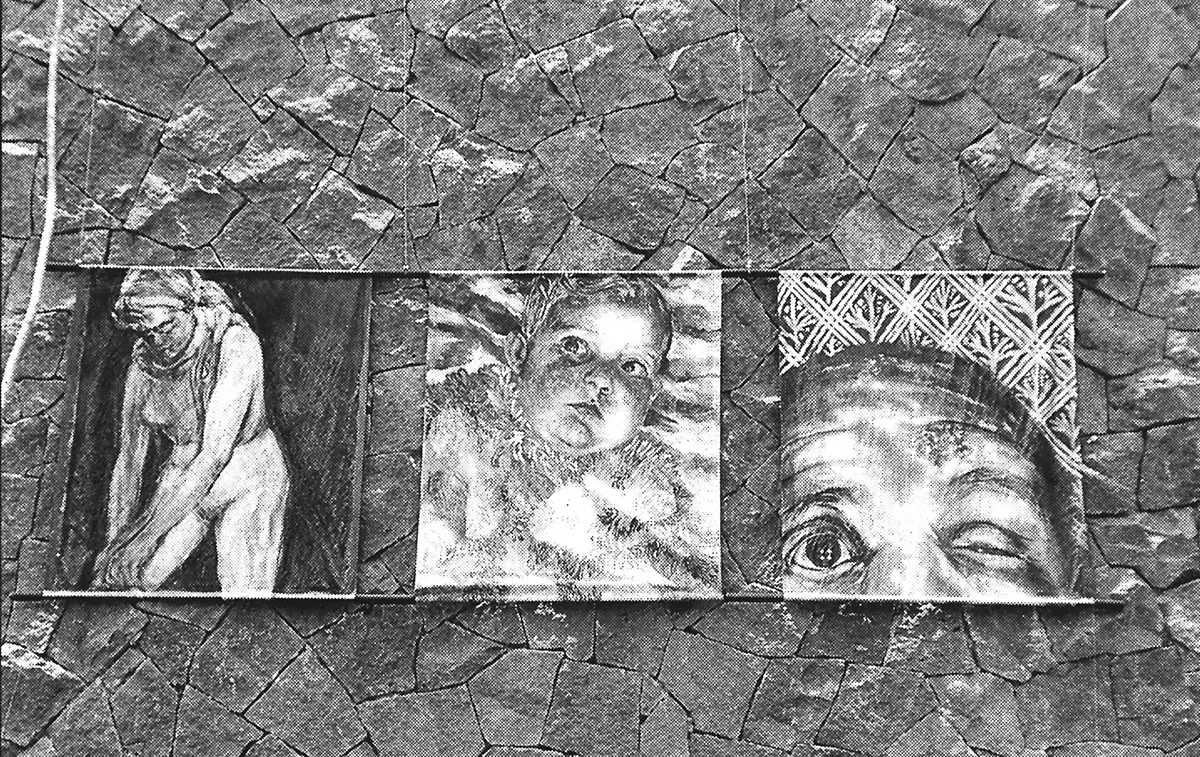
The Biennial also included some works of photography, traditional collage, and mixed media, as well as others that can easily be classified within conventional parameters. In this respect, the contrast between the two kinds of work —conceptual and traditional— re-reflected in general the poverty of the conventional solutions to the problem, in itself questionable, of two-dimensionality. An exception was probably the work presented by Trini, who combined five medium format oils into a polyptych in which, by virtue of its location —the canvases were suspended and made up a column that formed an angle with the ceiling of the mezzanine of the Theater of the Arts— was transformed into an installation designed to involve the spectator at the phenomenological level. The spectator not only had to look up to see the work but on discovering a series of bird's eye views of urban panoramas, momentarily lost any notion of vertical/horizontal, up/ down, and plunged into a two-dimensional illusion of depth and the bottom.

Within the architectural complex that housed the exhibition, there were works that achieved a good integration with the building, such as the banners of Paloma Menéndez's Sea Snake, or Cuahutémoc Rodríguez’s Void, though in these cases it was difficult to decide whether they were part of the usual decoration or the exhibition itself. Thus what remained indefinite was the actual concept of the two dimensions-especially since this is a category that, strictly speaking, can only be applied to illusionist pictorial works which seem to conjure up a sense of space and depth, the third dimension. It was several years ago that abstraction closed the “window on the world" and recognized the picture's status as an object. Large parts of the works included in this Biennial were based on this premise and some managed to take it to its most radical consequences at the ludic, conceptual and decorative levels. Even though the support and diffusion of contemporary artistic production are necessary, it is also reasonable to expect greater clarity in the theoretical and historical premises underlying the selection criteria of events of this kind—that is, if the real objective is to promote the development, with critical feedback, of contemporary art in Mexico.
ISSA MARÍA BENÍTEZ