
For all those who have followed the development of the work of the Venezuelan artist Patricia van Dalen, her project House/Garden/Windows, recently presented at the Art Gallery of the Central Library of the Simon Bolivar University, marks an important stage in the celebration of color as a vital part of her work. The three projects-the mural House, the installation Garden, and the paintings titled Windows reveal an intricate network of changing perspectives, as well as a complex interplay of elegant forms and geometric collages, in which color both determines and limits the forms which are naturally integrated into the space and very structure of the work.
The project as a whole is imbued with a rational and emotive spirit. Each work, or their combination, transforms the images and space in which their physical components are placed. Van Dalen draws attention to the human spirit in the relationship that she establishes between existential metaphors and technological structures and nature. The project was clearly defined in its technical specifications, artistic goals, and conceptual objectives. The first part was the House, which functioned metaphorically as an icon on the one hand, and as a sensitive geometrical abstraction on the other, expressed in a house painting printed on mural-size vinyl fabric. In the words of the artist, this mural, which was placed on the facade of the building, is a focal point of reflection on art as the housing of what is sensitively visual and it announces that painting lives here. The mural welcomed the public entering the library as the house of knowledge and wisdom. In this case, a twofold plastic discourse was established concerning form as a two-dimensional construction and form as a complex geometrical structure.
The Garden proposal consisted of the intervention of over 2,500 square meters of lawn, on a plot of land next to the University library, with thousands of little flags (symbolizing flowers), in orange, pink, and red, which signaled a new manner of painting for the artist—one where physical space is used as a support for painting. In plastic terms, the work was resolved through entropic dynamics, as a result of the contrasts produced by the colors with the green of the grass and the effect and changes of the light on the elements, both artificial (flag) and natural (grass), of the work. This work can thus be seen as an impressionist derivation analyzed in contemporary terms.
The experiment had already been carried out by Van Dalen. The creation of imaginary gardens, gardens with flowerpots full of flowers, is an expression of the artist's fantasy, imagination, and artistic interests. As in her other works, the Garden involves a repetition of forms, the accumulation of events, and the serialization of color-all which produce a mysterious but very festive atmosphere. The work is a celebration of the joy of living, the need to feel communion with nature, the free air, color, and the sun.
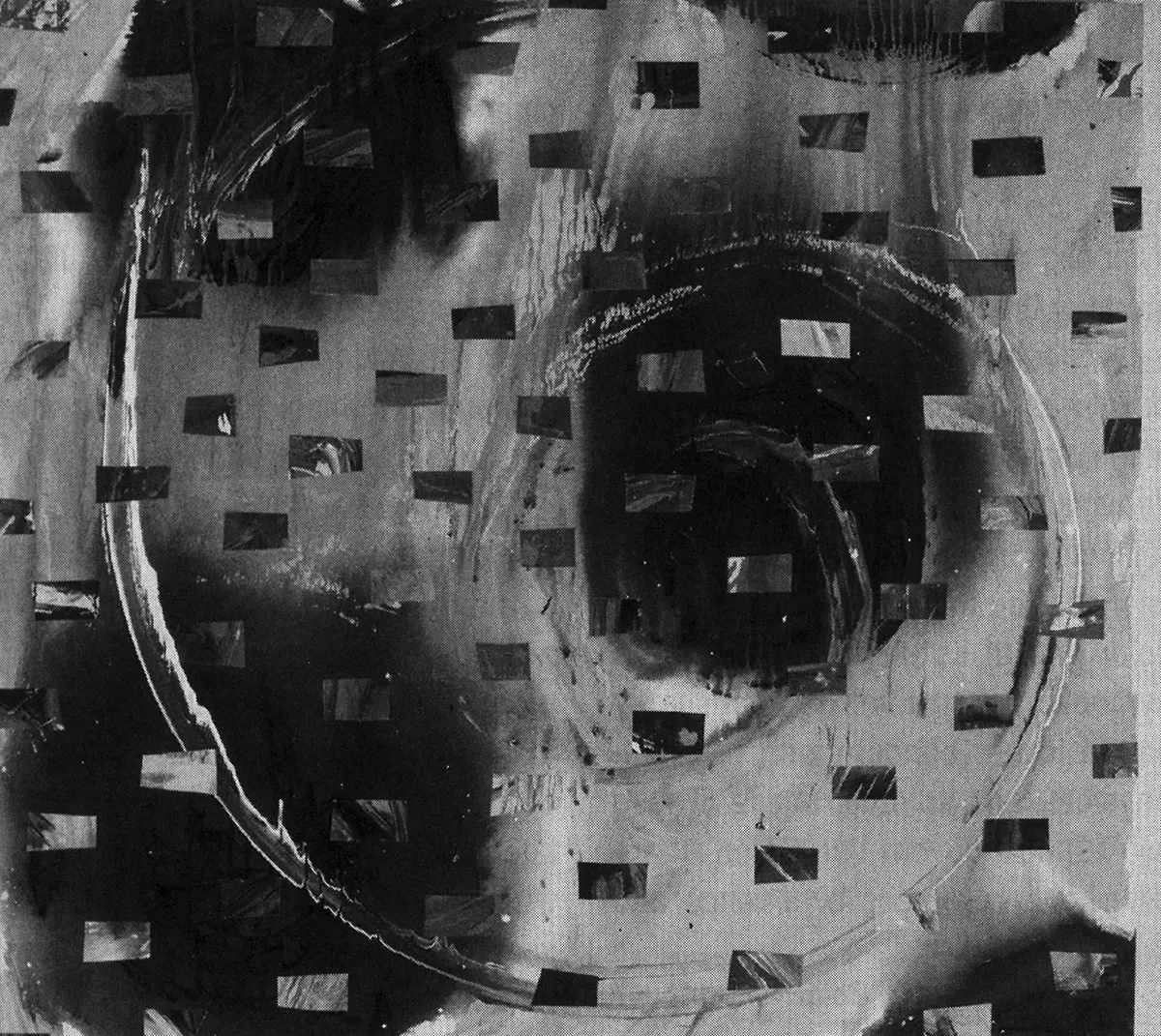
The third part of the project consisted of Windows. These were a series of two-dimensional pieces, that appeared to be three-dimensional when viewed through special glasses (distributed to the public), creating different readings at the conceptual level and in terms of perception. The works, which were mainly done in paper cut-outs of geometric figures with colored papers glued together at the back, and with thick and thin brushes of paint on them, created different surfaces which merged the figure-background relationship; the figures advanced or receded often in accordance with the position of the spectator, or the use of the 3-D Chromadepth glasses. This part of the exhibition had a direct physical and symbolic relationship with the house- the mural of the facade.
In conclusion, House/Garden/Windows was a kind of specific chronicle of the plastic and conceptual codes underlying Van Dalen’s reflections on the relationship between life, art, and existence. The multi-dimensional use of color and of its physical, visual, and symbolic possibilities is necessarily linked to her concern with pictorial, physical, and spiritual space. These two aspects govern Van Dalen's handling of her resources, experience, and talent.
BÉLGICA RODRÍGUEZ