
Regarded as one of the leading figures of Dominican expressionism, Master Ramón Oviedo has enjoyed a long and illustrious career. Born in 1927 in Barahona, Dominican Republic, he has received numerous awards and honors for his work over the years. He has represented his country in Biennial exhibitions and has executed important mural commissions in the United States and Latin America, including the OAS General Secretariat Building in Washington, DC (1975). His dedication to the qualities of plastic expressiveness inherent in the act of painting has occupied him through the years. He continues to dedicate himself to painting by using striking new methods and techniques to enhance the surface of his works and imbue them with powerful, often ritualistic, presence. Now in his seventies, he maintains a full and rigorous painting schedule and has a remarkable ability to maintain a fresh outlook with considerable technical experimentation and the exploration of new subjects and means of expression.
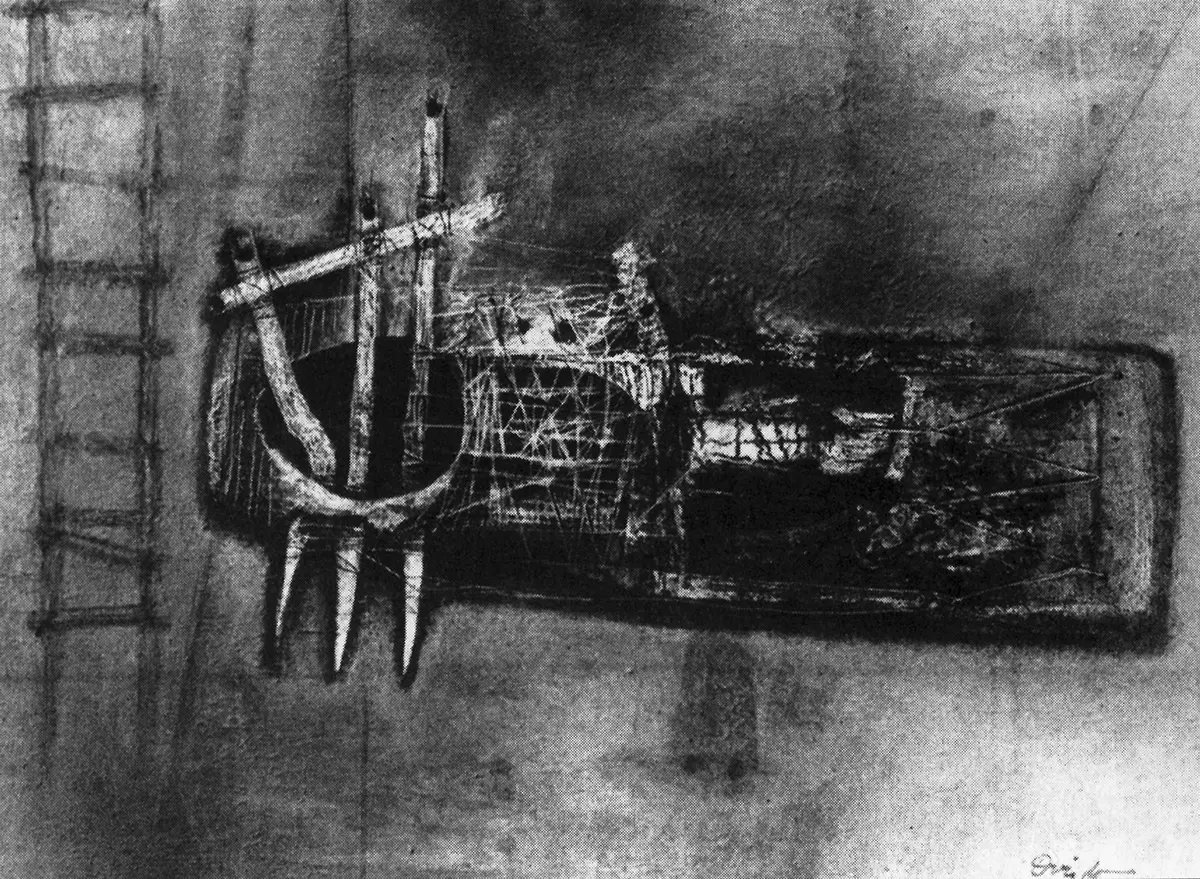
This exhibition is titled Persistencia Evolutiva de la Forma en la Materia (Evolutionary Persistence of Form in Matter) and pays respect to this expressive materialism that has been so much a part of his oeuvre. From within the depths of complex surface textures, there emerges a personal vocabulary of signs and symbols, artifacts, animals, and human forms that transforms each work into a meaningful discourse on the human condition. Inspired by ancient concepts regarding life and death, themes of duality, primitive markings and glyphs, and nature in her most mysterious guise, Oviedo incorporates a variety of materials (string, paper, cloth, gesso) into his imagery that brings them to new life.
The surfaces of Oviedo's canvases are reminiscent of withered skin, bark, or some other natural material. He works in layers, scratching away to reveal the color beneath, and leaves the marks of his process like the graffiti of the past. In Forma Semi-Definida (1997), a petrified mummy is suspended in time and space by actual strings, and parts of the canvas have been slashed and stitched. The haunting countenance of the ancient artifact is hanging helplessly in the void of infinite reality. Such eerie forms also appear in womb-like abodes and caves.
No less distressing is Forma Atrapada (1997), a fleeing red figure that refers to the vanishing civilizations of the New World. His concern for the extinction of humans and animals in the wake of progress has been present throughout his career.
CAROL DAMIAN