
At first glance, the works in Rubén Torras-Llorca's recent exhibition would seem to closely follow the art of René Magritte. Of course, a more thorough examination of his work shows how very dissimilar the two artists are. Torres-Llorca works with a range of materials and cultural references that never entered Magritte’s lexicon, and he touches upon a range of themes and issues that the Belgian artist never considered. In many cases, Torres-Llorca’s work also operates with a level of didacticism that Magritte’s art lacked as well. Despite these differences, how ever, the trappings of surrealism pervade these works, including the tendency to create discordant word/image couplings and the employment of mundane objects and figures that take on a sense of the mysterious and the uncanny.
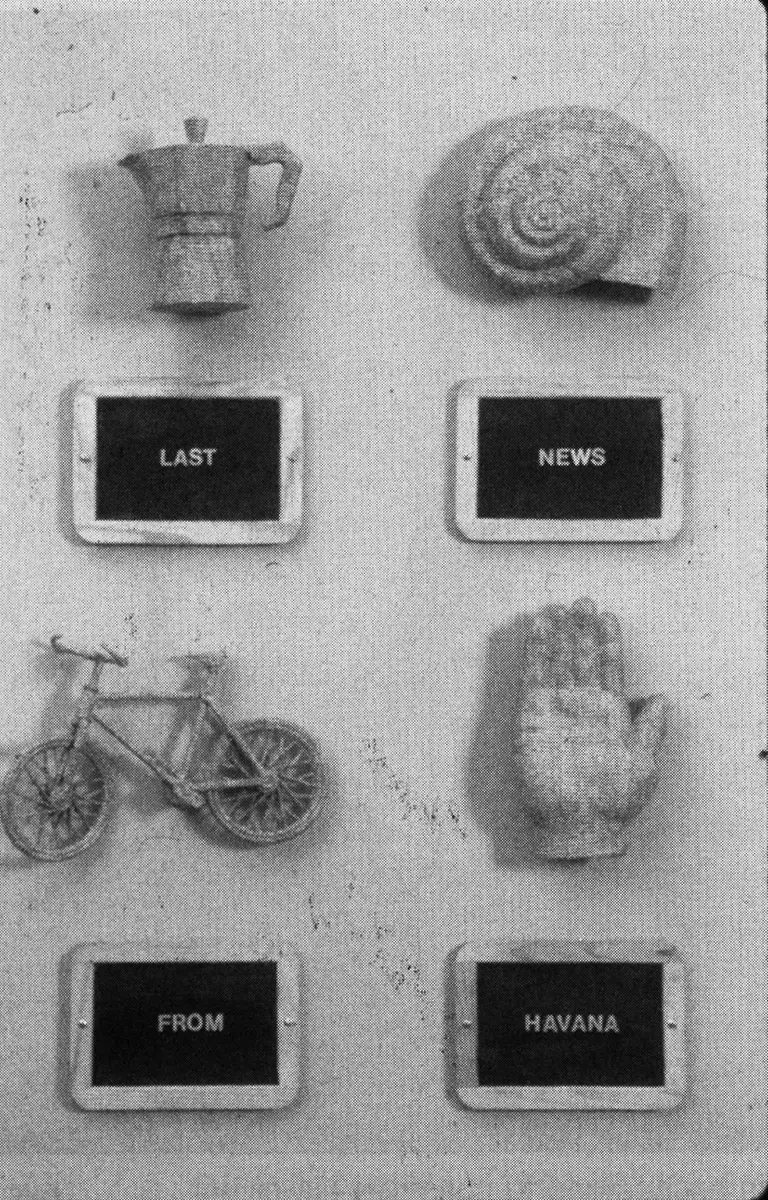
Torres-Llorca named this exhibition Fill in the Blanks, and indeed the viewer is encouraged to construct his or her own narrative. Many of these works involve a series of small-scale blackboards upon which a word or phrase has been printed. Often each board is accompanied by some relief figure, ei then sculpted by the artist or found and reclaimed by him. The frame-by-frame arrangement of text and image, and the often sequential thrust of the pieces add a cinematic quality to this work and emphasize the idea of narrative. For example, his piece titled After Dinner Conversation consists of two verti cal rows of blackboards, appearing to end with two sculpted heads (one blind folded and one with a hammer protrud ing from it) set on chairs on the floor. After a moment we realize that the piece ''moves" from bottom to top, tracing the trajectory of a relation ship from its early positive stage ("she listened to me;" "we had the same interests") ("and we got divorced"). Accompanying the text are wall drawings of houses and other bits of domestic vernacular.
Many of Torres-Llorca’s works en gage such domestic paraphernalia, either with the text or with the objects, such as heads, children's toy horses, chairs, and houses. The idea of creat ing such banal imagery to which we can relate, and thus add to our own experiences lends a certain psychological component to his work. This is made explicit in a series of word association games arranged in a long horizontal line on the wall under the heading Some Causes of Neurosis. Each sculpted object is paired with a work that does not have an obvious relation, yet there is an exact match between the words and objects in the piece, and they do relate when one takes the time to sort them out. The clinical aspect of the work, including a set of directions and the blackboards, creates a stu dent-like role for the viewer and implicates us in actively looking at and engaging with the pieces, even to the point of re-ordering them in our minds.
This identity is reinforced by History Teaches Us Nothing, wherein a series of miniature desks are set along a wall on the floor face blackboards bearing quotes from various artists. The texts, from the likes of Uccello, Michelangelo, Goya, and tellingly, Magritte, assume different formats but all address the is sue of the paucity of funding for living artists.
There are a few pieces that avoid this format and in fact eschew text altogether, though they are in the minority. They have strength, however, owing to their greater ambiguity. It is with these pieces, after all, that the viewer truly gets to fill in the blanks, with much less guidance and prodding. Throughout, the exhibition moves from the heavily obvious to the very obscure, and it is not always clear if this wavering falls within the parameters of the artist’s in tension or his control. However, what this body of work may lack in maintaining a fully consistent intellectual complexity, it makes up for with a poignancy and humanity seldom felt in comparable art predicated upon semiotics.
JOHN ANGELINE