"Desire is a house of a thousand doors on which art plays its concerts"
Alberto Ruy-Sánchez
A retrospective exhibition by the Mexican artist Adolfo Riestra —described by the critic Edward Sullivan as the quintessence and product of many of the aesthetic and stylistic trends of the 1980s in the West— was recently presented at the Museum of Contemporary Art of Monterrey (MARCO). The show was an attempt to assess the contribution of his work to modern art and his role “as an artist who overcame the stereotypes affecting Mexican art of his time",1 as Sullivan, the curator of the exhibition, noted in the catalog.
Riestra's work, which is mainly recognized as sculpture, comprises a broad gamut of expressions that include drawing to painting as well as sculpture, to which significant reference is made in this well-presented anthology of his work. Characterized by the skillful placing of a few lines, broad areas of color, and the use of dynamic forms and “personal visual language", or "private shorthand," as Sullivan points out in his presentation text, Riestra's pictorial work can be set “within the international trends which developed at the beginning of the 1980s and which had such an impact at the end of the period”. This part of Riestra's work has traditionally been seen as belonging to the so-called neo-Mexicanism, although in Sullivan's view, it is closer to "neo-expressionist- tendencies from the time of his first drawings done in 1968 around the student movements in Mexico City.
Sullivan says that drawings like Military Tank and El Tapado (both from 1969) can be seen as icons (in their frugality, close-up view, and direct description of oppression and fear) of a terrible period in the history of modern Mexico. The concern to depict —especially in the drawings—critical situations of contemporary society would accompany Riestra constantly throughout his career, as can be seen in his series on the earthquake which hit Mexico in 1985. Sullivan nevertheless establishes a link between the early pictorial work of Riestra —describing small towns, popular festivals, and figures from the street— with the art of the 1930s and 1940s (particularly such drawings as Landscape, town, and mountain from around 1960 and Beggar from 1969), which reflect a Mexicanist perspective that the artist would soon abandon, along with any future reference to folkloric elements.
The relaxed style of Riestra’s drawing is seen by Sullivan as a visual and psychological strategy. Sketches with tense, unsure, and sometimes almost clumsy lines are in the curator’s view a means of calling attention to the individuality of each object. In the same way, the artist used color as a direct and spontaneous reflection of the moods and dramatic circumstances of his characters.
Through his technique, Riestra sought a sense of freedom in the two dimensions: I believe that painting has to lose some of its formalism, it has to be given a less solemn tone and games have to be found. Painting in its process of creation is totally informal; let us remember Jackson Pollock, whose work, although serious, was done in the most spontaneous and informal manner. I want to play with painting and I want the spectator to do so too. My game in is the air, in the spheres which break with gravity by adhering to the work, along with the void and movement.
In addition to his drawings and paintings, Riestra’s large ceramic sculptures (of which he produced more than two hundred during his brief career, cut short by his premature death in 1989) stood out in the sober museography of the MARCO exhibition rooms.
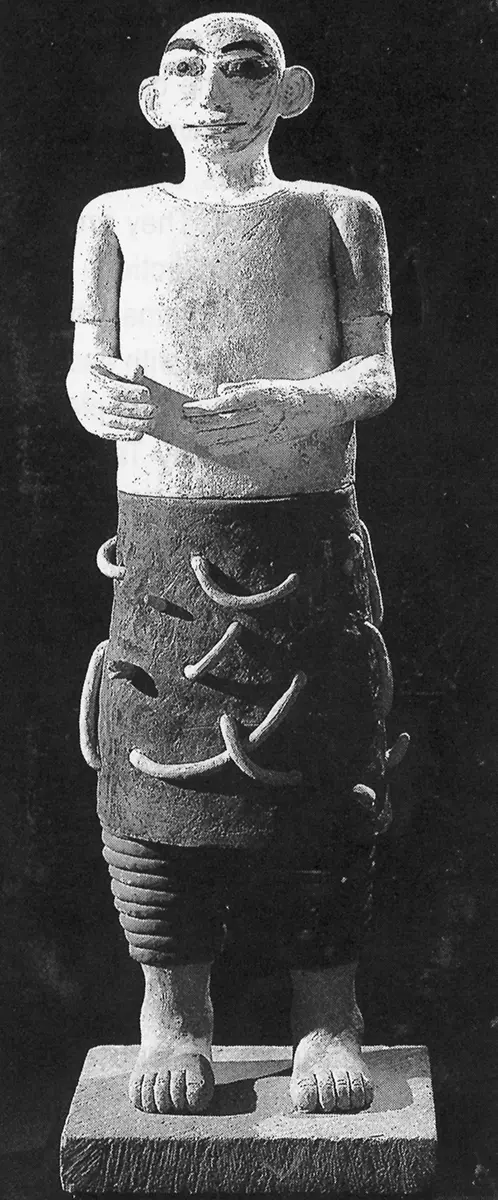
As a logical consequence of his work in drawing and painting, Riestra’s sculpture originally emerged from popular Mexican art, which he assimilated at the aesthetic level, but in all his work there are references to a rich universal sculptural tradition, Cycladic, Egyptian, and Graeco-Roman, as well as features of pre-Hispanic monumentality and the tombs of ancient Greece, as Sullivan notes.
In his essay for this exhibition, titled Un sueño de tinta y barro: Adolfo Riestra, apresurando el milenio, Alberto Ruy-Sánchez2 describes part of the artist's sculpture as a work of sensations: "All Riestra’s sculptural figures fill us with a strong sensation of coming from a secret world of the soul. They are not human actions that reveal the presence of feelings, but the contrary: they occupy space as only a feeling can. They are emanations rather than representations. They are intangible feelings that take shape through the clay, becoming strange sensations in the process."
At all events, this exhibition seems to reflect a coherent panorama of the life of an artist, his times, and his aspirations. -Sculpture is a walk through the inside of bodies-, the artist once said, and this remark might well apply to his entire work —and life— in the context of his own principle, namely that the best art is life itself.
NOTES
1. Edward J. Sullivan, Las ironías subversivas de Adolfo Riestra. Dibujo, pintura y escultura, Museum of Contemporary Art of Monterrey, Monterrey, N.L., Mexico, 1998.
2. Alberto Ruy-Sánchez, Un sueño de tinta y de barro. Adolto Riestra, apresurando el milenio, Museum of Contemporary Art of Monterrey, Monterrey, N.L., Mexico. 1998.
PATRICIA GARCÍA CAVAZOS