
In 1994, the Chilean artist Alfredo Jaar traveled to Rwanda immediately after one of the most terrible massacres of the century (the assassination of a million members of the Tutsi tribe by members of the Hutu ethnic group), in order to document the event and obtain images and testimonial accounts of the atrocious event. Since then, the essence of his work has been based on these accounts and photographs. More precisely, it is based on the artist’s reticence to show that work. Real pictures, for example, a work from 1995 which belongs to this series, consists of a series of black boxes enclosing photographs of massacres, refugee camps, and destroyed cities; in the top part of the boxes, we can read a description of these absent images. Let there be light, of the same year, is a set of also black boxes on which there appears, inscribed in light, the names of the killing sites.
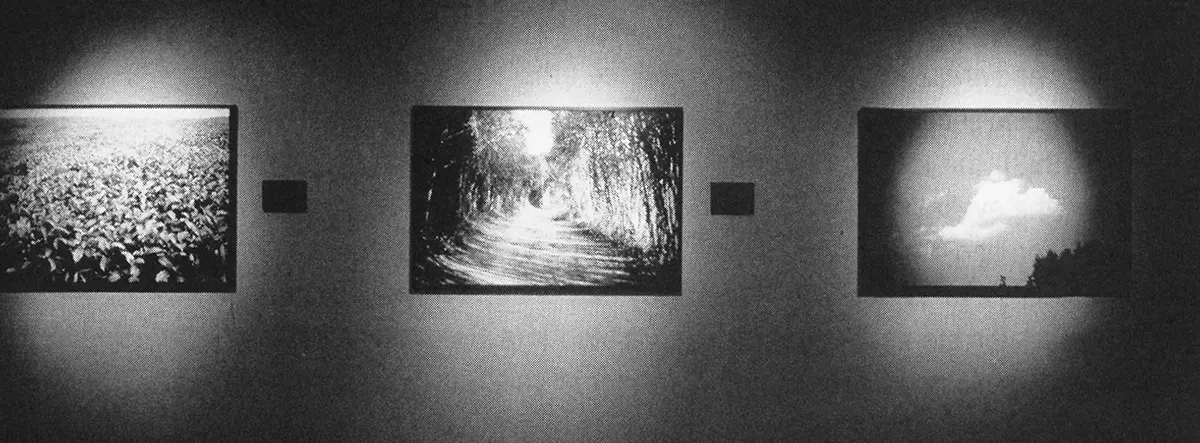
The most recent exhibition by the artist in the Lelong Gallery included two works from this series. The first is Field Road Cloud, a sequence of three photographs in a field, near a church in Ntamara, Rwanda where 400 people were massacred, of the road leading to the place, and of a peaceful cloud that passed overhead, during Jaar's visit, accompanied by schematic drawings of the killing. The second consists of a text written in a light, along a wall, telling the very sober account by a woman called Gutete Emerita of the brutal assassination of her husband and children, in the antechamber to a room which contained only an enormous light table on which a million (the number of dead in Rwanda) identical slides of the eyes of this woman were piled up—the eyes which had witnessed the scene which the text relates.
The Ntamara scandal is referred to only in terms of the road, the field, the cloud, and the witnessing eyes.
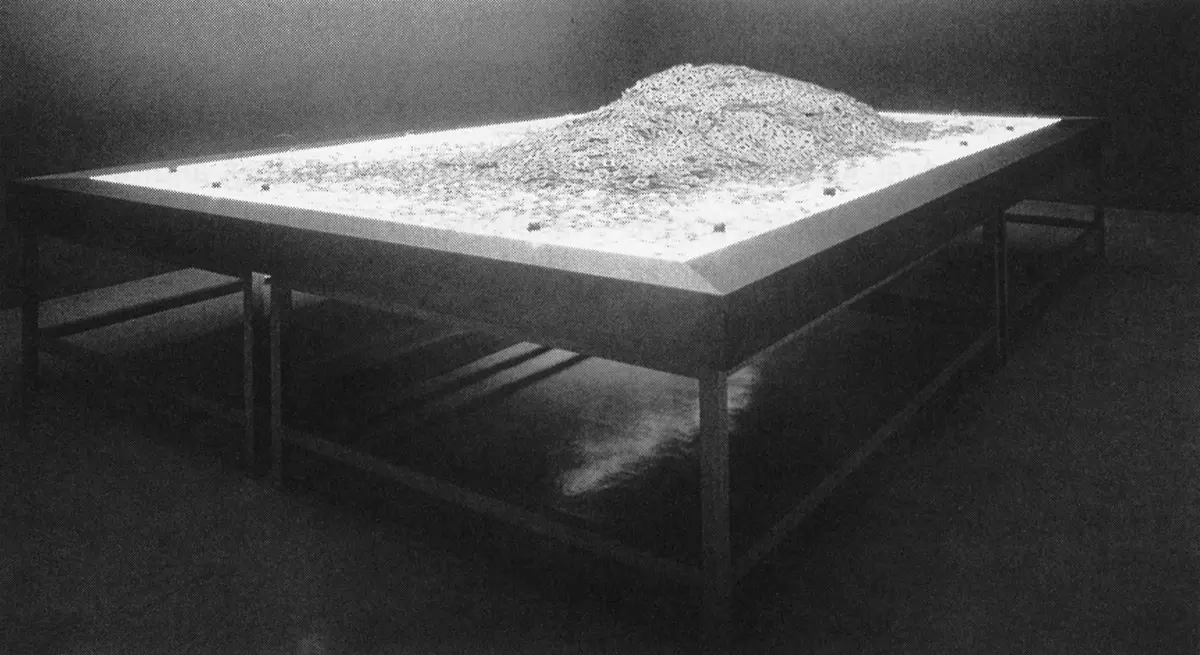
Jaar’s problem in designing this installation (and with the entire “Rwanda Project”) is clearly the following: how can one compose something with certain features of beauty, a “work” that at the same time calls attention to one of the worst massacres of the century, without making it into a balanced representation? But in addition, how can one avoid capitalizing on an overwhelming tragedy in a work which is a peaceful component of the history of recent art, and in the artist's own career? How can one avoid reaping an artistic and in the final analysis personal benefit from such things?
Has Jaar been successful in resolving these problems? A serious answer to this question cannot be given in a few lines. However, some things can be said. Alfredo Jaar's solution is consistent. It is also elegant (although it is not clear, in this case, if this is valuable). If the objective is to make the spectator disturbed, then the installation (judging from my initial reaction) is effective. But this elegance, consistency, and effectiveness depend on the use, by the artist, of certain established kinds of logic.
First of all, an architectural logic: that of the mausoleum, with its relics and its figures of light, its austerity and sense of retention. Secondly, a logic of representation: that of constructing an account of an event that at the same time cannot be represented. The Rwanda massacre is evoked here only through certain testimonial elements: the fields, the roads, the clouds, and above all, the eyes of Gutete Emerita. But the testimonial disposal of Jaar’s installation has a precise genealogy, a European a German genealogy, and most of all a French reference. The earliest antecedent for this installation is perhaps a film, Nuit et Brouillard, by Alain Resnais (and its sequel, Hiroshima mon amour). The most impressive element in this genealogy is possibly another film, Shoah, by Claude Lanzmann. These are works that are based on the postulate that absolute disaster, genocide, the maximum figure of which is the Holocaust, cannot be depicted, and that any treatment of the theme must reveal-in a manner that is sublime, as Lyotard would say, or tremendous, as Borges might put it—the impossibility of representation.
The media with which Jaar has chosen to deal with the genocide in Rwanda are closely related to those that a certain artistic or intellectual tradition has used for a number of decades to confront the Holocaust. To the question of how to depict the absolute scandal of the 1994 genocide without justifying it, rationalizing it, or aestheticizing it, Jaar has replied with images of (non) representation that have a modern European genealogy. Is such an operation just within regard to those who died in Rwanda? The reply is not easy. At best, I would say that Jaar’s response is as just as it is possible to be, bearing in mind the circumstances; at worst, it serves as an intense stimulation to ask oneself that question.
REYNALDO LEDDAGA