The paintings presented by Amalia Tapia at her latest exhibition reflected her artistic maturity and real delight in the pictorial process. These works reveal not only her technical skill but an aesthetic and emotive attitude towards a variety of everyday elements which are presented to the spectator —consciously or unconsciously— as autobiographical details.
A well-established Panamanian artist, Tapia began her career as a watercolorist and presented her first exhibitions more than twenty years ago. With tenacity and self-discipline, she has developed her oil painting, through a variety of stages defined mainly in terms of thematic variations. Her realistic, though disturbing, compositions are well known: coconuts suspended in space and tied with ropes; hanging, inert trousers; manila paper bags; and for many years her torn canvases or the back of canvases on stretchers, painted in minute detail. In her more recent work, Tapia has used with considerable subtlety the technique of collage, incorporating into the canvas such elements as photographs, newspaper cuttings, and pieces of hand-written documents, fragments of reality in works that have always achieved a balance between the real and the imaginary, the fleeting and the permanent.
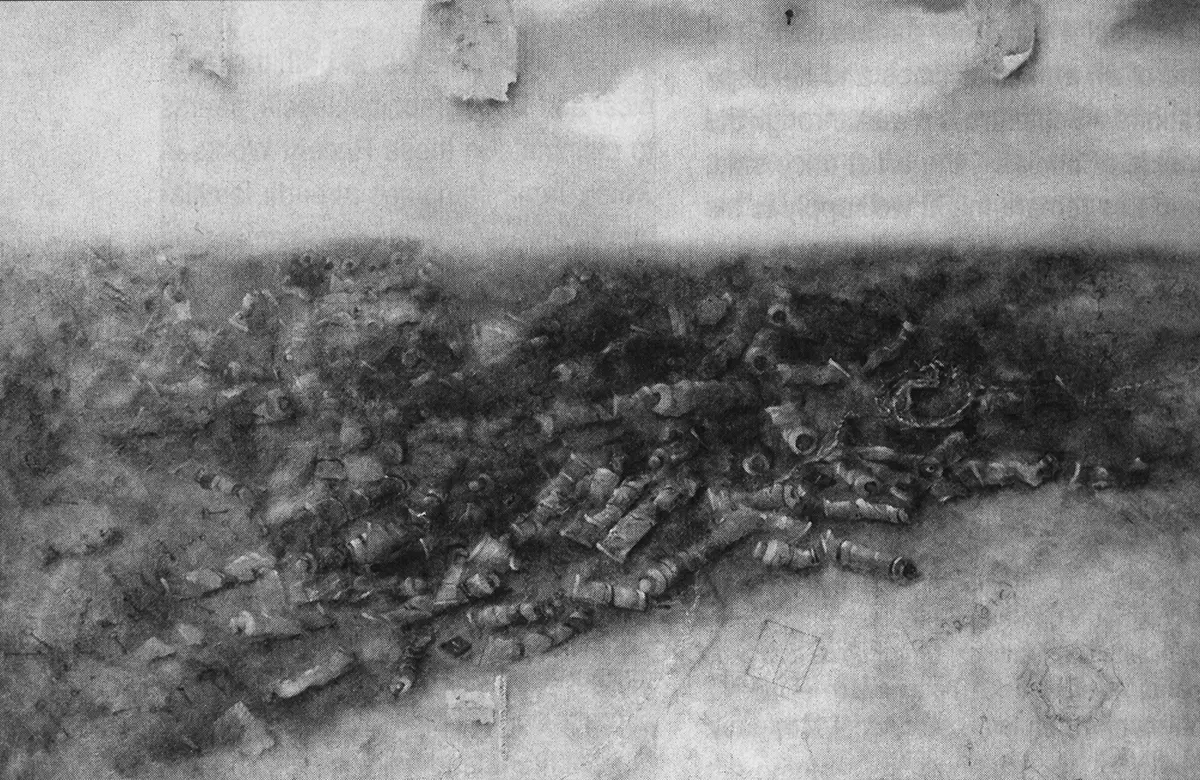
This entire process, at both the technical and iconographical levels, seems to culminate in these recent works in which Tapia combines already familiar ingredients with other new elements in works of great lyricism. It is tempting to explore the possible meanings of many of the features which appear in several of her works, some more enigmatic than others: keys and the eyes of locks, books with their pages torn out or ripped letters and envelopes, graffiti, shells, ropes or barbed wire, knotted pieces of cloth, tubes of paint, matches, and nails appearing in trompe I'oeil, shiny copper centavo coins, apples which have been cut or bitten, lead soldiers which seem to have fallen down or to be in the process of fabrication.
The manner in which these many elements co-exist, floating in the imaginary spaces of Tapia’s canvases, links this artist to a long art historical tradition. We are reminded of the dream worlds of the surrealist Rene Magritte, the trivial but intensely meaningful objects of Liliana Porter, and the paintings of blurred square compartments (though not the colors) that made Mark Rothko famous. Tapia has managed to exploit the lessons of art history, reinterpreting them and making them her own. There is something intensely personal, almost intimate, in her manner of painting and in the sensation of abandonment and solitude transmitted by these canvases from the very beginning. The melancholic effect is corroborated by the penumbra of the works and the titles, which speak of dreams, acts of forgetfulness, absence, and memories.
In works such as Remembering Essences, Tapia, who as well as being a painter is an exceptional flamenco dancer, makes very personal references when she paints her dancing shoes surrounded by a dark cloud. These shoes are apparently full of memories reflected in very tiny details, such as a counter in a game or a fishing hook. However, the composition and the message are much less impressive in her images of shoes than in other paintings that are more challenging to the spectator, as in the magnificent A Reflection of Solitude, in which the dark and undefined space of the canvas is occupied by twelve small images, arranged as in a photographic album. They are parts of an iconographic collection, with a characteristic sense of drama in the use of light and shadow, and with each little compartment suggesting multiple readings. In line with the way Tapia's pictures encourage the spectator to make a reading, these twelve images can be seen as verses of poetical composition.
At the same time, as in parchment darkened by time, the green in the background of this work and the different variations from white to cream in the others included in this exhibition provided a visual repose from the earthy, and sometimes muddy depths that characterized so many of Tapia's pictures in recent years. (Unfortunately, the catalog does not do justice to the subtlety and luminosity of Tapia’s colors, either in the reproductions inside or in the unfortunate tones appearing on the cover).
Equally notable as the colors in these works were the unusual absence of collage, as well as the constant use of textures, which apparently created a priori on the canvas. However, the generalized and arbitrary application of textures achieved its purpose only in those compositions in which the surface acquired its own personality, becoming a kind of skin or wall on which Tapia writes her story, as in Going along Fourth Street.
In other pictures, much more than the texture, the main effect came from the differences achieved with the oils that this artist uses impeccably to recreate the vaporous nature of a cloud or the transparency of water. In Tapia's work, the atmosphere of magic and mystery, the pictorial discourse, and the symbolic codes —including those which we cannot decipher— do not have any nationality but belong in a sense to an unconscious world that we all share. Perhaps it is for this reason that these very silent works seem to speak out to us.
MÓNICA KUPFER