
During the time of the exhibition presented by the Claude Bernard Gallery at the 1983 edition of the FIAC, Antonio Seguí told the philosopher Gilbert Lascault in an interview published in the magazine Beaux-Arts, "I do not tell a story which I would like to present in images...My objective is quite different. I have 'plastic objects' which allow me to compose my picture. These elements, these plastic objects are figures, objects, houses, animals, the sky, earth, water, town, and the countryside. A red tie, a white sock, a black car, a blue sky, and green or golden shadows are the elements that are placed together to make up a picture. The spectator can read them in various ways. They may suggest stories, but that is the spectator's affair: his responsibility and privilege. Towards 1967, some of my works had as their title this piece of advice: 'It's up to you to make the story.'"
The Maison de I’Amérique Latine and the Marwan Hoss Gallery (which has just opened a branch in Brussels) have taken note of this piece of advice and have, with the complicity of Seguí, used it as the concept for their joint exhibition. Linder the generic title of It's up to you to make the story. This joint presentation is interesting in many respects (in particular, the choice of works), but above all because of the special component —in terms of scenery— of inviting the spectator to make a varied reading of the work through the introduction of elements external to the work, but which are linked to the life of the artist. The concept of the exhibition, constructed around a to-and-fro process, visual meanderings, and fixing of the gaze, might have the following objectives: to solicit the imagination of the spectator, to encourage the establishment of associations, to awaken his curiosity, to guide his search, to propose ways of constructing, collecting and bringing together things in full freedom, to give access to other codes, and to ask questions about the multiple sources of the gaze.
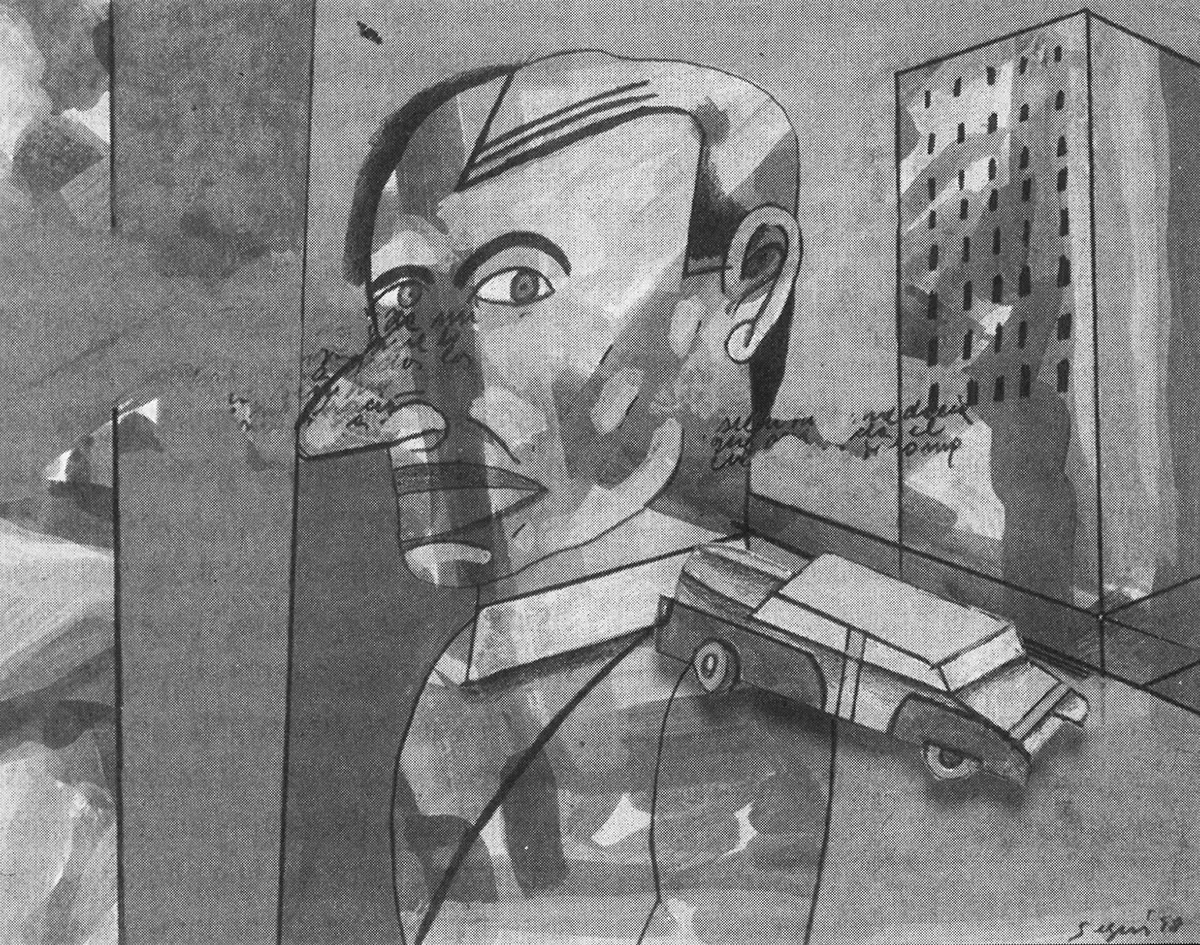
The Maison de I'Amérique Latine proposed a confrontation between the works and a selection from the personal collection of the artist. Like a kind of treasure hunt appealing to the spectator's spirit of adventure, the exhibition appeared to be a jigsaw puzzle of dates, periods, and genres (paintings, collages, cut-outs, objects, drawings, sculptures, ceramic pieces). But instead of disturbing the spectator, the deliberate mixing of several kinds of artistic objects enabled him to pull at some of the threads of the intellectual, formal, and sensitive canvas that underlies the contextualization of the work. What made this different from a traditional retrospective (although personal objects of the artist are increasingly present in exhibitions today), was the absence of any organized chronology, and above all, the introduction —in complicity with the works— of a selection of masks, statuettes, sculptures and effigies in terracotta or wood, from the artist’s own collection of African and pre- Columbian art, mainly from Mexico and Peru.
The artist does not want to establish any difference between his two worlds, that of creation and that of collection, they should co-exist side by side, interact, and question each other. The man in a hurry who paces up and down the city is a bit like the wood sculpture, Man in movement from Asmat, New Guinea; the accumulation of effigies titled The strength of the tribe or the army of shadows, from Bamikele, Camerun (fabric and pearls) suggests other crowds, while the smile of the Peruvian terracotta sculptures evokes other similarities and encounters. But there is no point in trying to make any summary or to establish a direct relationship between the collection and the work: this would be to betray the artist's idea and distort the purpose of the show. The collection is rather an illustration of Seguí's accumulative obsessions, it appears in a sense as his double and its silent presence intervenes like second nature. The show also reflects the playful nature characteristic of the artist who gives a privileged place to games and plays as much for himself as for the spectator. Nevertheless, his plastic strategy is in evidence here, which he claims is the decisive dimension of his art and which enables him to make the rationality of pictorial work co-exist with the random nature of interpretations.
One of Seguí’s most recent large canvases, Reading for everyone (mixed media on canvas, 1996) is particularly interesting. The narrative has abandoned a pseudo-lightness and acquired a veritable dramatic dimension. The spirit has become darker, becoming once again political, incorporating the words “Rwanda", “fascism", depictions of Hitler, soldiers in arms, and military figures drawn and painted within a frame of meaning entirely written in the artist’s hand (in black on a white background), highlighting the words “problems", “arms", “wounded”, “Bosnia", “disaster", “torture"... The skulls, calaveras, crosses, and tombs become increasingly numerous, and death stalks the scene. Both the present and the future become darkened. Seguí continues to speak of the worst by laughing, and humor is his antidote to all acts of unreason.
The exhibition at the Marwan Hoss Gallery presented some of Seguí’s recent work in two rooms. At the entrance, three large acrylic pictures on canvas from 1998 appeared as a trilogy on the mystery of Peron’s black aircraft. Two universes appear side by side. There is charm and seduction (Everyone is talking about the black airplane and Waiting for the black airplane), thanks to a finish that has the transparency of pastel and the lightness of colored crayon, a very refined and delicate sense of drawing, which Seguí contrasts with the drama in The black airplane has passed, in a register which is more expressionist, more violent, but also more inventive, and open to possible forms of renewal.
Over the years, the coherence of Seguí’s work has been obvious, maintained by the continuity of style and exploration, to the point of obsession and mockery of a social and personal image. In the second room, small figures —in what appeared to be little scenes taken from his canvases— evoked a greater sense of visual repose. But these small format works (acrylic on board) are not, despite their apparent simplicity, devoid of complexity. With perfect mastery and a great sense of coherence in the juxtaposition of colors, they reveal subtle work that gives attention to nuance, particularly around the greys and blues.
Where then can we place Seguí's painting? In routine (that of the depiction of an obsessive world) or fidelity (to a style, an image of self and the other)? It is without a doubt in the pleasure of painting that Seguí goes beyond these possible identifications. In that still, intact joy which he likes to claim for himself, there is also the pleasure of seeing, because the current also runs into the spectator, who is drawn to these pictures, intrigued and seduced.
CHRISTINE FRÉROT