
One of the most prestigious artists of the intermediate generation in Chile is without a doubt Arturo Duclos (1959). His public role, which began around 1980, has consisted of a large number of one-man shows, always well-received by the critics, in galleries in Santiago (Tomas Andreu), Paris, New York (Annina Nosei Gallery), Rome, Milan, Bogota, Caracas, and Buenos Aires. He has participated in the Havana International Biennial and in the Ibero-American Art Biennial of Lima.
The painting of this artist, and this is one of its great qualities, reflects many aspects of our post-modern, late modern, or trans-modern reality. This is apparent in his canvases, which do not have a representational, figurative, or mimetic function, and never embody an expressionist sense of despair. To a large extent, his pictures remind us of certain attitudes by artists from the sixteenth century who might be described as mannerists. As in the case of those artists, Duclos’ proposals have an obvious sense of balance, refinement, and sophistication. Everything is well articulated, although everything is unnatural. As in the case of mannerist art, his is a “stylized style”, bizarre, and full of artifice (in the positive sense of the term).
His work, therefore, reflects many of the features which characterized developments in the visual arts of the 1980s. It is modern because it is the product of its time; heterodox because it is Latin American; and postmodern through its conviction about the end of what is social, the end of reason, progress, and politics.
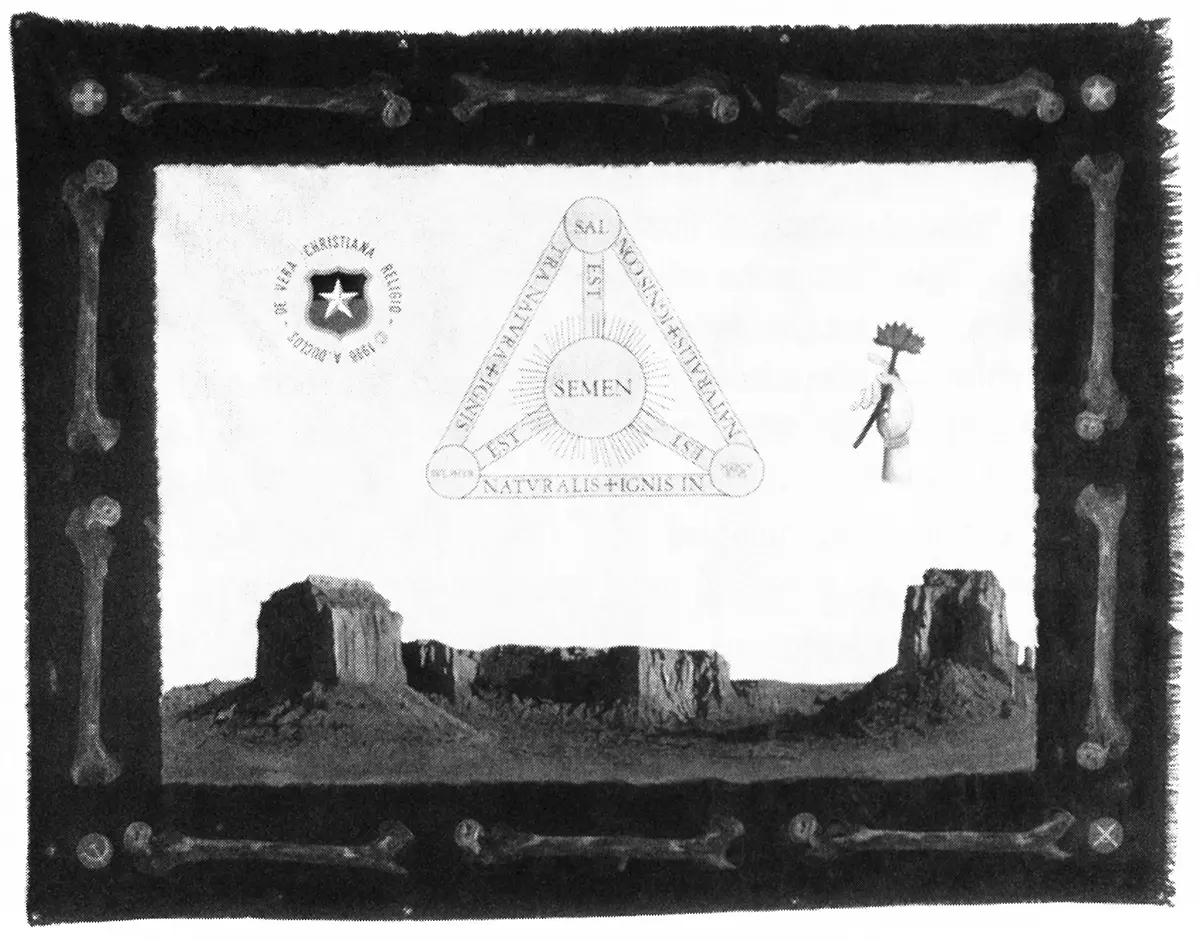
His paintings, of medium format, presented without stretchers, reveal an almost maniacal reiteration of images taken from various contexts. Depicted with precision, they are presented against a freely stained background. The figures are taken from various iconographical repertoires and capriciously brought together. At no time is there any sense of a linear and unitary reading of the images. But their combination, although meaningless, seems to reveal that everything “is in its place”, as in the arbitrary contiguity of an encyclopedia. It would not be too hazardous to say that, like the mannerists, Duclos collects and exhibits meraviglie. His canvases recall the “cabinets de curiosités” filled with strange geological specimens, biological curiosities, and rare zoological items (the reader will remember the collection assembled by Rudolf II of Prague).
In Duclos' canvases, there is, in plastic terms, no visual, hierarchical "center”. With a sense of order which reveals his admiration of Mondrian, Malevich, constructivism, and minimalism, he presents his figures and symbols with analytical rigor. The combination is thus distanced, and the artist himself has said that he is not interested in what is being combined, or in the relationship that this might have with the truth. Thus his panels gather together four creatures: an angel, an eagle, a bull, and a lion; as well as the five basic Chinese animals. Naturally, he also bears in mind Borges' book about imaginary beings.
The canvases on show at this exhibition included some icons: trees, diagrams of masonry, symbols from alchemy, human bones, etc. But there were four permanent symbols, with clear historical references: the cross (Duclos says that it might be the cross of Malevich and the cross of the Red Cross); the hammer and sickle (communism); the star (which is related to magic, the star of Bethlehem, the flags of certain nations and the idea of success); crossed swords (a medieval symbol which also evokes the idea of power through force). These symbols always appear in the corners of the canvas. Perhaps these presences overflowing with symbols and signs allude to the loss of meanings, truths, and ideologies.
Furthermore, the canvases depict not only visual images, but abound in written texts, quotations from many different cultures, and sources of knowledge: hermetic, cabbalistic, philosophical, scientific, mythological, etc. Everything is discontinuous, even the languages: Spanish, Latin, English, and French. Thus some of the canvases have texts reading: "De vera Christiana Religio”; "True Freedom", and "There’s no reason to believe in art”.
Sometimes there is a quotation from the tradition of alchemy and its attempts at the transmutation of the individual (as in the case, at another time, and with a different intention, of Marcel Duchamp). "I began with certain references to alchemy, Duclos has said. However, this revival was a posture for me: it was an attempt to search in the past, but placed in the present situation. The alchemists tried to accelerate to the maximum the effects of time, to accelerate processes until they changed the nature of metals, magically transmuting them."
Although Duclos does not say so, he seems to coincide with Duchamp in more than one secret, including perhaps his enthusiasm for Raymond Roussel, the author of Impressions of Africa and Locus Solus. There is no doubt that the painter is interested in the creative method based on the exploration of the automatism that underlies wordplay and images. The same can be said about his sense of humor. With these games, which abound in his work, certainties become masked. It is impossible to decide if there is a secret or no secret in each picture; if there is any meaning or whether they depict the devaluation of culture, the end of the historical project, and other characteristics which the theorists of postmodernism have made us accustomed.
Ironically, until recently, Duclos signed his pictures like the Renaissance artists: faciebat, composite. Now he does so, in a reference to contemporary industry, with copyright.
JORGE LÓPEZ ANAYA