The exhibition by Carlos Cárdenas which recently lined the walls of the Fredric Snitzer Gallery in Miami suggested a more or less chronological reading of the drawings done by the artist between 1994 and 1998.
The earliest drawings were from his Boxing series of 1994. Figures drawn in pencil on paper recall earlier works in which, by means of caricature, the artist reflected on his attitudes towards stereotypes and human relations in general. The simplicity of the linework and the kind of animation used in this series (the gloves are in fact the faces of little men who express themselves easily and spit) marked a clear continuity with the humorous features that characterize his work.
When he moved to New York, Cárdenas discovered an unlimited source of images and ideas which he develops and illustrates in his drawings. The 1994 series introduced the city as his main theme. Man’s relationship with buildings, the personification of the latter, and the relative nature of life in the “Big Apple" are some of the themes handled in his caricatures done in pencil with a very little color. In formal terms, they are characterized by the presence of the typical little “windows", and “bricks" and the use of elements from his early work.
Inspired by St. Patrick’s Cathedral, the artist has done a series that is interesting from the stylistic and conceptual point of view. First, he moves away from figuration towards a more abstract technique in which the circle becomes a form of painting. Each circle can be interpreted as texture, color, or simply as the enlargement of a point. The use of various circles or points linked by lines recalls subway maps and suggests a spatial reference. The circles introduce color into the drawings (a feature already present earlier in his paintings), which is used monochromatically to create special effects and atmospheres. In the case of the cathedral series, each of the five boards includes a portion of the building camouflaged by circles colored in green and aquamarine tones. The reconstruction of the church is achieved by a discovery of the different camouflaged parts and their mental combination in a kind of puzzle.
In some drawings, the images are organized in horizontal planes which are repeated in a reference to a musical stave or narrative. The artist’s objective is to enable the spectator to interpret the work as an interplay of images, forms, and colors. In Landscape I (1997), Cárdenas presents a series of aerial views in which the architectural structures seem to be immersed in dense circular vegetation. He also includes frontal views in which the timetables of trains bound for New York, camouflaged by circles of color, reproduce the landscape observed by persons traveling to the city by this means of transport.
Most of the drawings follow the same formula, with subtle variations in theme and the selection of color. In the series on transportation (History of Transport, 1997), red tones and brilliant blues dominate. The series on immigration and exile (Series C, 1997) has an oneiric effect created by its use of pink and soft greens. The Gardens series (1998) includes aquatic, musical, and celestial landscapes in blue and aquamarine tones.
Love and Sex (1997), Flags (1998), and Tarot (1998) present more complex themes. Love and Sex, a series with clearly erotic connotations, returns to the questioning of human relations. A man with roots like a tree and a serpent woman are some of the figures which the artist uses in his constant questioning of the relationship between the couple (in some drawings the sexual aspect is quite explicit). In Flags, Cárdenas uses maps and photographs to create different images with political connotations. A strategic map of Kuwait that refers to the Gulf War and a map of Paris which serves as a backdrop to the United States are some of the flags which can be seen as political commentaries or simply as visual games. The Tarot series, on the other hand, combines almost all the elements making up Cárdenas’ aesthetic language: the city with its buildings and its spatial games, the windows done with tracing paper and through which figures from the tarot appear, the circles, grids and caricatures (in the case figures from playing cards).
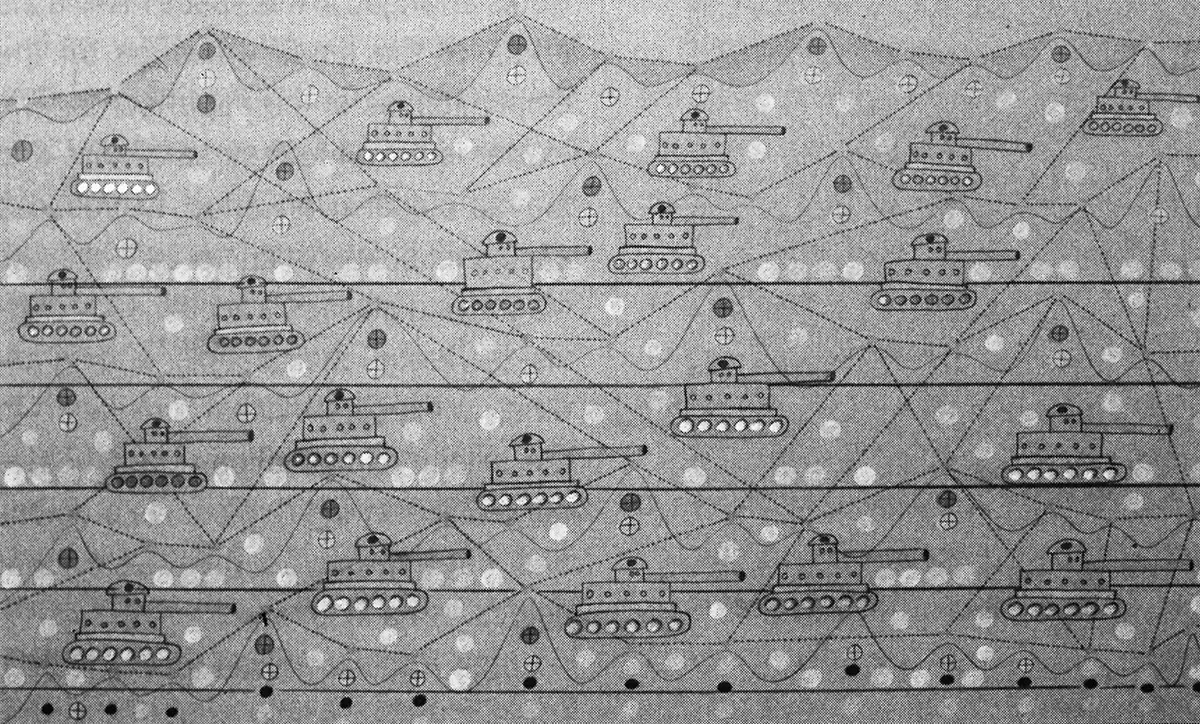
In the final series in the show, little planes, tanks, fruits, and mountains are repeated in horizontal strips and transformed into the notes of a stave or the little windows of lit-up skyscrapers. These almost childish images, like the rest of the show, are a little decorative, although they have their own raison d’être and their logic within the aesthetic proposals that Carlos Cárdenas has been developing in his pictorial work.
FRANCINE BIRBRAGHER