
Félix Perdomo is an artist with a very special gift for substituting reality with a nostalgic, child-like gaze. This gaze is defended continuously throughout his work. His apparent lack of aesthetic concern is closely related to his recapitulation of innocence.
However, behind this apparent candor, we can perceive an almost metaphysical kind of thought reflected in his atemporal conceptions and the solitude of his figures. What emerges from a picture by Perdomo is very close to a neutralizing and immobile field, devoid of action and ideas that transform its inner reality.
Five years ago Meyer Vaisman made a statement in the magazine Artscribe which I believe was very apposite: “I feel completely paralyzed. I do not see at this time any possibility for revolutions." I think that Vaisman's intentions have other connotations which distinguish them from the poetics of Perdomo since they originated in another context in which novelty is a continuous requirement. Nevertheless, they can be fully related to the silent spirit of Félix Perdomo. Indeed, there is nothing contorted or activated in the conception of the pictures of this artist. Everything is suspended or paralyzed, without any space for revolution or irony, humor or pain. Paralyzed perhaps with the profound melancholy of Morandi or the emotional solitude of Giacometti. Paralyzed too by the atmosphere of this human landscape with which we are familiar throughout Latin America, where life is precarious and pain with anguish is condemned to silence, making civilization an abstract and incomprehensible stain.
But how can such a “paralyzed” work evokes such associations?
These interior landscapes have an almost imperceptible way of producing sensations worthy of careful attention, though conceived within a very conventional space and tradition (just as our own emotions, of melancholy or euphoria, are also conventional). In their presence, we place ourselves —as in a certain kind of poetry— in a zone of oblivion, although not of abandonment. This oblivion acts by reminding us of something important in life which we cannot pin down exactly, something which breaths freshly in places that we recognize as our own, but that inevitably seems profoundly enigmatic or distant.
We might think that these paintings are an attempt to forget everything. They want to exist as the final point of an arrogant and unsatisfied tradition of contemporary art and naturally, want to be seen as the beginning of a new relationship with the spectator, providing him with guidance for the contemplation of his own vulnerability.
The English critic Cyril Connolly once said that "from now on, an artist would be judged not only by the resonance of his isolation but the quality of his despair." This well-known remark has been voraciously applied to almost all the art of this century, especially the art produced after the end of the Second World War.
But there is no visible sign of despair in the work of Perdomo, though there is a heroic sort of isolation, not of himself, but of what was foreign to him.
In 1985, during a fortunate encounter with one of his pictures, I began to examine the work of who was for me at that time, an unknown artist. I knew that he was studying at the Pedagogical Institute in Caracas. I met him there and since then I have greatly enjoyed his work. On very few occasions have I lost the sense of astonishment his art provokes in me. In thirteen years I have seen how his work has maintained a sense of balance and equilibrium between the real and unreal worlds. I believe that while the reality is something stable, the unreal destabilizes what is depicted, becoming logical at unconscious levels.
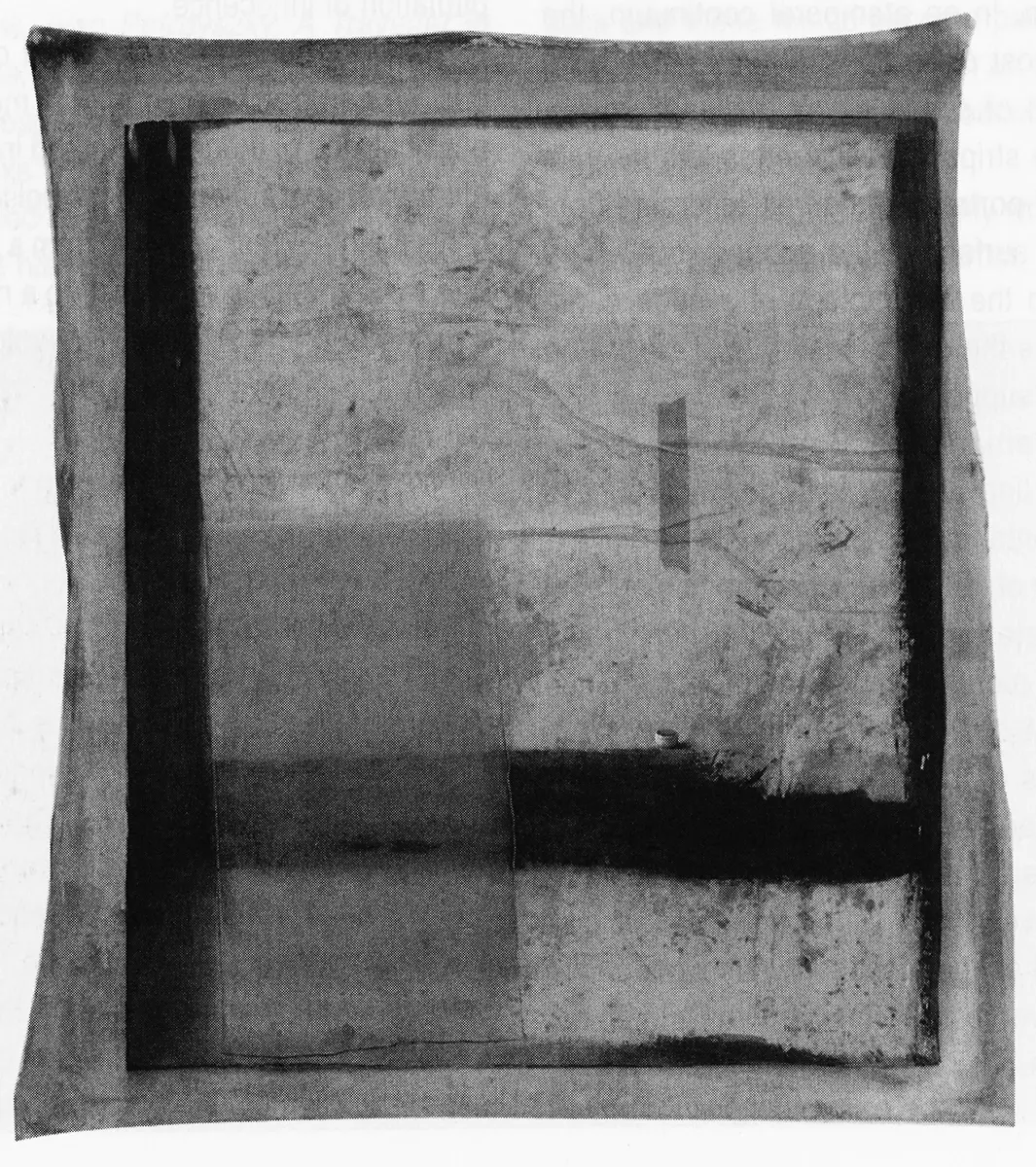
These remarks are an attempt to “understand" one of his paintings, apparently one of the chromatically most stark, austere, and sober works seen in recent years in Venezuela. Perdomo’s palette does not change between greyish transparencies and earth colors, precariously mixed with various types of glue which he then scrapes from the canvas to leave a dry, poor and discolored surface. There is also an inscrutable process of elimination involved in Perdomo’s work, an implacable process in which he reduces all traces of good painting to a minimum of expression, but transcending it without gesture, ardor, color or texture, transforming it into something which is both living and dead.
This “careless” manner of working is even clearer in his most recent desolate “landscapes.” The canvas is exposed to the rain as well as to the relentless steps of those who walk in his studio. In this way, he prepares the basis that subsequently provides the indispensable element of the pictorial surface.
Only an immense earth-colored surface, in which small cups or other passive elements float timidly, reveals that his work is directed towards some real or human element. The abstract dimension is the lost gaze of the innocent spectator, who unconsciously searches for his ideal mirror in each work of art.
These paintings, as a result of their acute simplicity, do not seduce us (seduction is a trivial recourse in the plastic arts). On the contrary, their simplicity moves us, including for a long time after we have been exposed to their sense of paralysis.
EUGENIO ESPINOZA