Two years ago, in this publication, the review of the Pictorial Art Biennial —the only barometer of work by young artists in Panama— concluded that the third edition was characterized by a low creative level. The fourth edition confirmed this diagnosis.
The exhibition of 45 works by 38 artists, selected (out of a total of 257) by a jury with a solid international reputation, opened on June 11th with the prize-awarding ceremony and remained open for one month. Despite the obvious organizational efforts that made the event possible, the five galleries of the Museum of Contemporary Art gave the visitor the clear impression that the show lacked both weight and intensity. There were few works that inspired admiration, reflection, or a sense of questioning.
The Biennial resulting from this competition is of unequaled importance in Panama since very little is presented in the time between exhibitions. Thus it is absurd to expect better results in the Biennial as long as the country continues to lack any spaces in which the more daring and less commercial aspects of national and foreign artists can be presented. An artist cannot grow unless his or her work is shown and benefits from intelligent curatorship and criticism, and seen by a public (including collectors and the artists themselves) educated to look at such work. It is well known that the most valuable aspect of contemporary creation is often that which has not been digested by the market and its consumers, and this is all the more applicable to this event in Panama, where galleries rarely dare to show work that does not seem to be attractive, and where art customers are perceived as being ultra-conservative in their tastes.
Not even the Museum of Contemporary Art —a private institution that has existed for more than 30 years and which has without doubt known better times, fulfills its mission of promoting the good health of the country’s artistic production. At present, the museum itself is not in good physical shape and lacks trained staff in all areas (management, curatorship, fundraising, education, research, restoration, and maintenance of the collection). At the governmental level, the National Institute of Culture is responsible for promoting the arts, but it lacks any credibility and efficiency, and only serves to confuse and disorient, rather than educate in this sphere. In a word, the lack of art spaces in the country is due to the apathy and ignorance of those who exercise economic and political power in Panama.
In such a context, the Biennial— which is sponsored by the National Beer Company, and directed by independent specialists— has from the beginning, emerged as the only window offering any view of the process of the current production of (mostly young) contemporary artists. The efficient and highly professional manner in which all the preparatory stages of the event — from the invitations to the selection of prestigious jury members to the preparation of an excellent catalog— confirmed the power and attraction of the event and its undeniable value for the plastic arts scene in the country.
But the Biennial must also learn to improve so that it can make a more rounded kind of contribution. Indeed, the organizers themselves, Irene Escoffery and Mónica Kupfer, as well as Alfredo Arias (Vice president of the sponsoring enterprise) have made positive changes to each new version and publicly stated that they will continue to do so.
The major innovation occurred this year, with a change of name. This opened up the way for the inclusion of sculpture with the establishment of a special award of $5,000 (as with the other awards, this is an acquisition prize).
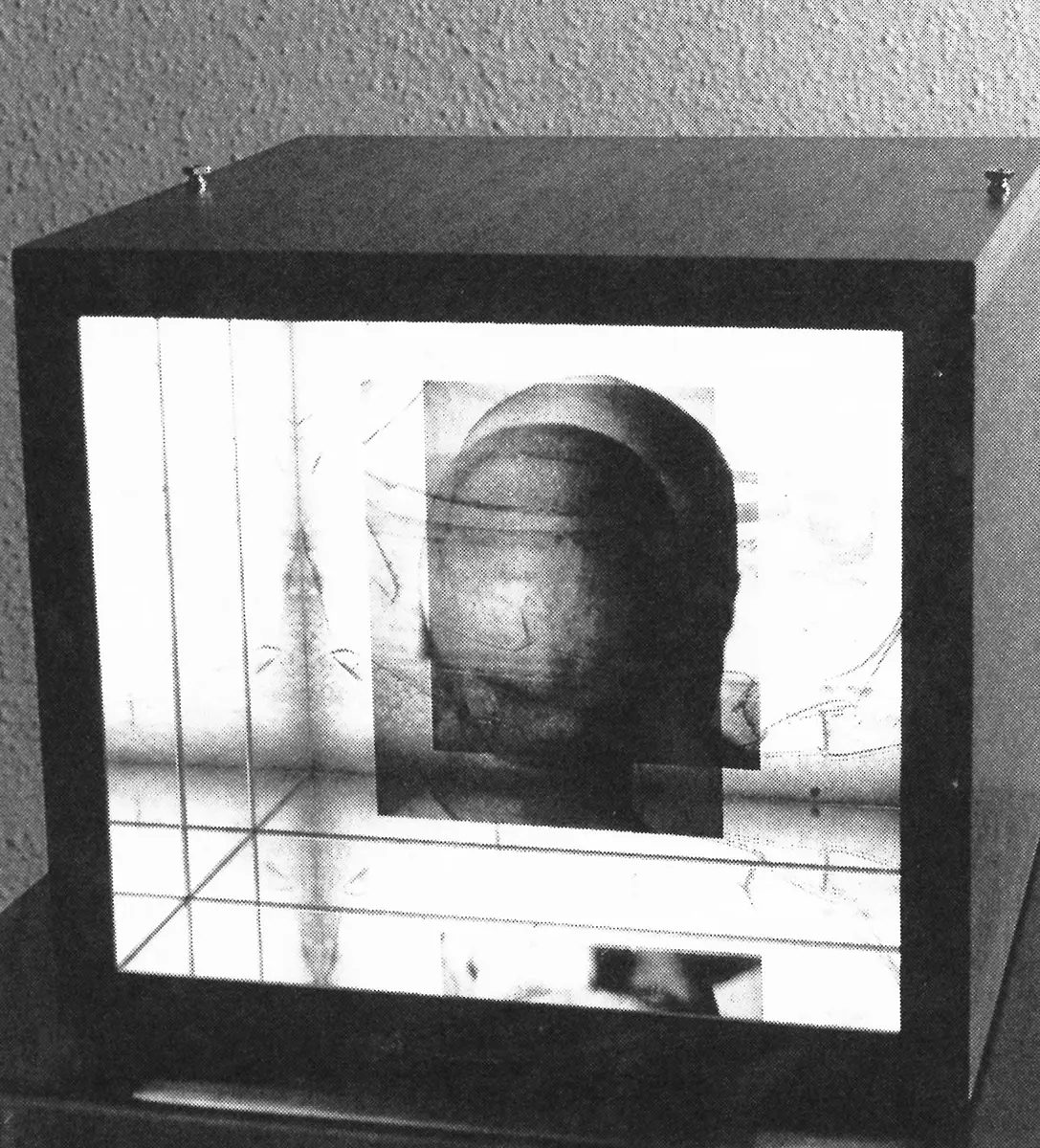
The Special Prize for Sculpture was awarded to a work titled Illuminated Box No. 1, by the Panamanian artist Iraida Icaza "forgiving new orientation to local sculptural tradition, through the subtle use of elements, materials, and complex visual concepts, in a poetical work of multiple readings," according to the jury made up of Virginia Pérez-Ratton, director of the Museum of Art and Contemporary Design of San José, Costa Rica, the history of art lecturer Ivonne Pini (also executive editor of ArtNexus), and Edward Sullivan, director of the Department of Fine Arts of New York University.
Icaza, who has for many years lived outside the country —first in Tokyo and now in New York— has made a name for herself in commercial and artistic photography; indeed, her prize-winning work uses this medium as its main element. The work consists of a small wooden box illuminated with fluorescent light with a glass window that allows the spectator to look inside; several mirrors, two transparencies suspended as if in mid-air and, at the back, a black-and-white photograph together suggest a series of visual games which change with the position of the spectator.
Many of Icaza’s photographs show multiple images in delicate juxtapositions, but in this case, the three-dimensional nature of the work and the interaction between the various materials gave greater depth and ambiguity to an aesthetic project that has always been characterized by its exploration of the fragmentary limits of emotive memory. The artist admits that even though she has created various “boxes', she wanted to present one here for the first time now that the Biennial had been opened up to the sculpture.
In this fourth edition of the event, the room devoted to sculpture was in fact the most impressive. Seven three-dimensional works, arranged in an impeccable manner, were presented. All were very different from conventional sculpture, both in form and materials. The jury explained to the press that the many entries to the Biennial showed little mastery of the techniques and concepts historically considered characteristic of the medium and that this led them to believe —rightly so— that there is no real sculptural tradition in Panama. The jury therefore made a rigorous selection resulting in a refreshing handful of works that turned their back on the classic concepts associated with the term "sculpture."
The jury also awarded an honorable mention to Mascot Light by the Panamanian artist Ramón Zafrani, for its playful and innovative design and use of materials. The other artists whose three-dimensional works were selected were Manuel Montilla and Dickey Velarde (Panama) and Leslie Milson and Emily Zhukov (United States).
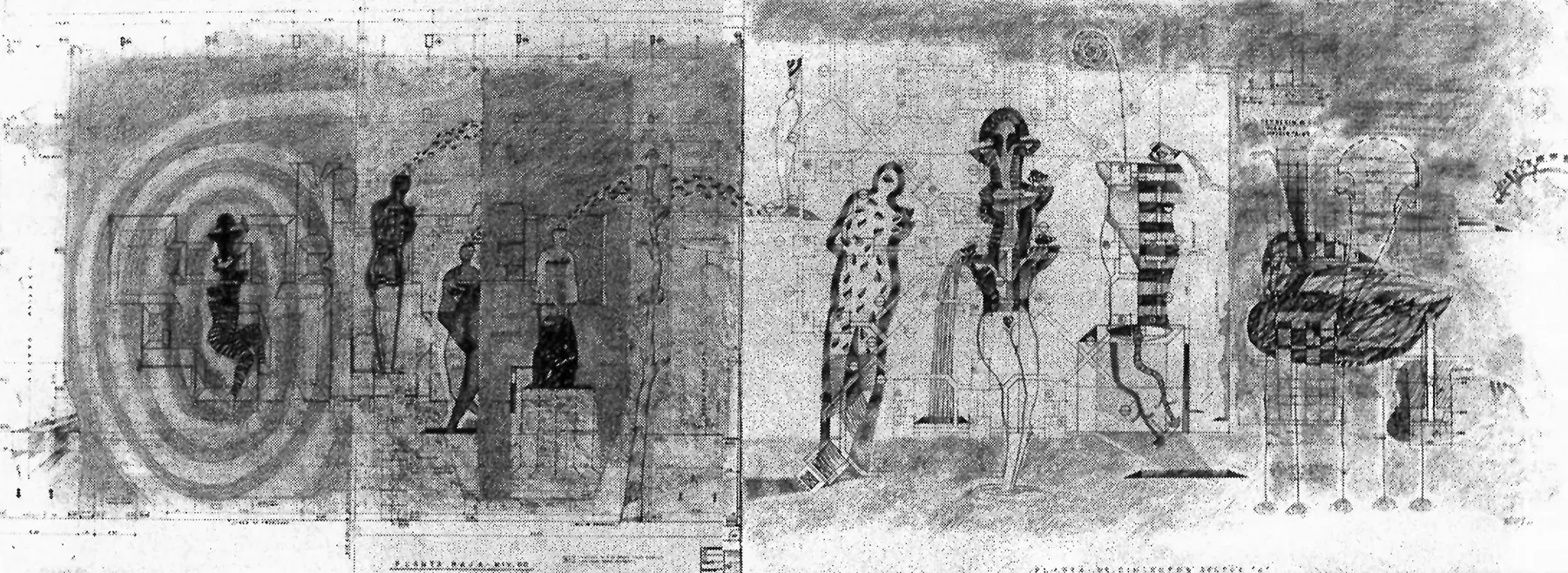
In the wall works category, the Ecuadorian Fernando Toledo was awarded the First Prize for a diptych from his series The Disaster Victims, "for the strength with which he uses traditional drawing and combines it with architectural plans, with clear references to the fragmentation of human beings in the contemporary city." In addition to $6,000, the First Prize also included a week-long trip to New York with all expenses paid.
Toledo had already won prizes at two previous Biennials: a First Prize in 1994 and a Second Prize in 1996. I believe that the awards were deserved on all three occasions since the artist has contributed new and significant projects each time.
This year Toledo presented a drawing on paper, a medium rarely given much attention in Panama. His personal iconography —together with his constant formal explorations and use of totemic and increasingly less rigid figures— is combined with the interior settings of a luxury apartment building designed by a local architect. In creating this series, Toledo borrowed the plans and photocopied several sheets on watercolor paper. His “disaster victims", traced in soft colors, appear to wander timidly through rooms destined for other people. In this work, the intimate meditation on life in our tropical city, which was a feature of his work for several years, has given way to a new social dimension.
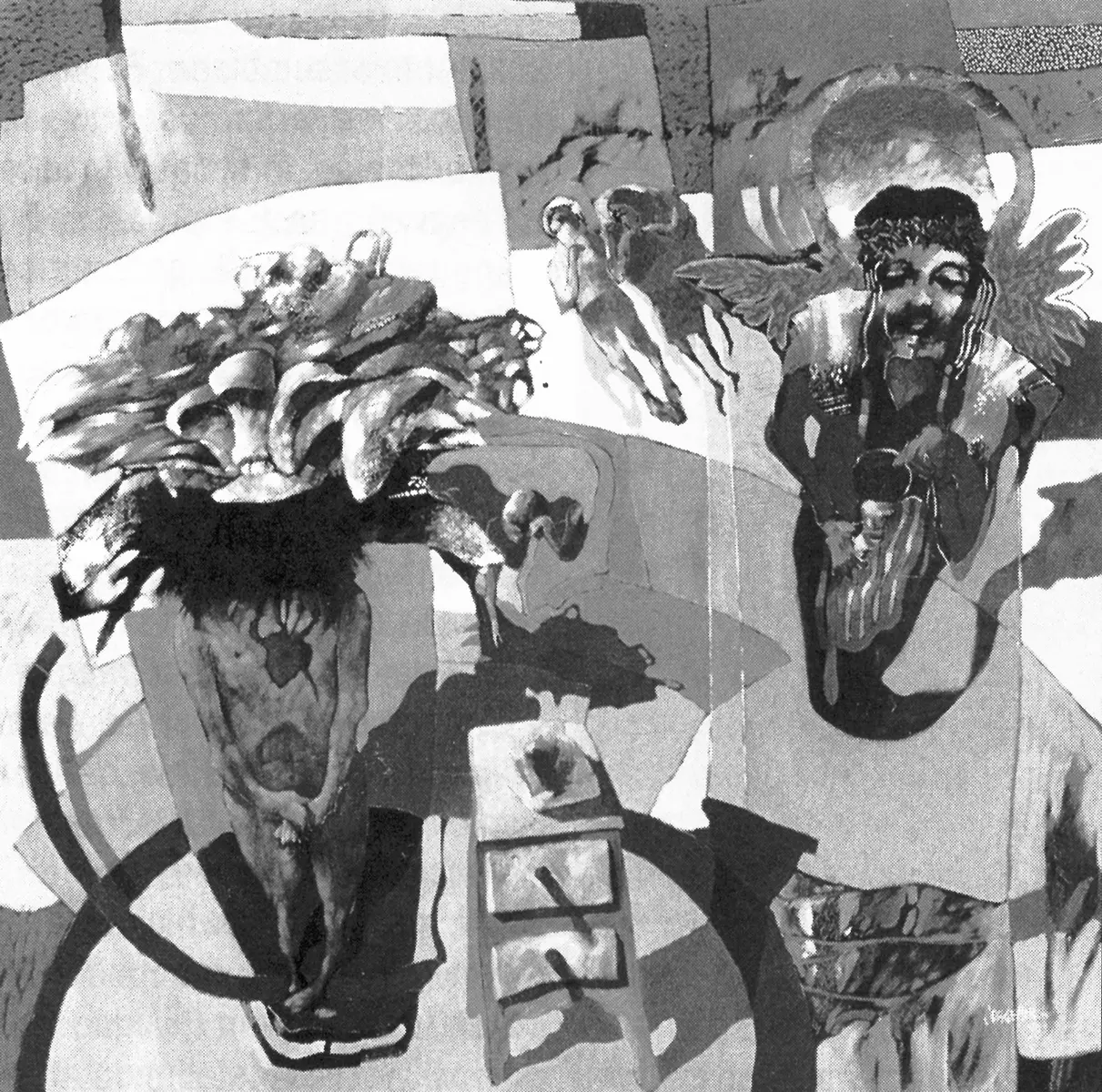
Jorge March was awarded the Second Prize — $4,000— for Miracle, a large acrylic on canvas which, in its dramatic use of perspective and the human figure has done without overwhelming the space, represented a qualitative leap in the production of this Panamanian artist. The Third Prize, $3,500, went to Jorge Ruiz Melgar, a painter from the Azuero peninsula, for Beyond the Light. In this work, he abandoned the characteristic figuration of his contemporaries and proposed a spare kind of geometry that nevertheless revealed close links with his region in terms of color, technique, and materials.
Two honorable mentions were awarded in this category: Panama, Heart of the Universe by the Panamanian Haydée Victoria Suescum, was full of humor and wit that contrasted with the artist's sober and almost abstract production of recent years. The work was a reinterpretation of her longstanding fascination with signs and names referring to such places as the public market and popular neighborhoods. The other honorable mention went to Remember by the Panamanian Viviana Rivera, a bold picture combining painting, collage, images, and text, though the jury recommended that the artist take greater care at the conceptual level.
This was the first time that the jury made written comments on each of the works winning prizes or mentions. The report signed by Pérez-Ratton, Pini, and Sullivan also included a series of excellent recommendations to the organizers of the Biennial. These included the idea that future editions should be based on two generic categories: two-dimensional and three-dimensional works; that artists should submit two or three works; that the age should be made a condition of participation; and that a parallel salon of invited artists should be included. There is no doubt that the application of these recommendations and, in particular, the salon, would substantially strengthen the Art Biennial of Panama. Fortunately, the organizers have confirmed that this will be the case. We all know that the “veteran” artists refuse to participate in the competition, a situation which occurs in national events of this kind throughout the world. A parallel salon that would guarantee a high creative level would give greater weight to the exhibition of selected participants and provide a more complete panorama of the art scene in Panama.
ADRIENNE SAMOS