
A recent exhibition that attracted a lot of attention was Insectary by Francisco Toledo, at the Juan Martin Gallery in Mexico City. The show revealed the work of a creator who has not exhibited for several years and whose presence had been sorely missed on the museum and gallery circuit. The exhibition consisted of two of the painter’s notebooks, one from a private collection (that of the Quetzali Gallery in Oaxaca) and another which was available for purchase. In both cases, the books had to be taken apart to be displayed in the show, and in many cases, pages with drawings on both sides had to be framed.
The montage was striking: from the ceiling, the pictures were hung in such a way that the public could both sides of them, with some of the images obviously being inverted. Although all the works were done in ink and watercolor, the technique was very varied. In some cases, Toledo just did a drawing on paper and then worked on the outlines and the central image. In others, he used a piece of petate (a kind of straw material that is very popular in Mexico for making baskets and other objects), which he marked, perhaps using a mechanical press, on the damp leaf, giving it texture.
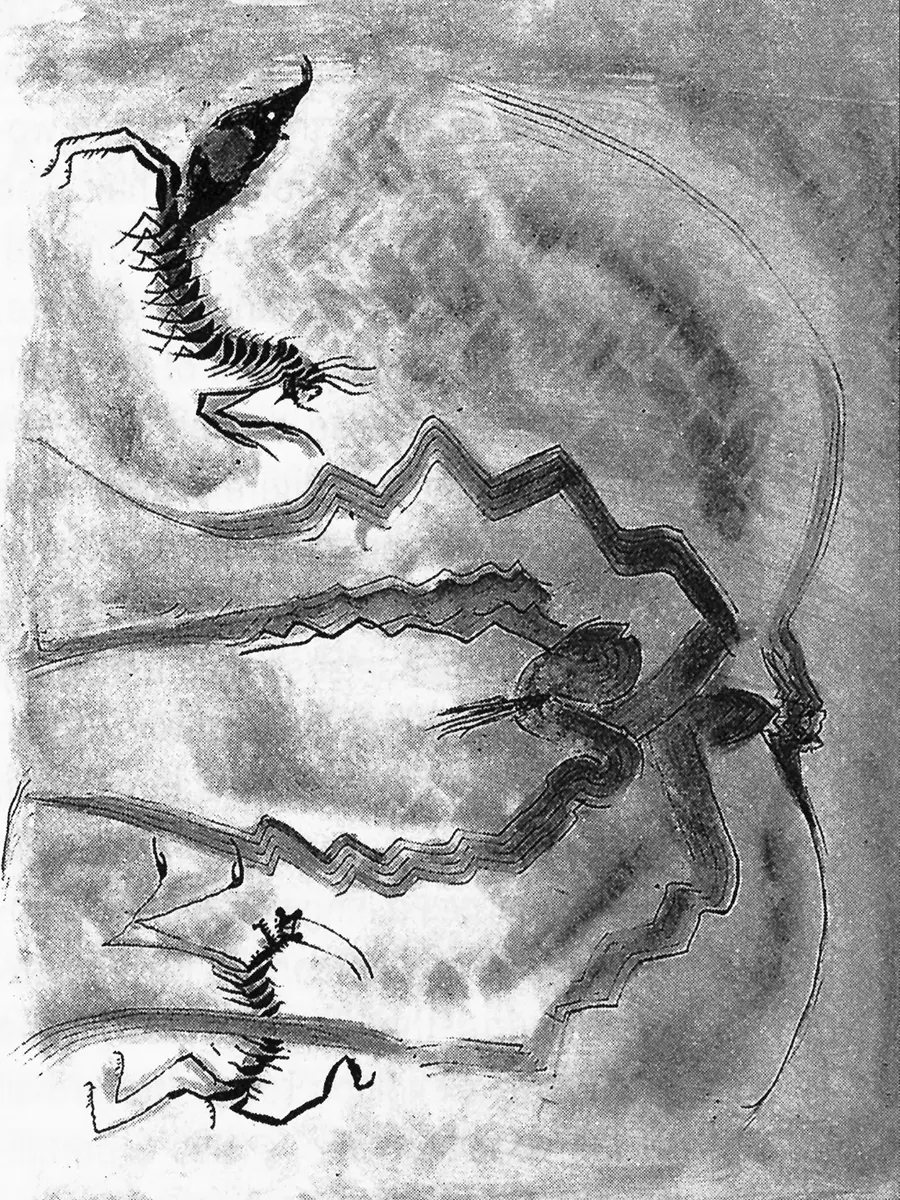
All the work presented on this occasion, most of which had been done in 1997 and 1998, was of magnificent artistic quality. The delicate line work and sense of precision, the fantastic sense of invention, and the creative elan all proved fresh sources of surprise.
Scorpions, wasps, butterflies, little doves, spiders, and even "insectified" human beings inhabited this exhibition and filled the now detached pages with a sly kind of humor. Toledo took up his multi-tipped pen and clearly enjoyed doing these bodies from the most creative kind of insect zoology.
If something has always characterized Toledo's work, it is precisely his immense facility to invent fantastic characters (which, it has been said, are only reconstructions of Zapotecan stories and anecdotes). But this time it was clear that the work on display had not been done for the purposes of an exhibition but was rather a kind of intimate activity. This made the visitor a little apprehensive since he knew that only through such circumstances was it possible to see the notebooks which otherwise would never have left the studio or workshop, and remained there as works that would subsequently be used for other larger projects or considered as a kind of daily exercise, enabling the artist to "keep his hand in," as it were.
The uninterrupted movement of the creatures created by Toledo on these sheets of paper, their rapid flight, incessant climbing and creeping, and predatory attacks on other creatures some of which were more chimerical than others—these were only some of the delights of this exhibition which was only the subject of a couple of notes in the specialized press.
There is without doubt reason to undertake a review of entomology in order to classify the hundreds of species that Toledo has invented, their mocking behavior and intelligence, and their hidden poison masked by an air of good humor. Above all, this study would note the rapidity with which they passed in
front of our eyes and our inability to give them a name, so that one day we could tell about how we came across them and that the only antidote we needed was our own complicity.
SANTIAGO ESPINOSA DE LOS MONTEROS