Richard Long establishes, after verification, a topography, or is he simply singing a “song to nature”? The Spiral Jetty makes this very distinction since it is one thing to refer sentimentally to an idea of nature in terms of the late aesthetics of Romanticism-re—invented by the ecologists—, and another, to create a notion of territoriality in which this concept, which has already been thoroughly called into question and radically outdistanced by Baudelaire —viz Jauss— has become a concept of anti-nature.
It is clear that from Baudelaire on we have had to refer to a nature that is artificially created and not—as in the case of telluric cultures—to a sentiment that is subsumed in nature, which is part of the organic world. The question is valid if we follow this sequence: where today in Latin America are the great telluric cultures, the great forests? It is clear that this loss inevitably leads to a loss of the past, but how can we use this nostalgia without lapsing into the false innocence of the "good savage"? Into a pastiche of the organic world? In our art, the feeling of nature was in the case of the Bachués merely a pre-Hispanic joke, a piece of ingenuous rhetoric. Only in the early stages of Alberto Arboleda does there appear a formal intention regarding the organic world and its symbols. Consuelo Gomez and Hugo Zapata openly raise this issue; both manage to explore precociously the dangerous theme of the native element as a supposed legacy. But let us proceed in stages.
At first sight, the work of Zapata is characterized by a personal eclecticism, but as we delve deeper, we discover that his personal process predates, in existential terms, what we understand by the term sculptor, that is—excuse the pleonasm—a sculptor who has graduated in sculpture and who devotes himself to the making of sculptures as a profession.
Because in the case of Zapata the questions he poses to both history and nature mark the stages of concern that will eventually become a sculptural process. And in doing so, he is verifying a position vis-à-vis the fact that both modern and postmodern sculpture is there before us, but as a personal choice: Moore or Arp or Cascellia or Anish Kapoor or Tony Cragg or Rūkriem. In fact, the postmodern critical conscience questioned the inevitability of any heritage and made it possible to choose -what I believe is appropriate- in defining what I am formally seeking. Not a legacy but methodologies to explore reality.
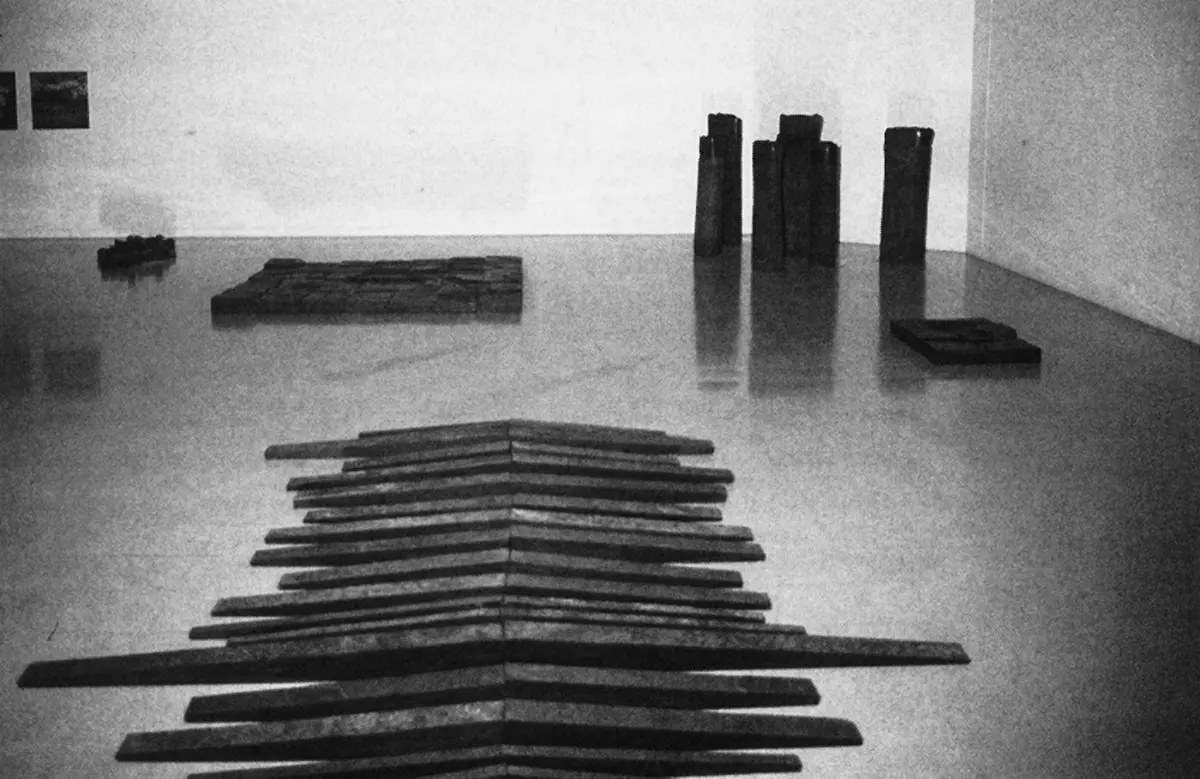
We cannot speak in Zapata's case of metaphors, since the process has not yet ended and there is very clear evidence—in the best sense of the term— of hesitations on the part of someone who is feeling things out, looking here and there, colonizing a theme, cautiously drawing closer to it. But what is present is a techné capable of legitimizing the stages of this process of search in which the material acquires an undoubted aesthetic dimension. And it is this techné that was most evident in this exhibition, confirming that the artist has had the courage to make, for himself and for the public, a selection of work within this process of questions and experiences irreversibly linked one to the other.
We should not, therefore, speak of a retrospective—which is a balance sheet of an artist’s life work—but of an exhibition in the sense given to the term by Max Bense: to show is to show oneself and to recuperate, through this act of sincerity, the ontological importance of the process, the work in progress whose edges are still not clear. Is there perhaps not an obvious aporia between his, —telluric traces or nostalgia—a rational geometry that might be a possible solution to this tellurium? The masterly lesson of Ramírez Villamizar, incorporating and renovating other geometries as it does and going beyond the pre-Hispanic element, is a point of reference in this respect.
The true artist does not shun these aporias to content himself, on leaving such quicksand, with the comfort of a personal style. On the contrary, Zapata places himself at the very center of the controversy about such concepts as nature, earth, and environment legacies which today, in times of nomadism and globalization, are being examined from the standpoint of theoretical suppositions which are completely different from those of the Romantics or the nationalists. De Maria, Smithson, the Boyles, and of course, Long are now proposing new definitions of the concepts of the map, territory, place, site, and geography.
What was important in this exhibition was that it introduced the spectator to these questions and investigations at a time when we are witnessing a ferocious attack on our surroundings, that is, on our legacy of images. The intelligence of the show’s mise en scène lay in the way it took the visitor through this process of investigation and exploration: boxes, pebbles, geographies, chalices, and paths. It was like an archeological cross-section of living legacies and paths to be followed when the old codes of nature and the earth ceased to be relevant and it becomes necessary to invent new codes.
DARÍO RUIZ GÓMEZ